

Lead Quality And Bidding
Journey-Aware Bidding and Lead Quality Readiness for Google Ads
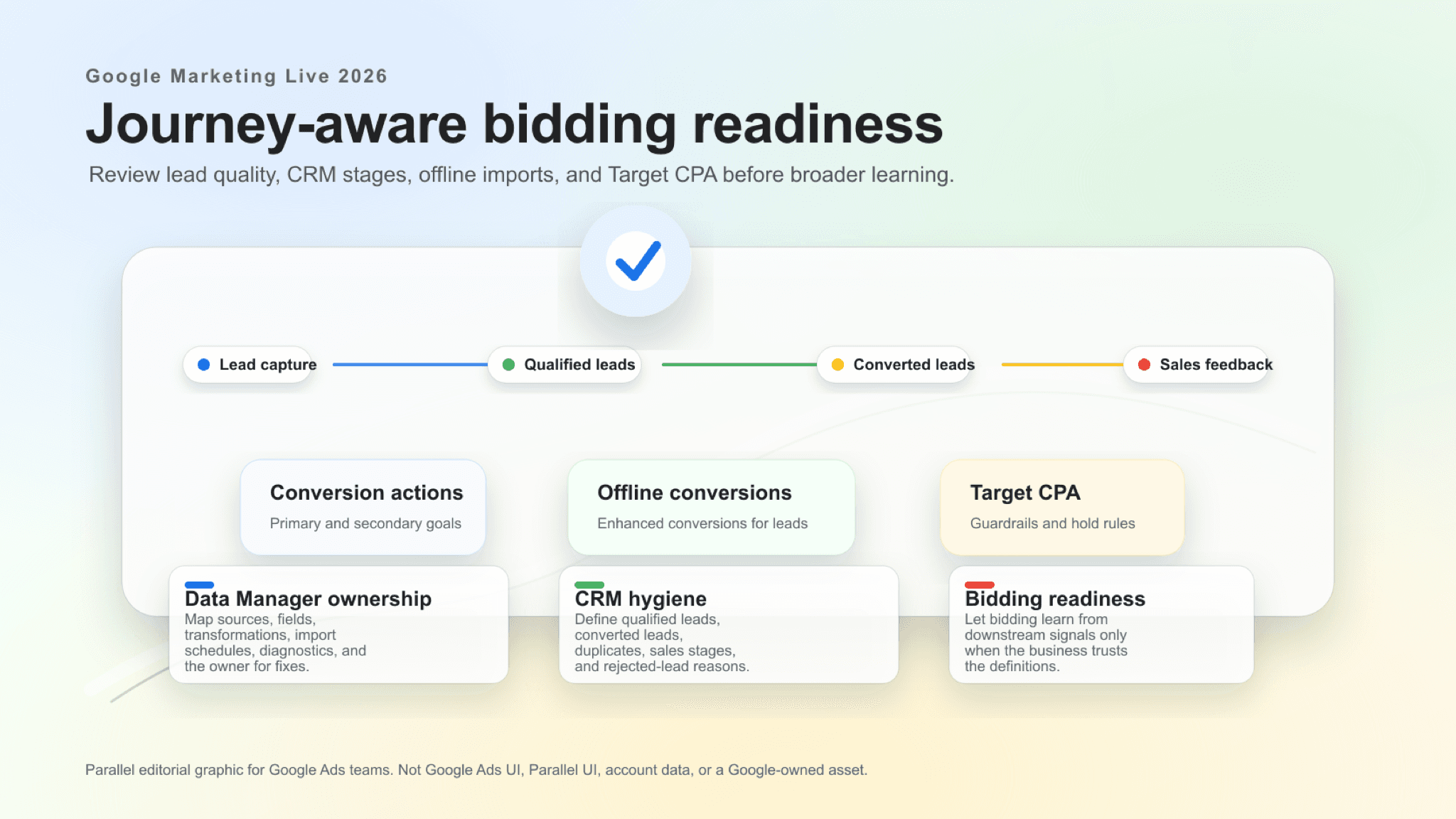
This guide is for bidding expansion decisions that depend on qualified leads, converted leads, CRM stages, offline conversion imports, and Target CPA guardrails.
Journey-aware bidding only works when CRM stages, offline conversions, and Data Manager imports are clean enough for Target CPA to learn from the full lead-to-sale path.
Key takeaway
Journey-aware bidding raises the lead-quality bar because Google says Search campaigns optimizing to a Target CPA will be able to learn from both biddable and non-biddable conversion goals when advertisers track the full lead-to-sales journey.
Before treating that as an optimization opportunity, teams should review CRM stages, qualified leads, converted leads, offline conversions, enhanced conversions for leads, Data Manager connections, Data Manager mapping, lead values, sales feedback, and Target CPA guardrails.
The readiness risk is not that downstream data is automatically bad. The risk is letting Smart Bidding learn from incomplete, mislabeled, delayed, or poorly owned signals before the team can explain what the signals mean.
Journey-aware bidding makes CRM hygiene, offline conversions, enhanced conversions for leads, qualified leads, converted leads, and Target CPA guardrails part of the bidding decision.
- Primary conversions, secondary conversions, qualified leads, converted leads, enhanced conversions for leads, offline imports, and lead values were checked against Target CPA behavior before any bidding change was recommended.
- Data Manager connections, CRM mappings, import schedules, diagnostics, and sales feedback quality were reviewed before deeper-funnel signals were treated as decision-ready.
- The review separated accounts where bidding could learn from better lead quality now from accounts where conversion data still needed cleanup before Target CPA expectations could move.
Google says journey-aware bidding is currently in beta and is meant to help Google AI better understand complex lead-generation customer journeys.
In Google's bidding and budgeting announcement, Search campaigns optimizing to Target CPA are described as being able to learn from both biddable and non-biddable conversion goals when advertisers track the full lead-to-sales journey.
That shifts the first review from bidding tactics to data quality. Calls, forms, newsletter signups, qualified leads, converted leads, and closed sales need consistent definitions before a broader learning loop can be interpreted.
The platform can only learn from outcomes the business has already named.
Google documentation·Google Ads & Commerce Blog
Bidding and budgeting updates
Google's bidding and budgeting post introduces journey-aware bidding in beta for Search campaigns optimizing to Target CPA, along with Smart Bidding Exploration and budget pacing updates.
Open bidding postBefore changing Target CPA expectations, review the conversion and CRM signals that would teach Google AI what valuable demand looks like.
| Area | What to review | Why it matters |
|---|---|---|
| Conversion actions | Primary and secondary conversion actions, form submissions, calls, chats, newsletter signups, qualified leads, converted leads, and imported offline events. | Journey-aware bidding is only useful if the account distinguishes early lead volume from deeper lead quality. |
| CRM stages | Stage names, status definitions, duplicate handling, sales-owner updates, rejected leads, no-shows, opportunities, closed wins, and closed losses. | Smart Bidding can only learn from downstream outcomes that sales and marketing define consistently. |
| Offline conversions | GCLID coverage, user-provided data, import schedules, diagnostics, duplicate rules, timestamps, and failure handling. | Delayed or incomplete offline imports can make recent performance look worse or better than it is. |
| Enhanced conversions for leads | Google tag or Google Tag Manager coverage, hashed first-party data, Data Manager import mapping, API support, and diagnostics. | Enhanced conversions for leads can strengthen offline measurement when the first-party data flow is implemented correctly. |
| Target CPA guardrails | Current CPA, conversion lag, lead-to-sale rates, sales capacity, lead values, budget limits, and the hold rule for weak or delayed data. | A new bidding learning path should not outrun the team's ability to explain lead quality and business value. |
Open conversion action settings
The audit is only complete when every row has an owner and a pass, hold, or fix-first call.
Google Ads Help separates qualified leads and converted leads as goal types for deeper lead-to-sale funnel events. Qualified leads represent Google-generated leads that have been further qualified offline in a CRM or internal lead system. Converted leads represent leads that complete a chosen later step such as a sale, closed deal, or another defined conversion step.
Those distinctions are where many bidding-readiness problems show up. If a sales team uses inconsistent stage names, updates records late, or treats every form submission as equivalent to a qualified opportunity, the account can report more signal while still teaching the wrong lesson.
The team needs a named CRM stage for qualified leads, a named stage for converted leads with a clear business meaning, and a rule that keeps form fills, calls, and newsletter signups separate from deeper lead quality unless the business intentionally values them the same way.
Bidding cannot learn from funnel depth the sales team has not defined in writing.
Google's enhanced conversions for leads Help describes it as an upgraded offline conversion import that uses user-provided data, such as email addresses, to supplement imported offline conversion data. Google also points advertisers using offline conversion imports toward upgrading with Google Ads Data Manager.
The practical readiness question is ownership. Someone needs to own the website tag, CRM source, Data Manager connection, field mapping, transformations, import schedule, diagnostics, and privacy-safe data handling before lead-quality signals become a bidding dependency.
Without that owner, downstream signals stay noise.
01
Map the source
Identify whether each lead-quality signal comes from the Google tag, Google Tag Manager, Data Manager, Google Ads API, a CRM connector, or a manual import.
02
Map the fields
Confirm GCLID coverage, user-provided data, timestamps, lead IDs, stage names, conversion names, values, and deduplication rules.
03
Map the monitoring
Review diagnostics, failed uploads, import latency, conversion lag, duplicate imports, and the owner responsible for fixing breaks.
Google documentation·Google Ads & Commerce Blog
Data Manager and measurement updates
Google's measurement post explains Data Manager map view, Data Manager API expansion, Google tag upgrades, and the broader first-party data foundation for Google AI.
Open measurement postGoogle video·Accelerate with Google
First-party data strength for Google AI
Google's official Data Strength session gives teams additional context on first-party data, Data Manager, Google Tag Gateway, and AI-era measurement.
Journey-aware bidding is especially relevant for Search campaigns optimizing to Target CPA because the campaign objective is lead acquisition efficiency. The account needs a clear answer to which outcomes count, which outcomes only inform, and which outcomes should stay out of bidding decisions until they are trustworthy.
That review should include conversion lag, qualified-lead rate, converted-lead rate, sales capacity, rejected-lead reasons, lead values, budget limits, and the team's signal-drift detection window.
Pass
CRM stages are stable, offline conversions are importing cleanly, qualified and converted leads are defined, and the Target CPA review has clear lead-quality thresholds.
Hold
The account has enough lead volume, but CRM definitions, import diagnostics, sales feedback, or enhanced conversions for leads setup are still unreliable.
Fix first
Lead stages are missing, offline conversions are broken, form spam is high, sales follow-up is inconsistent, or the team cannot tie Google Ads leads to downstream outcomes.
Lead-quality bidding decisions involve more than the Google Ads settings screen. A team has to connect Search campaign performance, conversion actions, CRM definitions, offline imports, enhanced conversions for leads, Data Manager connections, sales feedback, and budget expectations.
Parallel AI reads that picture from the connected Google Ads account, writes the readiness review in a doc or spreadsheet your team and clients can act on, and drafts any Target CPA or conversion-action change for a person to approve before it ships.
The write-up should exist before the bid target moves.
Journey-aware bidding is still described in rollout-limited language. Keep the article and account plan precise until Google publishes deeper feature documentation.
- Do not claim exact journey-aware bidding UI, eligibility, reporting, setup, or non-biddable goal weighting beyond Google's published wording.
- Do not assume weak lead data always worsens performance; frame it as a readiness risk that can make learning and interpretation less reliable.
- Do not move Target CPA expectations before qualified leads, converted leads, offline conversions, enhanced conversions for leads, and Data Manager ownership are reviewed.
- Do not treat Data Manager, Google Ads API, or third-party import support as interchangeable without checking the account's actual connection path and diagnostics.
Google documentation
Google Ads and Commerce post on journey-aware bidding, Smart Bidding Exploration, campaign total budgets, and demand-led pacing.
Google Ads and Commerce post on Data Manager, Data Manager API, Google tag upgrades, Meridian GeoX, and Meridian Studio.
Google Ads Help reference for lead quality, conversion goals, value-based bidding, Data Manager, and CRM signal hygiene.
Google Ads Help reference for qualified leads, converted leads, funnel-stage conversion actions, and lead-quality optimization.
Google Ads Help reference for enhanced conversions for leads, offline import upgrade paths, Data Manager support, API support, and migration timing.
Google Ads API documentation for uploading offline conversions, enhanced conversions for leads API flows, diagnostics, hashing, and upload caveats.
Google Ads Data Manager Help reference for data source requirements, mapping, transformations, and update schedules.
Google Ads Help reference for lead-stage and value-based bidding transition context.
Google Ads Help reference for Smart Bidding and auction-time bidding strategy definitions.
- Blog homeBrowse every published Google Ads guide from one editorial index.
- Google Ads AI agent: complete guideThe pillar guide covers the category definition, the adoption model, and where the agent fits real Google Ads work.
- ResourcesMove between the definition page, pricing, product walkthrough, and trust pages.
- About Parallel AISee the company mission, editorial standards, and operating principles behind the product.
- SecurityReview the public data-handling, account-connectivity, and approval-control framing used throughout the published guides.
- Author profileSee the background, specialties, and editorial responsibilities behind the published guides.
- Editorial reviewReview how pricing, trust, and capability claims are checked before public content ships.
- Google Marketing Live 2026: What Google Ads Teams Should Review FirstThe first GML response is a prioritized account review across campaign inputs, not a feature rollout checklist.
- Data Manager Conversion Diagnostics: Fix Drift Before Bid ChangesFor analytics and paid media teams where conversion drift needs plumbing review before Smart Bidding moves.
- How to Find Wasted Spend in Google Ads With AIFor accounts that need lower wasted spend without overblocking useful traffic.
- Google Ads Data Manager: First-Party Data Source ReviewFor marketing and RevOps teams where list uploads outpace stewardship and match rate monitoring.
- Google Search Ads After GML 2026: AI Mode, Offers, and Lead QualitySearch terms, conversion actions, and documented reporting need a baseline before AI Mode or AI Max changes move budget.
- Google Ads Budget Pacing Update 2026: What Changed and What HoldsHelpful when spend looks front-loaded after the 2026 pacing changes and the team needs to decide whether the curve is healthy, risky, or escalation-worthy.
- Smart Bidding Exploration for Performance Max and Shopping: Test PlanFor teams enabling Exploration on Search today or preparing for rollout-limited Performance Max and Shopping expansion.
- Browse the GML 2026 resource hubBrowse the Google Marketing Live 2026 resource hub for the related Search, AI Max, Shopping, Demand Gen, bidding, data, and measurement guides.