

Bidding Test Plan
Smart Bidding Exploration for Performance Max and Shopping
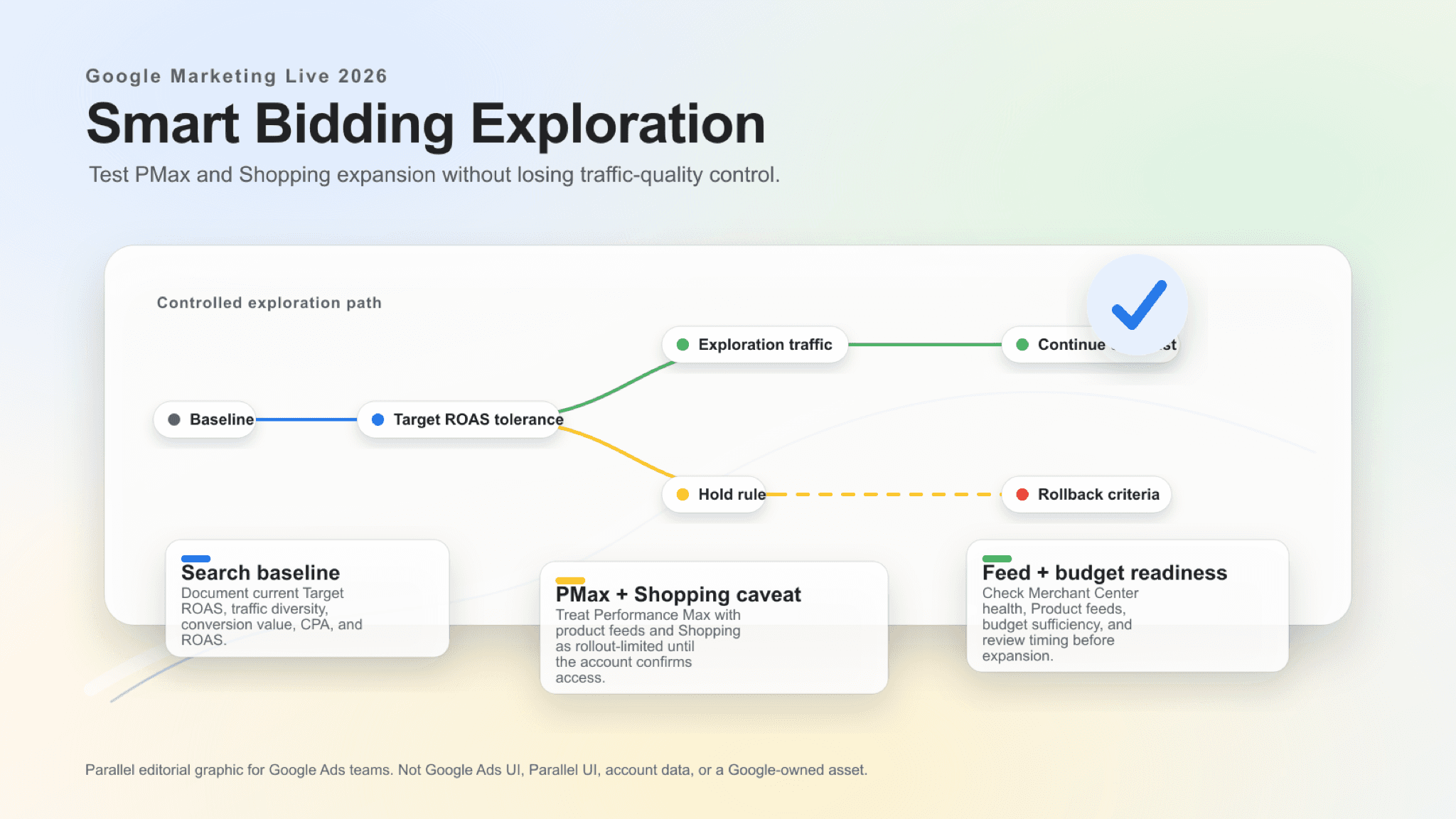
Illustrative concept graphic for Smart Bidding Exploration test planning, not a product screenshot.
Smart Bidding Exploration spends real budget to learn new query categories. The playbook sets what you will pay to find out before traffic diversity becomes a strategy.
Key takeaway
The paid media lead enables Smart Bidding Exploration on a Search campaign and celebrates traffic diversity until finance asks why margin thinned on the same conversion volume. Google's About Smart Bidding Exploration page says the feature uses flexible ROAS targets to bid on potentially high-performing queries already eligible through broad match, Dynamic Search Ads, or AI Max, with traffic diversity as the key success metric for Search campaigns on Target ROAS today. Google's GML 2026 bidding update adds expansion language toward Performance Max campaigns with product feeds and Shopping campaigns with beta caveats. That is the tension: exploration buys new categories with real money before you know their quality.
The reframe is tuition, not discovery for free. Exploration spends budget to learn which query categories convert at acceptable ROAS. The playbook names baseline performance, effective Target ROAS tolerance, Merchant Center and feed health for Shopping paths, budget cap, traffic-diversity review windows, and rollback before broader traffic steers Smart Bidding. Parallel AI reads the connected Google Ads account, writes the test plan in a doc or spreadsheet, and drafts bid strategy notes for a person to approve.
Checked against current product behavior, account-review tools, and official Google materials so the explanation matches the real review process and live product boundaries.
- Google's About Smart Bidding Exploration page limits current documented setup to Search campaigns using Target ROAS; PMax and Shopping expansion stays bounded to GML announcement and beta language.
- Traffic-diversity metrics, conversion value, Product feed quality, budget sufficiency, and rollback criteria were treated as joint gates before test, hold, or wait recommendations.
- Parallel's role stays limited to connected account review, finished test summaries, and drafted changes held for human approval.
Smart Bidding Exploration sounds like free range until search term insights show new categories spending at a lower effective ROAS than the core. Google's About Smart Bidding Exploration page states the feature helps capture conversions from queries you were already eligible for while increasing unique search term categories, and that traffic diversity should be the key evaluation metric. That metric tells you breadth. It does not tell you profit.
DEFINITION
Smart Bidding Exploration
An opt-in Smart Bidding feature described in Google's Help documentation for eligible Search campaigns on Target ROAS. Google says it uses flexible ROAS targets to bid on potentially high-performing queries without expanding broad match reach. Google's GML 2026 bidding post adds expansion toward Performance Max campaigns with product feeds and Shopping campaigns with beta and coming-weeks language.
Google Ads Help: About Smart Bidding Exploration
Treat exploration as tuition. You pay temporarily lower effective ROAS tolerance to learn whether new categories convert at scale. Google's setup Help page describes effective Target ROAS behavior during exploration. The business question is whether that tuition buys durable volume or expensive curiosity.
Search term insights and traffic-diversity reporting in Google's measurement Help page are the official read surfaces. Compare unique categories with conversions against actual ROAS versus your stated target, not versus last week's vanity breadth screenshot.
Performance Max and Shopping expansion changes the stakes. Shopping traffic ties to Merchant Center health, product feeds, and disapprovals. A query category that looks diverse on paper can map to low-margin SKUs or weak feed rows. Google's public docs still center Search setup today; PMax and Shopping paths deserve wait rules until eligibility is confirmed in account and documentation.
Illustrative math: a Search campaign with a 400 percent Target ROAS enables Exploration on a $12,000 weekly budget. Traffic-diversity metrics rise thirty-one percent while actual ROAS falls from 420 percent to 360 percent over twenty-one days and conversion value rises eight percent. Finance asks whether the eight percent was worth the margin give-up. Numbers are illustrative. The mechanism is paid learning without a pre-written tolerance band.
Where Google's public Help pages do not confirm Exploration setup for your campaign type, verify eligibility in the live account rather than assume GML stage language equals production access.
More categories with weaker ROAS is still a business decision, not a platform win.
Once exploration is tuition, the test plan reads like any other controlled experiment: baseline, cap, tolerance, rollback.
Baseline window
28 days
Pre-enable ROAS, conversion value, and category mix.
Tuition band
Written
Effective Target ROAS floor the finance lead accepts during exploration.
Budget cap
Named
Maximum weekly spend Exploration may influence during the test.
Rollback trigger
Defined
ROAS, margin, or lead quality floor that ends the test.
Document baseline performance, exploration scope, budget cap, review window, and rollback before enable. Google's setup Help page implies flexible targets; your account needs the numeric band stakeholders already agreed to.
For Shopping and Performance Max readiness, pull Merchant Center diagnostics, primary feed attributes, and hero SKU conversion value before treating expansion as live. Exploration on unhealthy feeds learns the wrong lessons faster.
Separate stakeholder confidence from platform enthusiasm. Traffic diversity makes great charts. Rollback rules make great quarters.
Bid strategy change history should note who enabled Exploration and which tolerance band was active. When ROAS dips three weeks later, the team needs that record instead of a debate about whether Smart Bidding or the sales team moved first.
Review Bid Strategy report and traffic-diversity metrics
With paid learning as the frame, the pre-enable review fits one working session.
Confirm whether the account matches Google's documented Search Target ROAS workflow or a rollout-limited Performance Max or Shopping expansion path.
Define baseline ROAS, conversion value, search term mix, budget cap, effective Target ROAS tolerance, and rollback criteria in writing.
Review Product feeds, Merchant Center diagnostics, conversion actions, conversion value, CPA, and lead or revenue quality for the SKUs or offers in scope.
Schedule traffic-diversity, search term, and ROAS reads at fourteen and twenty-eight days with named owners.
- Write the tuition band before enable.
- Cap budget influence during the test window.
- Verify feed and Merchant Center health for Shopping paths.
- Set rollback before charts celebrate diversity.
Exploration without rollback is optimism billed weekly.
Test when conversion value is stable, feeds and Merchant Center are healthy, budget is sufficient, and a written Target ROAS tolerance band exists. Hold when traffic diversity rises but conversion value, margin, or stakeholder confidence is unclear. Wait when the account is outside documented Search setup and Google has not confirmed eligibility, reporting, or API support for your Performance Max or Shopping use case.
Test when
- Baseline ROAS, conversion value, and search term quality are stable over twenty-eight days.
- Tuition band, budget cap, and rollback owners are documented before enable.
- Merchant Center and primary feed checks are clear for any Shopping-related expansion path.
Wait when
- Traffic diversity is the only success metric written down.
- Feed disapprovals or thin conversion data would poison learning.
- GML expansion language exists but in-account eligibility is unconfirmed.
Smart Bidding Exploration planning is a connected-account workflow Parallel AI handles well. The agent pulls bid strategy reports, search terms, conversion value, CPA, ROAS, and change history from the connected Google Ads account, compares baseline and exploration windows, and writes test, hold, or wait rows in a doc or spreadsheet with tuition band and rollback columns. If the call is to adjust Target ROAS tolerance or draft a pause note, it waits for a person to approve that change. Diversity charts without rollback recreate the same finance conversation. See for adjacent read paths. On Monday morning, open traffic-diversity metrics and search term insights for any Exploration-enabled campaign, compare actual ROAS to the written tuition band, and send one continue, adjust, or rollback line before the test window extends.
Google documentation
Google's May 20, 2026 announcement for Smart Bidding Exploration expansion toward Performance Max campaigns with product feeds and Shopping campaigns.
Google's documentation for Smart Bidding Exploration eligibility, behavior, and traffic-diversity intent.
Google's setup documentation for eligible campaign setup and effective Target ROAS tolerance behavior.
Google's reporting documentation for traffic-diversity metrics and recommended evaluation windows.
Official Smart Bidding reference for Google's automated bid optimization systems.
- Google Marketing Live 2026: What Google Ads Teams Should Review FirstThe first GML response is a prioritized account review across campaign inputs, not a feature rollout checklist.
- AI Max Testing Playbook for Google Ads Search CampaignsFor paid search leads running a controlled AI Max experiment on a healthy Search campaign.
- Journey-Aware Bidding and Lead Quality Readiness for Google AdsQualified leads, converted leads, offline imports, and Data Manager diagnostics need a clean baseline before Search campaigns learn from deeper funnel signals.
- Performance Max Channel Reporting PlaybookHelpful when channel mix shifts every week and the team needs a routed follow-up instead of another dashboard debate.
- Data Manager Conversion Diagnostics: Fix Drift Before Bid ChangesFor analytics and paid media teams where conversion drift needs plumbing review before Smart Bidding moves.