

Measurement And Finance
Meridian, Google Analytics 360, and Qualified Future Conversions for Finance Reviews
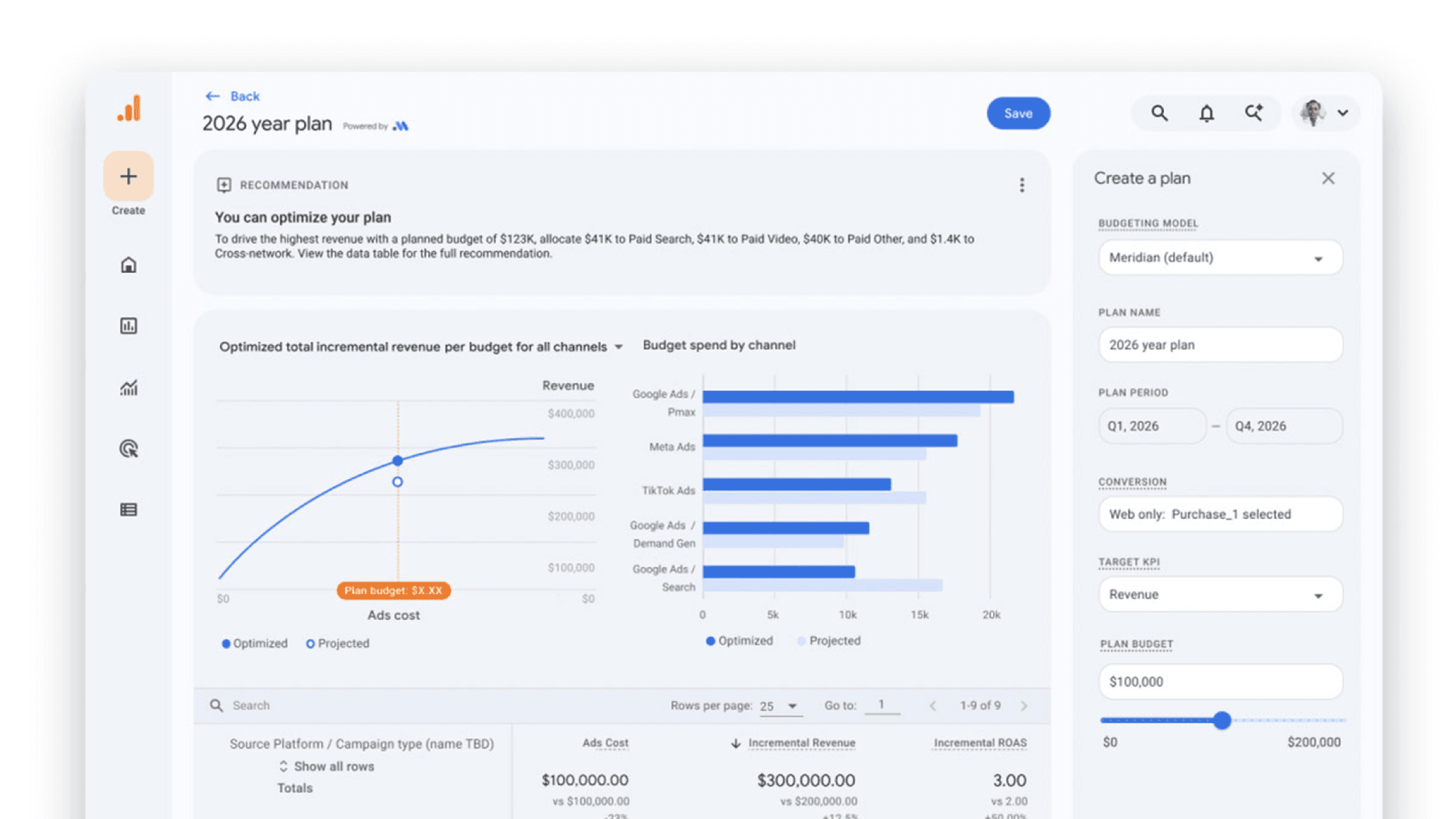
Finance conversations depend on separating platform conversions, attribution, MMM, future-facing signals, and first-party data.
Meridian in Google Analytics 360 and Qualified Future Conversions only strengthen finance conversations when Data Manager, offline conversions, and attribution boundaries are clean.
Key takeaway
Meridian, Google Analytics 360, and Qualified Future Conversions give Google Ads teams a stronger measurement story after Google Marketing Live 2026, but they do not remove the need for careful account and data review.
Meridian is moving into Google Analytics 360 so teams can unify first-party and cross-channel signals, measure causal performance, and forecast scenarios. Google also described Qualified Future Conversions as predictive signals that connect upper-funnel spend to future sales through signals such as brand searches.
Before using these updates in a finance conversation, teams should confirm Data Manager sources, Google tag coverage, offline conversions, qualified lead definitions, attribution boundaries, and which account actions can actually change spend, bids, budgets, or creative.
Meridian, Google Analytics 360, and Qualified Future Conversions can strengthen planning conversations only when Data Manager sources, Google tag coverage, offline conversions, and attribution boundaries are clean enough to explain.
- Data Manager connections, Google tag coverage, offline conversions, qualified lead definitions, and attribution settings were reviewed before any budget conclusion was drawn.
- Causal measurement, forecast scenarios, brand-search signals, and campaign actions were kept separate so the finance story did not overstate what the data proved.
- Google Ads actions that could change now were named separately from measurement questions that still needed Data Manager, Google Analytics 360, Meridian, or CRM follow-up.
Google's measurement announcements give paid media teams more language for causality, forecasts, and upper-funnel value, but finance-facing claims still start with source quality.
Google said it is bringing Meridian, its open-source Marketing Mix Model, into Google Analytics 360. The same update says teams will be able to bring first-party, cross-channel data and metrics signals together, measure causal performance, and use predictive scenarios to guide investment decisions.
Google also described Qualified Future Conversions as predictive signals powered by Gemini that link upper-funnel spend to future sales through signals such as brand searches. Google says those signals will eventually integrate with Meridian to help refine MMM accuracy.
That is useful context for budget conversations, but it does not replace account review. A measurement story is credible only when conversion actions, first-party data sources, offline conversion imports, attribution language, and reporting windows are strong enough to support the recommendation.
Finance hears the signal chain first, the model second.
Finance conversations get messy when platform conversions, attribution, MMM, forecasts, and data quality are treated as the same kind of signal.
| Measurement area | What it helps answer | What to avoid assuming |
|---|---|---|
| Google Ads conversions | Which conversion actions, values, qualified leads, or converted leads campaigns are optimizing toward. | That platform conversion volume equals business profit without offline quality, value, and margin review. |
| Attribution | How Google Ads assigns conversion credit across eligible touchpoints and reporting views. | That attribution alone proves incrementality or the correct media mix. |
| Meridian and MMM | How media, seasonality, and external factors may explain causal performance across channels. | That every Google Ads campaign setting has a direct one-to-one Meridian recommendation. |
| Qualified Future Conversions | How upper-funnel spend may connect to future sales through predictive signals such as brand searches. | That Qualified Future Conversions are a replacement for current conversion actions, CRM stages, or finance-approved forecasts. |
| Data Manager and Google tag | Whether first-party sources, site tags, offline uploads, and linked products can support better AI and reporting. | That a connected source is automatically clean, consent-ready, mapped correctly, or useful for bidding. |
Google reference·Google Ads & Commerce Blog
Qualified Future Conversions
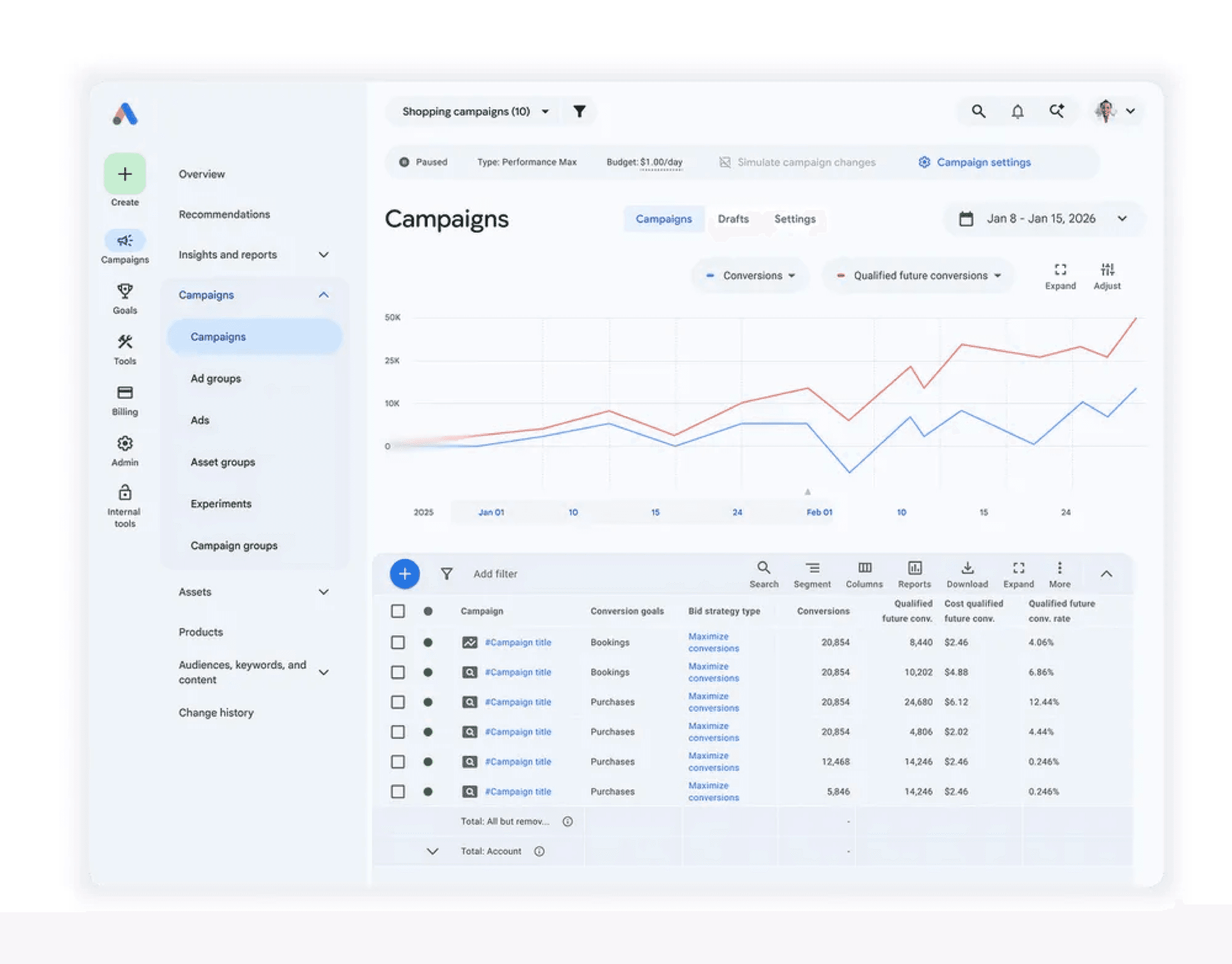
Google's public Google Marketing Platform post includes Qualified Future Conversions imagery for upper-funnel measurement context.
Meridian in Google Analytics 360 is most useful for teams that need to connect media investment, cross-channel data, causal performance, and scenario planning. The finance question is not simply whether Google Ads reported more conversions. It is whether the team can explain what likely drove revenue and how the next budget scenario should be tested.
For Google Ads teams, the account-level response should be practical: identify which campaigns, conversion actions, values, revenue sources, and external assumptions finance will expect to see when Meridian or Google Analytics 360 insights enter a budget discussion.
Meridian changes the budget conversation only when the account inputs are named first.
Budget scenario inputs
Confirm campaign spend, channel grouping, revenue quality, conversion lag, seasonality, and known business constraints before interpreting a forecast.
Actionable account levers
Translate a measurement finding into specific budget, bid, creative, feed, or landing-page questions rather than treating it as a generic performance score.
Finance language
Use causality, forecast, attribution, and conversion-quality language carefully so leadership understands the confidence level behind each recommendation.
Google's Analytics update says Qualified Future Conversions link upper-funnel spend to future sales via signals like brand searches and will eventually integrate with Meridian. That is important for teams whose upper-funnel campaigns are undercredited in short-window reporting.
The risk is using a future-facing signal as if it were the same as a booked sale or a cleaned CRM opportunity. Paid media teams should keep Qualified Future Conversions separate from primary conversions, secondary conversions, qualified leads, converted leads, offline conversions, and finance-approved revenue until Google publishes deeper mechanics and the account has a clear reporting process.
Qualified Future Conversions are measurement context, not an automatic budget increase. Current conversion actions and offline conversion quality stay visible beside any future-facing signal. The team should document what it knows, what Google has confirmed, and what still depends on Google Analytics 360, Meridian, or account-specific availability.
Future-facing signals do not replace booked revenue until the account can show how they connect.
The strongest measurement discussion still depends on first-party data quality. Google Data Manager, Google tag, offline conversion imports, enhanced conversions for leads, and CRM stages shape whether Google Ads can optimize toward outcomes finance recognizes.
Before presenting a new measurement story, teams should know who owns each source, how often it updates, which fields are mapped, which conversion actions are primary or secondary, and how sales teams classify lead quality.
A finance memo built on broken imports is worse than no memo at all.
Open Data Manager in Google Ads
01
Check Data Manager sources
Review source owners, supported data sources, mapping, transformations, update schedules, and destination use before relying on the source for campaign decisions.
02
Check conversion action quality
Separate primary conversions, secondary conversions, qualified leads, converted leads, and offline conversion imports before Smart Bidding or reporting treats them as equivalent.
03
Check tag and diagnostics
Review Google tag coverage, Tag Diagnostics, consent dependencies, and site changes that can affect measurement quality.
Measurement updates after GML 2026 can create a gap between what leadership wants to know and what the Google Ads account can safely support. The review needs account context, first-party data notes, conversion-action definitions, source caveats, and next actions in one finished record before finance turns it into a budget decision.
Parallel AI reads Google Ads, Data Manager, Google tag, Google Analytics 360, Meridian, CRM, and conversion-action context from the connected account, writes the finance-ready measurement review in a doc or spreadsheet, and drafts any budget or campaign change for a person to approve.
The finance conversation should start from a finished review, not a slide of platform headlines.
Several measurement details remain rollout-limited or product-specific. Keep those details as planning inputs until Google publishes deeper documentation or the account confirms availability.
- Do not claim every Google Analytics 360 advertiser has the same Meridian experience or rollout timing.
- Do not publish Qualified Future Conversions mechanics, UI behavior, pricing, or API details unless Google documents them.
- Do not treat brand searches, forecasts, attribution, and booked revenue as the same kind of signal.
- Do not use measurement updates to justify campaign changes before conversion actions, Data Manager sources, Google tag health, and offline conversion quality are reviewed.
Google documentation
Google Marketing Platform post on Meridian in Google Analytics 360, Qualified Future Conversions, brand searches, forecasting, and measurement updates.
Google Ads and Commerce post on Data Manager, Data Manager API, Google tag upgrades, Meridian GeoX, and Meridian Studio.
Google for Developers reference for Meridian, Google's open-source marketing mix model.
Google Ads Help reference for Data Manager, linked products, Google tag, and data source categories.
Google Ads Data Manager Help reference for source requirements, mapping, transformations, and update schedules.
Google Ads Help reference for attribution-model distinctions in Google Ads reporting.
Google Ads Help reference for funnel-stage conversion actions and lead-quality optimization.
Google Ads API documentation for offline conversion imports, enhanced conversions for leads, diagnostics, and upload caveats.
- Blog homeBrowse every published Google Ads guide from one editorial index.
- Google Ads AI agent: complete guideThe pillar guide covers the category definition, the adoption model, and where the agent fits real Google Ads work.
- ResourcesMove between the definition page, pricing, product walkthrough, and trust pages.
- About Parallel AISee the company mission, editorial standards, and operating principles behind the product.
- SecurityReview the public data-handling, account-connectivity, and approval-control framing used throughout the published guides.
- Author profileSee the background, specialties, and editorial responsibilities behind the published guides.
- Editorial reviewReview how pricing, trust, and capability claims are checked before public content ships.
- Google Marketing Live 2026: What Google Ads Teams Should Review FirstThe first GML response is a prioritized account review across campaign inputs, not a feature rollout checklist.
- Google Ads Data Manager: First-Party Data Source ReviewFor marketing and RevOps teams where list uploads outpace stewardship and match rate monitoring.
- Data Manager Conversion Diagnostics: Fix Drift Before Bid ChangesFor analytics and paid media teams where conversion drift needs plumbing review before Smart Bidding moves.
- Google Tag Upgrade Checklist for Paid Media Teams After GML 2026Helpful when Google tag upgrades need a paid media measurement review before teams trust reports or change campaign targets.
- Ask Advisor in Google Analytics for Google Ads Teams: What to Review NextFor analytics diagnosis that must become a clear paid media next step.
- Cross-Channel Bid Optimization: Review Budget Moves Before You ReallocateFor teams about to reallocate Google Ads budget when channel ROAS rows use different counting rules.
- Performance Max Channel Reporting PlaybookHelpful when channel mix shifts every week and the team needs a routed follow-up instead of another dashboard debate.
- Browse the GML 2026 resource hubBrowse the Google Marketing Live 2026 resource hub for the related Search, AI Max, Shopping, Demand Gen, bidding, data, and measurement guides.