

Brand Safety Governance
Third-Party Exclusion Lists in Google Ads
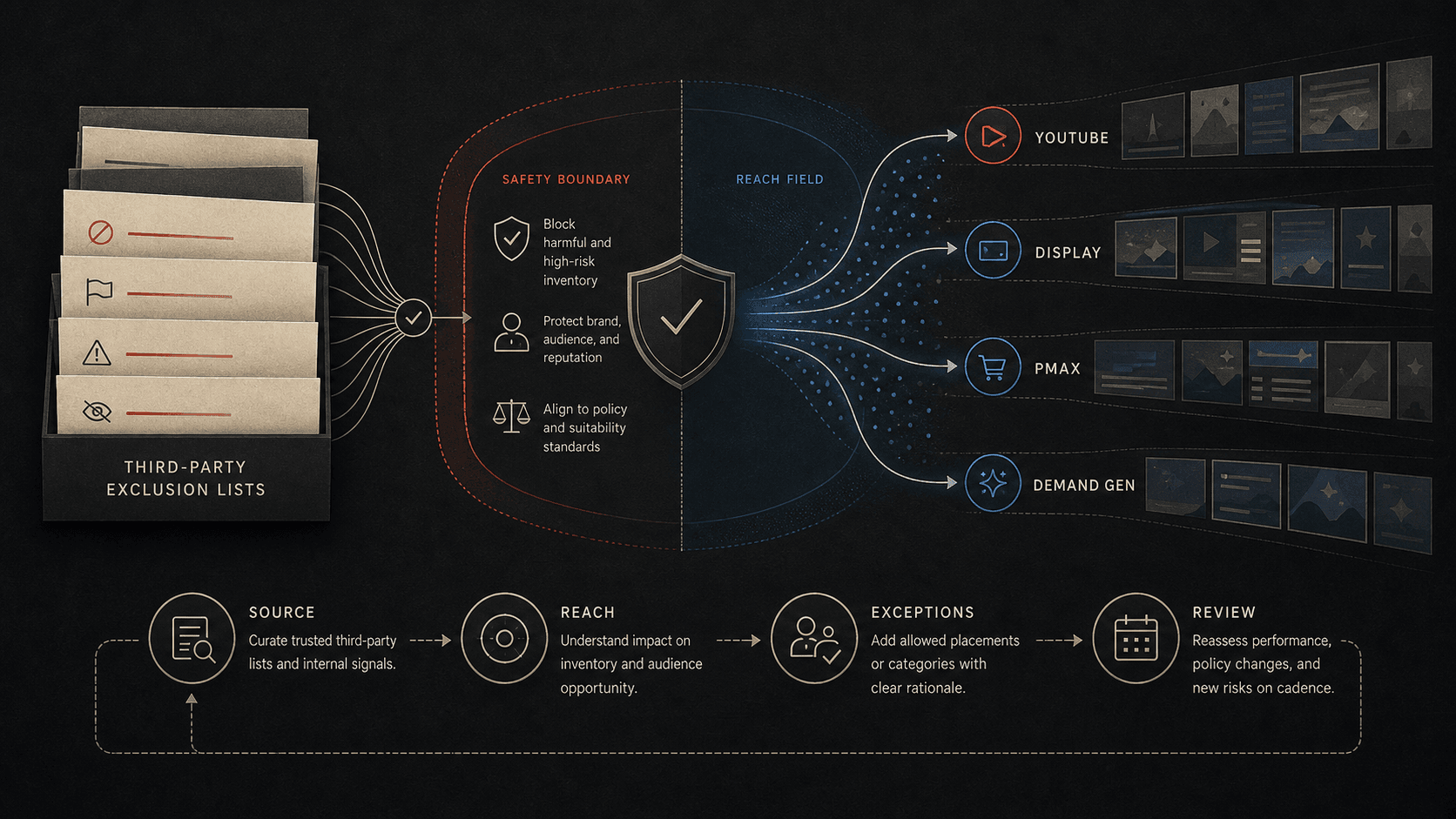
Illustrative concept graphic for third-party exclusion list governance, not a product screenshot.
Third-party exclusion lists apply someone else's brand-safety model to your spend. Governance names source quality, reach tradeoffs, exceptions, and campaign reads before account-wide rollout.
Key takeaway
The brand safety lead attaches a DoubleVerify list at the manager account on Monday, and by Friday the Demand Gen team asks why reach collapsed on inventory that was converting. Google's Google Ads Highlights of 2025 page describes third party exclusion lists curated by DoubleVerify, Integral Ad Science, and Zefr to help ensure brand safe placements alongside expanded Search Partner Network reporting. That is the tension: outsourced curation can protect suitability while shrinking the placements Smart Bidding still needs.
The reframe is borrowed risk models, not free protection. A third-party exclusion list applies someone else's category logic to your auctions across YouTube, Display, Performance Max, Demand Gen, and Video campaigns. Governance names list source, update cadence, exception rules, affected campaign types, reach, CPA, ROAS, and the post-rollout read before the list becomes a default. Parallel AI reads the connected Google Ads account, writes the governance review in a doc or spreadsheet, and drafts list or campaign notes for a person to approve.
Checked against current product, pricing, trust, and official Google materials so the comparison, buying guidance, and fit criteria stay current and defensible.
- Google's Use placement exclusion lists Help page supplies reusable list behavior; third-party list vendors named in Google's 2025 highlights should be verified in the live account before broad rollout.
- Reach, placement reports, CPA, ROAS, and content suitability were treated as joint gates before apply, narrow, or pause recommendations.
- Parallel's role stays limited to connected account review, finished impact summaries, and drafted changes held for human approval.
Placement exclusion lists feel like hygiene until a list blocks a YouTube channel your prospecting campaign was learning from. Google's Use placement exclusion lists Help page describes reusable lists applied across campaigns and accounts. Google's 2025 highlights add third party lists curated by DoubleVerify, Integral Ad Science, and Zefr for brand safe placements. You did not write that category map. Your budget still lives inside it.
DEFINITION
Third-party exclusion list
A placement exclusion list maintained by an external brand-safety or suitability vendor and applied in Google Ads to prevent ads from serving on selected apps, URLs, or channels. Google's announcement language ties these lists to Search Partner Network control and brand safe placements. The list encodes vendor judgments about suitability, not your account's conversion history.
Google Ads Help: Google Ads Highlights of 2025
The vendor optimizes for categories and update cadence across many advertisers. You optimize for CPA, ROAS, and reach on your funnels. Those goals overlap often and collide sometimes. A list update that removes a questionable publisher can also remove a converting placement before your weekly report shows the damage.
Performance Max and Demand Gen amplify the tradeoff because one budget chases conversions across multiple inventory types. Google's Performance Max placement reports Help page notes visibility limits compared with classic Display reporting. A list applied account-wide can change outcomes in channels the weekly read does not break out cleanly.
Exception rules are governance, not bureaucracy. Finance brands may need hard blocks on certain categories. Performance brands may need whitelisted creator channels that a broad list removes by default. Without written exceptions, the account inherits vendor defaults and argues about CPA in the wrong meeting.
Illustrative math: a $32,000 weekly Demand Gen budget on tCPA bidding applies a third-party list account-wide. Reach falls nineteen percent while CPA improves from $58 to $52 and conversion volume drops fourteen percent over twenty-one days. Brand safety tickets fall to zero. Total qualified leads fall with them. Numbers are illustrative. The mechanism is borrowed suitability logic outperforming the brand dashboard while underperforming the revenue target.
Where Google's public Help pages do not document how a specific vendor list interacts with a campaign type in your account, verify behavior in placement and campaign reports rather than assume parity with another network's defaults.
Vendor scorecards belong beside Google Ads reads so brand safety and performance leads share one timeline when a list refresh lands mid-quarter.
Zero brand incidents with falling conversion volume is still a governance miss.
Once the list is a borrowed model, the weekly review compares suitability gains with reach, placement coverage, and conversion quality on the same date range.
Account-wide application is the default temptation and the highest-risk move. Google's placement exclusion list Help page supports sharing lists across campaigns. Governance should still ask which campaign types need the vendor model on day one and which can wait for a pilot read.
Change history matters because list updates arrive asynchronously from campaign edits. A CPA shift may trace to a vendor refresh, not to your bid strategy change from Tuesday.
Document who approves exceptions for creator partnerships, news adjacency, or regulated categories before the list blocks a line item the client already signed.
Manager account defaults magnify vendor drift. A list applied at the top of the hierarchy can reshape dozens of child accounts before local teams notice reach movement in placement reports. Pilot scope and named exception queues matter most when the vendor refresh cycle is faster than your internal change review cadence.
List rollout mapped to campaign reads.
| Campaign surface | First read | Rollback trigger |
|---|---|---|
| YouTube and Video | Reach, frequency, completion rate | Qualified lead or ROAS floor breach |
| Display and Demand Gen | Placement reports, CPA, conversion volume | Reach drop without CPA gain |
| Performance Max | Channel performance report, asset groups | Shopping or Search share shift without value |
| Search Partner Network | Search terms, placement reporting where available | Partner CPA divergence from core Search |
Review placement exclusion lists and campaign placement reports
With borrowed risk models as the frame, the pre-rollout review fits one working session.
Confirm list source, vendor update cadence, category logic, and who owns exception requests when brand or performance teams disagree.
Map affected YouTube, Display, Performance Max, Demand Gen, and Video campaigns and note which rely on prospecting reach versus tight remarketing pools.
Pull baseline reach, placement coverage, CPA, ROAS, and conversion volume for fourteen and twenty-eight day windows before the list applies.
Write rollback criteria if conversion volume, qualified leads, or ROAS cross written floors within one full lag window after rollout.
- Name vendor source and update cadence before apply.
- Pilot on one campaign type when account-wide scope is untested.
- Compare reach and CPA on the same lag window.
- Record exception owners before the list publishes.
A list without exception owners becomes permanent vendor policy.
Apply broadly when source quality, brand-safety value, and performance tradeoffs are documented and exception paths exist. Narrow when the list protects some contexts but removes too much useful reach elsewhere. Pause when source quality, update cadence, exception logic, or campaign impact is still unclear.
Apply when
- Vendor category logic matches the account's stated suitability policy.
- Pilot read shows acceptable reach loss for measurable brand-safety or quality gain.
- Exception and rollback owners are named before account-wide rollout.
Pause when
- Nobody mapped which campaign types lose prospecting inventory first.
- Performance Max or Demand Gen lack enough reporting depth to judge impact.
- The list is a reaction to one placement screenshot without baseline metrics.
Third-party exclusion list governance is a connected-account workflow Parallel AI supports well. The agent pulls reach, CPA, ROAS, conversion volume, placement notes, and change history from the connected Google Ads account, compares pre-list and post-list windows, and writes apply, narrow, or pause rows in a doc or spreadsheet with exception and rollback columns. If the call is to narrow list scope or draft a campaign note, it waits for a person to approve that change. Account-wide lists without a reach read recreate the same Friday argument. See for adjacent visibility work. On Monday morning, open placement reports for campaigns touched by the list, compare reach and CPA against the pre-rollout baseline, and send one apply, narrow, or pause line before any manager account default expands.
Google documentation
Google's documentation for reusable placement exclusion lists across campaigns and accounts.
Google's help page for Performance Max placement-report visibility and limits.
Official Performance Max reference for campaign scope, inventory, goals, asset groups, and optimization context.
- Performance Max Placement Audit: Find Waste and Lead-Quality DriftHelpful when placement visibility outruns lead quality answers and the team needs subtractive rules before exclusions ship.
- Search Partner Network Placement Reporting AuditHelpful when Search Partner placement visibility needs evidence-led quality review before exclusions or escalation.
- Non-Skippable Video Reach Campaigns: When CTV Teams Should TestFor CTV and YouTube teams deciding whether non-skippable Video Reach deserves a guarded format test.
- Google Ads Power Pack Brand Controls: What Still Needs ReviewFor brand and paid media teams pairing native Google Ads controls with approval and rollback discipline.