

CTV Test Planning
Non-Skippable Video Reach Campaigns
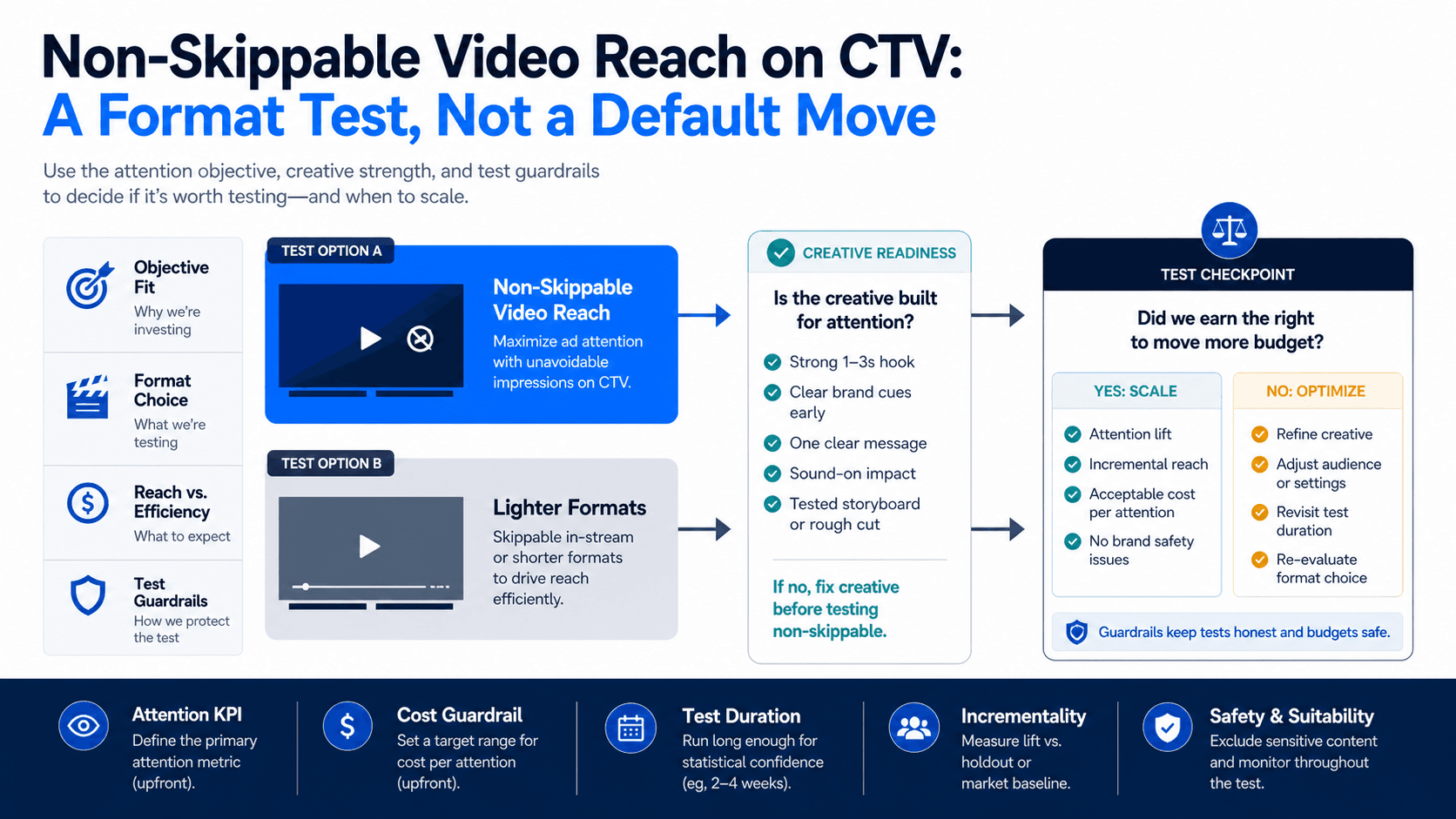
Illustrative concept graphic for non-skippable Video Reach test planning, not a product screenshot.
Non-skippable Video Reach trades viewer choice for guaranteed completion. The test plan asks which audiences that trade serves before CTV budget moves.
Key takeaway
The CTV test launches non-skippable Video Reach because completion rate looked weak on skippable lines, and the brand team forgets that the format removes the skip button for everyone, including people who were never going to watch fifteen seconds voluntarily. Google's Video Reach campaigns Help page describes reach-focused video formats across YouTube and partners, including efficient reach options built for attention at scale. Non-skippable delivery is the extreme version of that trade: completion becomes a delivery guarantee, not a creative verdict.
The reframe is forced attention, not free quality. Non-skippable Video Reach serves plans that value guaranteed completion on audiences where holding the full message matters more than efficiency per voluntary view. The test compares lighter video formats, reviews creative strength for a captive viewing experience, sets budget caps, and writes keep, narrow, or stop rules before scale. Parallel AI reads the connected Google Ads account, writes the format test in a doc or spreadsheet, and drafts campaign notes for a person to approve.
Checked against current product, pricing, trust, and official Google materials so the comparison, buying guidance, and fit criteria stay current and defensible.
- Google's Video Reach campaigns Help page supplies format and objective language; non-skippable availability should be verified in the live account before tests.
- Objective fit, creative readiness, reach versus efficiency, test budget, and stop rules were treated as joint gates before launch recommendations.
- Parallel's role stays limited to connected account review, finished test summaries, and drafted changes held for human approval.
Completion rate climbs the moment skipping disappears. That is arithmetic, not proof the story worked. Video Reach campaigns on Google Ads pursue efficient reach across YouTube and partner inventory per Google's Help documentation. Non-skippable placements push the trade furthest: the viewer cannot leave early, so the plan better know why holding them still helps the business.
DEFINITION
Non-skippable Video Reach
A Video Reach campaign delivery path where ads must play to completion before the viewer continues. Google's Video Reach campaigns Help page frames reach and attention objectives across YouTube inventory. Non-skippable delivery optimizes for completed exposure rather than voluntary engagement.
Google Ads Help: Video Reach campaigns
The trade serves some audiences better than others. New category introductions on broad CTV reach plans may justify forced completion when the creative is short, legible on a TV screen, and legally reviewed for sound-on playback. Retargeting pools with high intent may not need the same force; they need relevance.
Compare non-skippable delivery with in-stream skippable, bumper, Shorts, or Demand Gen video before the test. Google's video campaign materials describe multiple reach and view formats with different efficiency curves. Non-skippable should win on strategic grounds, not because completion rate was the only metric leadership understood.
Creative readiness is sharper here. A weak fifteen-second story becomes fifteen seconds of resentment when skip disappears. Brand, legal, and product claims need room-level review, not laptop-only approval.
Illustrative math: a CTV test spends $36,000 over four weeks on non-skippable Video Reach while a skippable control line spends the same. Completion rate runs above ninety percent on non-skippable and forty-one percent on skippable, while aided awareness movement is similar and cost per completed view is eighty percent higher. Numbers are illustrative. The mechanism is buying completion without buying incremental persuasion.
Where Google's public Help pages do not confirm non-skippable setup for your market or objective, verify format options in the live campaign builder rather than assume parity with other Video Reach paths.
Leadership decks love completion rate because it rises without debate. The test memo should pair completion with at least one business read the client already trusts, such as aided awareness, branded search, or site quality visits, so the format decision survives the first chart review.
Document the control line's CPM and completion side by side in the same weekly report so the test compares cost per completed view, not completion alone.
High completion with flat brand movement is an expensive captive audience.
Once forced completion is the trade, audience selection decides whether the trade is strategic or lazy.
Write the audience hypothesis before launch: who must hear the full message, why skip would have hidden the value, and what completion proxy maps to business outcomes you already trust.
Set test budget, success criteria, and stop rules in the same doc. CTV tests without caps become quarterly line items nobody can unwind.
Plan a post-test read on reach, frequency, completion, brand lift or search proxies, and any lower-funnel metrics the client secretly expects even when the brief said awareness.
Frequency on forced completion deserves its own cap. High completion on the same household four times in one week is not brand reinforcement; it is wear-out with a premium invoice. The test plan should state both completion goals and maximum impressions per user before launch.
Audience contexts mapped to format fit.
| Audience job | Non-skippable case | Lighter format case |
|---|---|---|
| Broad cold reach on CTV | Short, high-clarity story where completion carries the message | Skippable or bumper when CPM efficiency matters more |
| Category education | Forced completion when regulatory or product complexity needs full read | Reach and frequency across mixed lengths |
| Warm remarketing | Rare; relevance usually beats force | Demand Gen or skippable in-stream with offer clarity |
| Direct response efficiency | Hold unless completion clearly lifts qualified traffic | Performance-led video with CPA or ROAS guardrails |
Compare Video Reach format options in campaign setup
With forced completion as the frame, the pre-launch gate stays short.
Confirm the campaign is buying reach or attention, not only short-term CPA efficiency disguised as a CTV test.
Compare non-skippable delivery with at least one lighter video format on audience, creative, and cost grounds.
Review whether creative is strong enough for a captive viewing experience on CTV and sound-on environments.
Set test budget, success criteria, frequency caps, and keep, narrow, or stop rules before launch.
Partner inventory and YouTube home-screen contexts behave differently on CTV. A creative approved for in-feed skippable may read as intrusive when the skip control disappears on a living-room screen. Suitability review should include playback context, not only content category.
- Name the audience that benefits from no skip.
- Run a lighter format control when possible.
- Approve creative on a TV screen, not a laptop thumbnail.
- Write stop rules before the client sees completion charts.
Completion rate without a control line proves format mechanics, not strategy.
Test when attention value, creative strength, audience fit, and budget guardrails are clear. Stay narrow when non-skippable fits one audience context but not the whole CTV plan. Hold when the objective is direct-response efficiency or creative quality is not ready for captive viewing.
Test when
- A named audience benefits from full message completion more than skip efficiency.
- Creative, legal, and suitability reviews passed on TV-scale playback.
- Test budget, control line, and stop rules are written before launch.
Hold when
- The team chose non-skippable only because completion rate looked bad elsewhere.
- Creative is untested on CTV screens or sound-on contexts.
- Nobody defined what completion should move downstream.
Non-skippable Video Reach testing is a connected-account workflow Parallel AI supports well. The agent pulls reach, frequency, completion, spend, and campaign context from the connected Google Ads account, compares test and control lines where they exist, and writes test, narrow, or hold rows in a doc or spreadsheet the media and brand leads share. If the call is to cap budget or draft a Video campaign note, it waits for a person to approve that change. Completion charts without an audience hypothesis recreate the same QBR debate. See for adjacent premium attention tests. On Monday morning, open Video Reach reporting for any non-skippable test, compare completion and cost against the lighter format control, and send one test, narrow, or hold line before budget rises.
Google documentation
Google's Help reference for Video Reach campaign setup and format context.
Google's announcement context for video and campaign updates.
- YouTube Shorts Efficient Reach Campaign ChecklistHelpful when Shorts can add reach but the team still needs format, budget, and post-test reporting criteria.
- Peak Points YouTube Ads Checklist for Creative and Media TeamsFor brand and video teams deciding whether Peak Points solves an attention problem or adds premium CPM without a read.
- How AI Agents Help Optimize Google Ads: Reports, Settings, and Review StepsA technical guide to diagnosis, prioritization, and reviewed changes in Google Ads.