

Technical Guide
How AI Agents Help Optimize Google Ads: Reports, Settings, and Review Steps
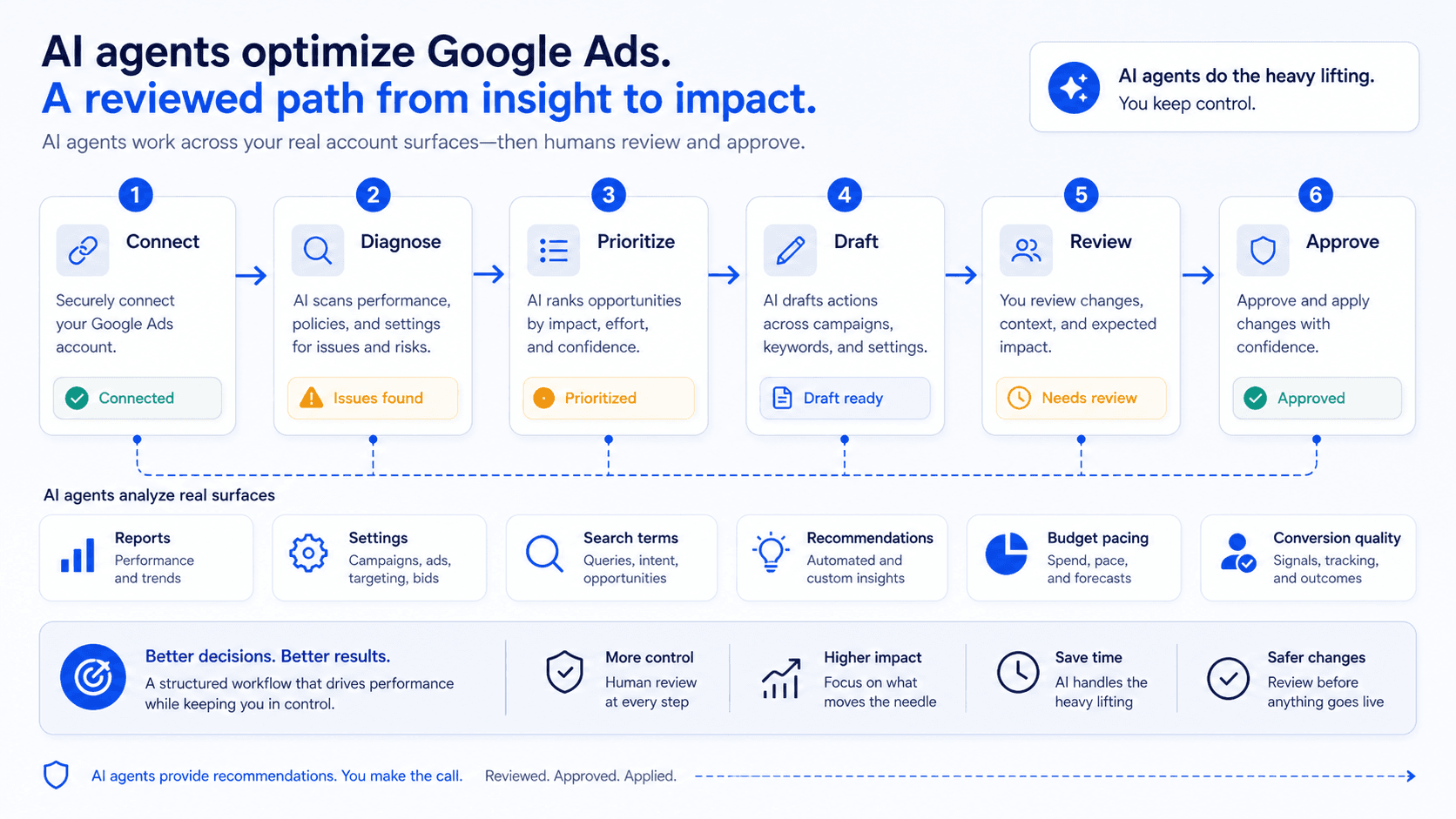
The review improves when the team repeats the same account job and compares outcomes with the prior recommendation.
Learn how AI agents optimize Google Ads by reading the account first, prioritizing the work, and packaging reviewed changes.
Key takeaway
AI agents help optimize Google Ads by reading the account around a specific job: search terms, negative keywords, budgets, conversion actions, Recommendations, Change history, Search behavior, Performance Max behavior, and the reporting need around that work. The point is to turn the review into prioritized next steps a person can approve.
Parallel AI handles this kind of Google Ads work as an agent on the connected account: it runs the analysis, writes the report or spreadsheet, and drafts any account changes for a person to approve.
The key distinction is not faster clicking. It is connected account context plus decision quality. Generic AI can explain PPC best practices. A useful Google Ads agent needs current account data, clear surface names, a ranked action path, reporting support, and explicit review before changes affect bids, budgets, keywords, assets, or settings.
Parallel is strongest when this process has to become shareable account work. It reads the connected account, turns the review into docs, sheets, and reports, and keeps drafted account changes waiting for human approval.
Checked against current product behavior, account-review tools, and official Google materials so the explanation matches the real review process and live product boundaries.
- Deterministic tasks are separated from judgment-heavy tasks before the review is designed.
- Require account context and approval gates on high-risk changes.
- Evaluate the workflow by decision quality and repeatability, not just raw speed.
- Product fit here means real Google Ads jobs: review speed, shared reporting, and account changes that stay under human control, not generic AI helper claims.
A Google Ads account rarely needs speed first. It needs a clear read on what changed. Search terms have shifted, CPA is drifting, the budget report is getting tight, or Performance Max visibility is weaker than the team wants, and the hard part is deciding what that mix of signals means before anyone changes the account.
DEFINITION
AI-agent optimization for Google Ads
Optimization by an AI agent means reading the account, ranking the work, packaging the recommendation, and keeping high-impact changes under review. It is not just applying platform actions faster.
optimization definition
That is why diagnosis comes first. A team does not save time if the system reaches for a bid, budget, or keyword change before it has actually read the account context behind the problem. The work improves when the system can connect Search, Performance Max, budget pacing, Change history, and conversion-action context before it reaches for the next step.
The five-stage sequence below is useful because it reflects the order a real review follows. Observation gives the account signals. Diagnosis turns those signals into a point of view. Prioritization decides what matters now. Planning turns that point of view into something another person can use. Review closes the loop so the next cycle starts smarter.
01
Observe
Gather structured account signals, recent changes, pacing, and performance context.
02
Diagnose
Detect anomalies, friction points, and plausible opportunity patterns.
03
Prioritize
Rank actions by expected impact, uncertainty, and downside risk.
04
Plan
Turn the ranked actions into a review-ready execution sequence, summary, or checklist.
05
Review
Compare outcomes to the plan and calibrate the next cycle.
Google video·Accelerate with Google
Prepare your campaigns for the new era of Search
Google's official Google Marketing Live follow-up session gives Search teams a current baseline for AI Max, Performance Max, and AI-era Search planning.
Optimization gets better when the account is read before the change is drafted.
From there, the technical question becomes narrower: what has to be true for the review to stay trustworthy. The answer is not one model or one prompt. It is the stack of account-data access, prioritization, planning, approval, and reporting quality that lets the same job repeat cleanly next week.
| Layer | Purpose | Failure mode if missing |
|---|---|---|
| Account-data path | Pull structured account data and context | Recommendations drift into generic PPC advice |
| Prioritization path | Translate signals into ranked decisions | Output becomes an unprioritized to-do list |
| Planning path | Turn decisions into next steps another account lead can act on | Handoff stays slow and manual |
| Approval path | Keep risky changes inside visible approvals | Speed increases, but trust drops |
The review breaks where one of those paths goes thin.
A strong diagnosis is not enough if the next person still has to translate it from scratch. The review has to leave behind something that travels cleanly into a weekly summary, an approval conversation, or the account work itself.
This is one of the biggest differences between a real optimization system and generic prompting. Generic prompting can give the team ideas. A good Google Ads agent has to give the team a ranked action list, a review-ready summary, or a checklist that survives handoff without losing the rationale.
| Output type | Why it matters | What breaks if it is weak |
|---|---|---|
| Ranked action list | Lets the team see priority, rationale, and likely next steps instead of a flat idea dump. | Execution slows down because the team still has to decide what matters first. |
| Review-ready summary or brief | Gives the next reviewer enough context to approve, reject, or reshape the plan quickly. | The workflow becomes a chat transcript that cannot travel across the team. |
| Execution checklist or sheet | Turns reasoning into a format another person can actually work from without reinterpretation. | Good analysis dies at handoff because the output never becomes operational. |
If the handoff fails, the optimization was never finished.
The next mistake is task misclassification. Not every Google Ads job needs the same kind of system. Threshold alerts, routine checks, and stable hygiene are different from diagnosis, prioritization, and change review.
Teams get better results when they let deterministic work stay deterministic and reserve the AI-agent path for the jobs where account context, ambiguity, and sequencing actually matter. That is how automation and AI agents complement each other instead of getting compared as if one should replace the other.
Deterministic path
Threshold checks, routine alerts, and stable hygiene tasks stay good candidates for automation.
Judgment-heavy path
Diagnosis, cross-account prioritization, and recommendation sequencing benefit from an connected-account AI agent.
Weak pilots usually fail in predictable places. Either the system never gets enough live account context to say something specific, or the team never turns the result into a review path another person can trust.
| Failure mode | What it looks like |
|---|---|
| Thin account context | The system reasons from stale or incomplete Google Ads signals and falls back to generic advice. |
| Weak handoff | The review finds the issue but cannot package the next step clearly enough for another person to execute it. |
| Informal approvals | The team moves faster but trusts the output less because ownership is blurry. |
| Moving target pilot | The team keeps changing the job before one recurring use case is stable enough to measure. |
Most failures look like weak AI, but they usually start as weak review design.
This category also has boundaries. AI agents are not automatically the right answer for every Google Ads task, and pretending otherwise makes the whole system harder to trust.
Stable threshold-based tasks with little ambiguity often belong in automation. Very high-risk changes where no one has time to review the rationale should stay tightly controlled. And if the team has no reusable summary format, no review standard, and no plan to keep the output consistent, the agent will not fix that discipline gap on its own.
The not-fit cases are useful because they make the fit cases clearer. AI agents are strongest where the review is real, the ambiguity is real, and the team still wants a controlled next step instead of a black box.
The category gets stronger when it says no to the wrong jobs.
Once the task is classified, the next question is whether the loop is actually closed. A lot of AI content stops at recommendation quality, but recommendation quality is only the middle of the story.
In a real workflow, the work does not end when the recommendation is drafted. Someone has to review why the recommendation was ranked that way, decide whether the action fits the current business context, and then compare the outcome against the original plan. Without that loop, the team learns very little and trust decays quickly.
This is also why the account review matters so much. It is the mechanism that lets the next person understand what the system saw, what it recommended, and what should be checked before execution.
No visible review loop means no durable optimization gain.
Approval language often gets flattened into “human in the loop,” but paid-search work is more specific than that. Someone owns the threshold, someone owns the rationale, and someone owns the final yes or no on the change.
The review has to make those roles visible enough that the next approver does not have to reverse-engineer the system's intent. That is how the team keeps trust while still moving faster on diagnosis and write-up.
Good implementations also log more than acceptance. They record what was rejected, what needed clarification, and which kinds of recommendations keep producing rework. Those are the signals that improve the next cycle instead of merely making the current one feel fast.
Approvals are not friction; they are how the team keeps the recommendation accountable.
By the time the pilot starts, the team should already know what good looks like. That does not mean locking the review into a brittle script. It means agreeing on the recurring job, the expected write-up, and the approval boundary before the first test run happens.
| Pilot standard | Why it matters |
|---|---|
| One recurring workflow | The pilot needs a job that already hurts enough to measure clearly. |
| Expected output | Define the review doc, sheet, or summary before the pilot so output quality can be judged consistently. |
| Visible approvals | Keep review ownership visible from day one instead of retrofitting it after a fast demo. |
| Actionability check | Judge not only whether the system found the issue, but whether another person could act on the output confidently. |
A pilot without review standards usually measures novelty, not optimization quality.
Implementation works best when the team starts smaller than it wants to. One weekly job is enough to prove whether the account context is strong, the write-up is usable, and the approval step still feels clean.
01
Week 1: baseline and classify workflows
Map recurring jobs, label them deterministic or judgment-heavy, and define approval thresholds.
02
Week 2: pilot one judgment-heavy workflow
Run one recurring diagnosis and action-plan cycle with explicit review checkpoints.
03
Weeks 3-4: standardize and expand
Document the prompt, review template, and approval pattern before adding new account sets or use cases.
Scale the review only after one weekly job stays clean for a few cycles.
The final mistake is to measure only speed. Faster work matters, but not if the diagnosis gets weaker, the approval path gets foggier, or the reporting still needs the same cleanup after the agent has done its part.
| Metric | What it proves |
|---|---|
| Time-to-diagnosis | Whether recurring performance issues get understood faster. |
| Recommendation acceptance rate | Whether the ranked next steps are credible enough to move forward. |
| Rework rate on action plans and reports | Whether the output survives handoff without major cleanup. |
| Time-to-implementation for approved actions | Whether the review path is shortening the route from diagnosis to approved change. |
| Team confidence in the decision | Whether the system is improving judgment, not just response time. |
On Monday morning, open Search terms, Change history, the budget report, and the last approved recommendation, then ask whether the next action is clearer than it was a week ago.
Use the current Google videos, Help pages, public announcements, and product visuals below to confirm availability, setup details, and reporting limits.
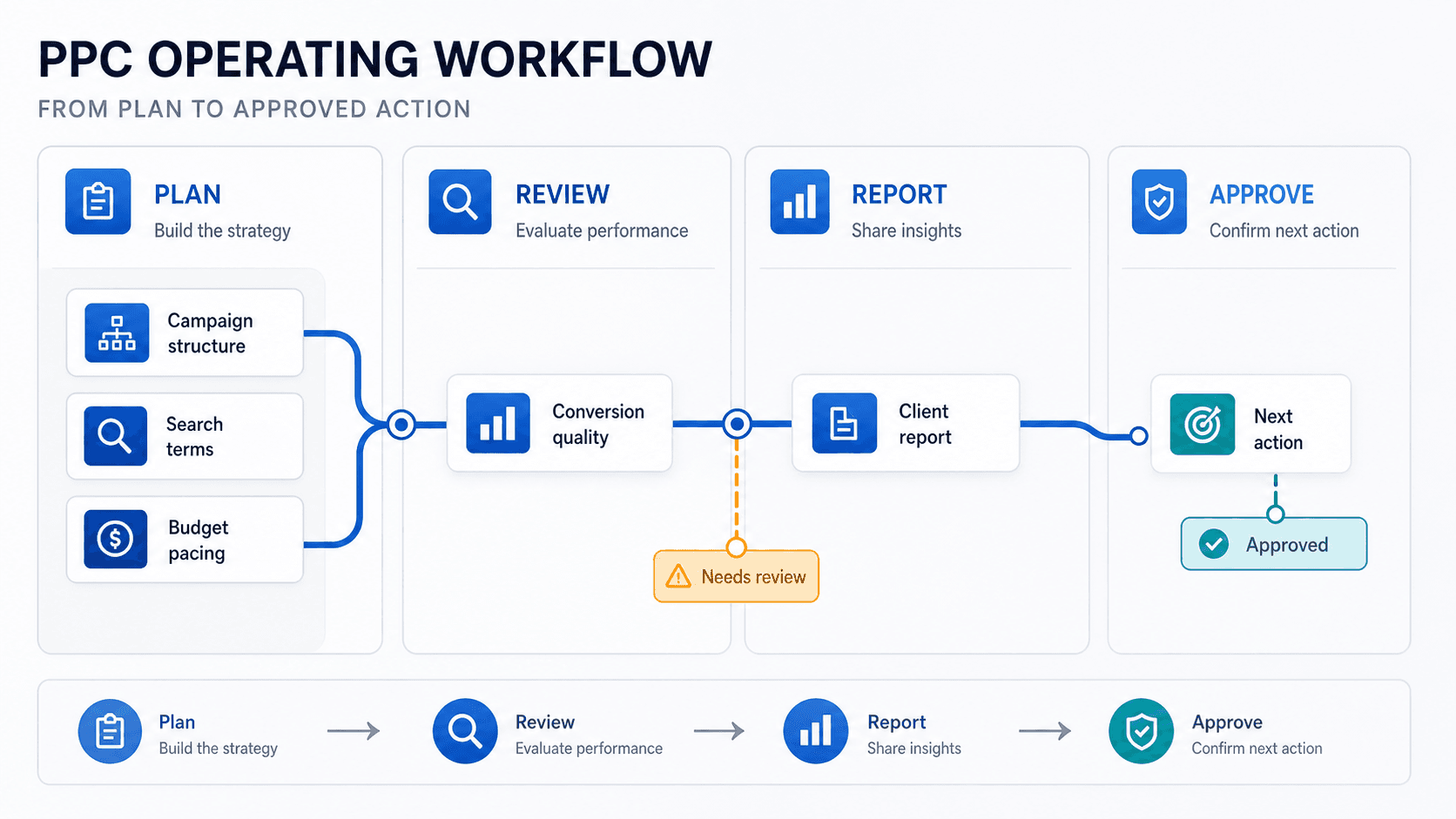
Source reference·Optmyzr
PPC operations and Google Ads review fit
Editorial graphic contrasting broad PPC operations software with a Google Ads-first account review and reporting process.
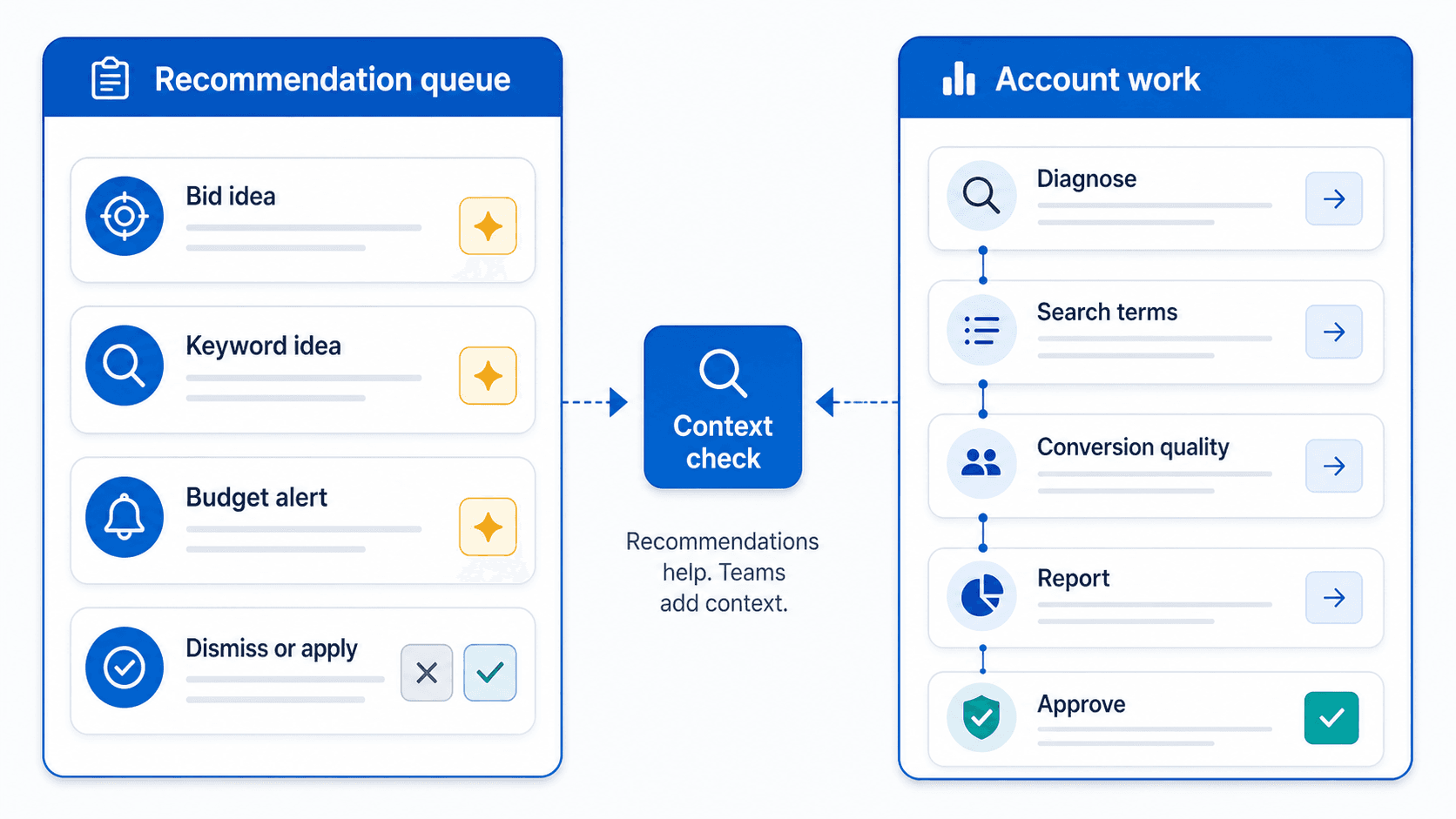
Source reference·Opteo
Recommendations and reporting fit
Editorial graphic contrasting recommendation-led account management with deeper Google Ads review and reporting work.
Google documentation·Google Ads Help
Google's guide to AI Mode and AI Max ads
Use Google's official overview of broad match, Smart Bidding, and responsive search ads as the baseline for any native Search AI claim in these guides.
Open official guideGoogle documentation
Official reference for using the search terms report to review which searches triggered ads and identify keyword or negative keyword updates.
Official reference for Google Ads Recommendations and how they use account history, campaign settings, and trends.
Official budget reference for average daily budgets, spending limits, daily costs, shared budgets, and budget reports.
Official reporting reference for Report editor, predefined reports, saved reports, and manager-account reporting.
Official manager-account reference for agencies and teams managing multiple Google Ads accounts from one place.
Google's current documentation for AI Mode and AI Max built on broad match, Smart Bidding, and responsive search ads.
Official Smart Bidding reference for Google's automated bid optimization systems.
Official overview of AI Max for Search campaigns, including matching, creative, reporting, and controls.
Additional documentation
team member-grade guidance on how intent matching, AI Overviews, and broader query interpretation change search campaign structure.
Practical review of which Google Ads AI features are safe starting points and which ones still require tighter human oversight.
Recent practitioner guidance on where automated bidding loses business context and which intervention points still need human direction.
Shows how mature PPC teams layer multi-condition automation, alerts, and review steps beyond simple native rules.
- Blog homeBrowse every published Google Ads guide from one editorial index.
- Google Ads AI agent: complete guideThe pillar guide covers the category definition, the adoption model, and where the agent fits real Google Ads work.
- ResourcesMove between the definition page, pricing, product walkthrough, and trust pages.
- About Parallel AISee the company mission, editorial standards, and operating principles behind the product.
- SecurityReview the public data-handling, account-connectivity, and approval-control framing used throughout the published guides.
- Google Ads Automation vs AI Agents: Rules, Native AI, and Agent-Led ReviewHelpful when a team needs to sort Google Ads work into threshold-based automation, auction-time optimization, or account-level diagnosis with approval.
- AI Max Expansion After GML 2026: What to Audit Before You Adopt ItHelpful when Google Ads teams need to audit AI Max readiness without losing account-level review and approval.
- Google Ads AI Agent for Ecommerce: Search Terms, Shopping, and PMax ReviewFor when Search, Shopping, Merchant Center, and Performance Max need one ecommerce review instead of separate meetings.