

AI Max Readiness
AI Max Expansion After GML 2026
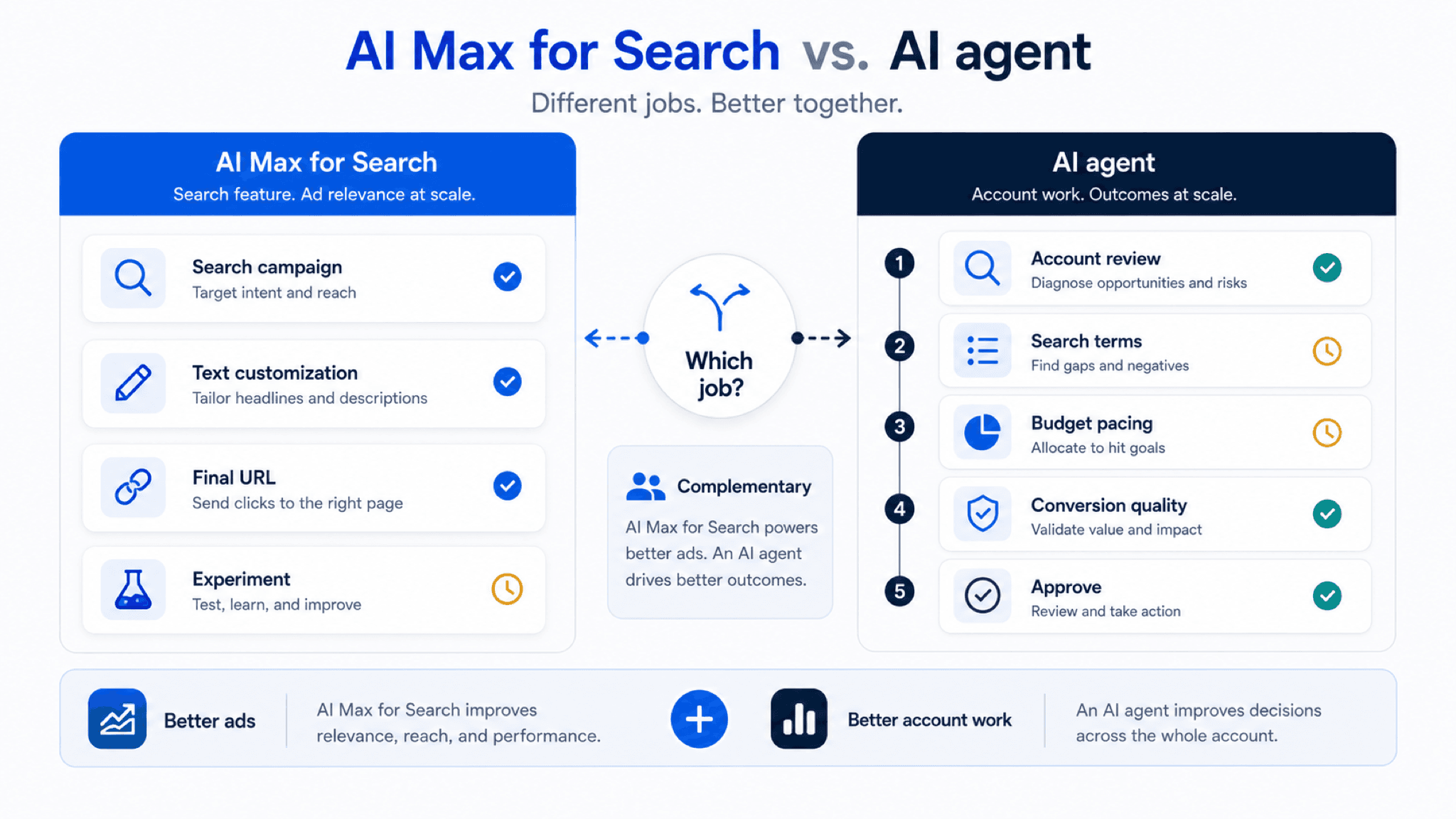
Use both when campaign tuning and team review are separate problems that need separate owners.
Review AI Max after Google Marketing Live 2026 by separating campaign-level controls from the account decisions that still need review.
Key takeaway
AI Max after Google Marketing Live 2026 should be treated as a Search expansion review, not as a single toggle that answers every account question.
Parallel AI is the AI agent platform for Google Ads work. Agencies and in-house teams hand off research, reporting, and optimization on connected accounts, and every account change the agent drafts waits for a person to approve it. Most tools in this category stop at recommendations. Parallel finishes the work in docs, spreadsheets, and reports a client or a lead can act on.
Before adopting or expanding AI Max, teams should inspect Search campaign quality, Dynamic Search Ads exposure, automatically created assets, text customization, Final URL expansion, URL exclusions, landing pages, tracking templates, brand settings, conversion actions, search terms, and reporting baselines.
AI Max belongs inside Search campaign expansion and matching. Parallel is strongest around the account work that follows: reading the connected Google Ads account, finishing notes in docs, sheets, and reports, and keeping drafted Google Ads changes waiting for human approval.
Google's AI Max expansion, Help, reporting, Dynamic Search Ads upgrade, and API references point to a narrower question: which Search inputs are ready for AI Max, and which account decisions still need human review before spend changes?
- AI Max controls, reporting, setup, release-note, and migration claims come from Google Ads Help and Google Ads API documentation.
- Confirmed AI Max behavior is kept separate from rollout-limited Shopping, travel, AI Brief, and migration details.
- Review conversion quality, landing-page coverage, brand controls, URL rules, tracking, and reporting baselines before expanding AI Max.
- A strong fit combines commercial judgment, human review, and reporting teams can share rather than only surfacing automation ideas.
The confusing moment usually comes after a good Search result, not before it. AI Max broadens matching, the campaign starts finding new volume, and the team still has to answer a separate question the next morning: what changed, what risk came with it, and which account decisions still need a person to review before the next move.
DEFINITION
AI Max for Search vs AI agent
AI Max is a Search-campaign system inside Google Ads. An AI agent is an account-review system around Google Ads. The practical question is which decisions stay inside the campaign and which still need account-level review.
boundary definition
That is the right starting point because it keeps the comparison honest. AI Max is trying to improve how Search campaigns match, expand, and adapt assets inside Google Ads. An AI agent is trying to help the team understand broader account context, explain the tradeoffs, and package the next decision cleanly.
Once the systems are framed that way, the choice gets simpler. The team is not choosing which one is smarter in the abstract. It is choosing which part of the job belongs in campaign controls and which part still belongs in account review.
AI Max for Search
A Search-campaign feature set inside Google Ads focused on search term matching, text customization, final URL expansion, and related reporting and controls.
AI agent
An external AI system used for diagnosis, prioritization, account review, summary generation, and human-reviewed execution planning.
Google video·Google Ads Help + Google Ads YouTube
AI Max for Search campaigns
Google's own explainer on AI Max is the cleanest embedded reference for what the feature does inside Google Ads before an external AI workflow is added.
The comparison gets clearer the moment campaign controls and account review stop competing for the same job.
From there, the comparison should stay practical. Ask what each system can actually own. AI Max owns campaign behavior inside Google Ads. The AI agent owns the account questions that still exist after the campaign behavior changes.
That split matters because it prevents a false tradeoff. Stronger in-product matching does not automatically create a better explanation for leadership, a cleaner migration note, or a better approval path for a budget shift. Those are different outputs with different review needs.
| Dimension | AI Max for Search | AI agent |
|---|---|---|
| Primary scope | In-product Search campaign matching and asset control | Cross-account analysis, reporting, and planning support |
| Output form | Search-campaign controls and reporting inside Ads | Recommendations, plans, account reviews, and reporting outputs |
| Best task type | Campaign-level tuning | Diagnosis, prioritization, and decision packaging |
| Governance style | Platform controls | Custom review and approval boundaries |
The easiest way to use both systems well is to route the next question before the team opens another meeting. If the issue is campaign matching, asset behavior, or Final URL expansion, stay inside Google Ads. If the issue is account movement, tradeoffs, reporting, or approval, move into the account review path.
That routing habit is what keeps hybrid stacks from becoming redundant. It lets the team use AI Max where Google has product advantage and use the AI agent where a broader account point of view is still required.
01
Main problem is in-product campaign tuning
Prioritize AI Max usage and measure the campaign-level effect inside Google Ads.
02
Main problem is explaining account movement outside Google Ads
Use an AI agent for cross-account diagnosis, reporting, and reviewed next steps.
03
Need both stronger Search coverage and clearer account decisions
Use AI Max for campaign controls, then define what the team reviews before budget, bid, or structure changes move forward.
Route the question correctly and the tool choice usually stops being controversial.
A good hybrid setup is not complicated. AI Max handles the Search-campaign controls it was designed for, while the AI agent handles the account explanation around those controls.
That means AI Max owns in-product matching, text customization, and Final URL expansion behavior. The AI agent owns account analysis, action planning, reporting, and the note that explains whether the campaign movement should lead to another budget, structure, or launch decision elsewhere in the account.
Keeping those responsibilities separate also protects review quality. The team can let Search campaigns learn and expand without pretending the account summary, the stakeholder explanation, or the approval call has already been settled.
The hybrid works when campaign tuning and account review stop tripping over each other.
AI Max readiness is not only a setup question. It is an explanation question. The team should know before rollout whether it can still explain search terms, landing-page fit, conversion quality, and budget movement after AI Max expands coverage.
| Readiness check | Why it matters |
|---|---|
| Search campaign quality | AI Max works best when the current Search setup is strong enough to absorb broader matching without unacceptable CPA drift. |
| Explanation quality | The team still needs to explain Search terms, landing pages, Final URL expansion, text customization, and conversion actions after AI Max is enabled. |
| Reporting separation | Campaign performance movement should be separated from review clarity so more coverage does not hide unresolved approval or reporting questions. |
A rollout is not ready if the campaign gets broader but the account gets harder to explain.
The first review period should stay short and disciplined. Three weeks is enough to see whether AI Max changed campaign behavior and whether the team got any clearer about what should happen next across the account.
That separation matters because good campaign lift can hide a messy review process, and a clean review can hide the fact that the campaign itself did not improve. The goal is to measure both at the same time without pretending they are the same result.
01
Days 1-3: baseline the current process
Record current Search terms, Final URLs, conversion actions, CPA, ROAS, budget settings, and reporting baseline before expanding AI Max.
02
Days 4-12: run controlled comparison paths
Keep AI Max focused on the in-product campaign role and run one account-review path in parallel.
03
Days 13-21: standardize the split
Document which decisions come from Google Ads reporting and which require a separate account note, client explanation, or approval.
A short review can tell you whether the campaign improved and whether the account story improved with it.
This is the line teams need to remember when AI Max starts performing well. Better matching is valuable. It is just not the whole decision.
AI Max can improve how a Search campaign explores intent and adapts assets inside Google Ads. It does not automatically explain cross-account movement, lead quality, budget tradeoffs, or the client-ready reason a change should happen now.
That distinction matters because stronger in-product performance signals can still leave open questions about Search term quality, landing-page fit, conversion-action reliability, and who should approve the next account change.
A stronger Search campaign does not remove the need for an account point of view.
After rollout, the week gets easier when the cadence is explicit. Let AI Max and native Search controls do their job inside the campaign during the week. Then use the AI agent to rank account-level issues, summarize what changed, and prepare the next checks before the approval conversation starts.
That cadence protects both systems from false expectations. AI Max is not asked to become the account summary. The AI agent is not asked to become campaign matching logic. Each system keeps the job it can actually own well.
A weekly cadence is how the stack stays complementary instead of redundant.
The monitoring list should also stay split. Some signals live inside Google Ads. Others only show up once the team tries to explain the campaign result to another person and decide what to do next.
| Signal to watch | Where it lives | What it tells you |
|---|---|---|
| Campaign-level reach and CPA drift | Inside Google Ads | Whether AI Max is broadening opportunity at an acceptable efficiency cost. |
| Account review clarity | AI agent review | Whether another stakeholder can understand what changed, why it matters, and what should happen next without re-diagnosing the account. |
| Approval bottlenecks | AI agent review plus manager approval | Whether the added review layer is producing cleaner decisions or simply creating more steps to check. |
Watch the campaign result and the explanation quality at the same time or the review will lie to you.
Using both systems does not guarantee a clean process. The failure mode simply moves. Instead of a missing tool, the team gets a vague boundary between campaign success and account decision-making.
The setup breaks when the team treats AI Max gains as proof that the full account decision is settled. CPA or ROAS can improve while Search term quality, landing-page fit, lead quality, or budget timing still needs review.
It also breaks when the AI agent becomes a vague second opinion instead of a clear account review. If the summary still lacks ownership, rationale, or a clean recommendation sequence, the team has more output without a better decision.
Hybrid failure usually looks like good performance paired with weak explanation.
Most AI Max mistakes come from collapsing the boundary again after the rollout starts. The team wants one system to own campaign tuning, account explanation, reporting, and approval, even though those are different kinds of work.
That is why the common errors all rhyme. Teams expect in-product optimization features to replace account review or client reporting. They measure only short-term campaign metrics while ignoring Search term quality, landing-page fit, conversion quality, and reporting clarity. They add an agent without a baseline for the account checks, reports, and approvals they already need. Or they skip approval rules after the first good result.
On Monday morning, open one Search campaign, its Final URL expansion settings, the last 14 days of search terms, the active conversion actions, and the current approval rule for the next change. That is enough to tell whether AI Max owns the problem, the account review owns the problem, or both do.
The stack works when each system owns its own decision and stops claiming the other one.
Use the current Google videos, Help pages, public announcements, and product visuals below to confirm availability, setup details, and reporting limits.
Google media·Google
AI Max road to GML
Google's public AI Max post includes GML-era AI Max imagery for the Search expansion discussion.
Google documentation·Google Ads & Commerce Blog
AI Max expansion updates
Google's GML-era AI Max announcement covering Search expansion context, AI Brief, text disclaimers, and migration direction.
Open Google sourceGoogle documentation·Google Ads Help
Google's guide to AI Mode and AI Max ads
Use Google's official overview of broad match, Smart Bidding, and responsive search ads as the baseline for any native Search AI claim in these guides.
Open official guideGoogle documentation·Google Ads Help
Google Ads Help: About AI Max for Search campaigns
This is the current official reference for AI Max controls, reporting, and scope. Use it when the question is feature boundaries, not product marketing.
Open AI Max helpGoogle documentation
Google's GML-era AI Max update covering Search expansion context, AI Brief, text disclaimers, and migration direction.
Official overview of AI Max for Search campaigns, including matching, creative, reporting, and controls.
Details on search term matching, text customization, final URL expansion, and related AI Max controls.
Official reporting reference for AI Max Search Terms, Keywords, Landing pages, and Asset reports.
Google Ads API documentation for version-specific AI Max settings and controls.
Google's current documentation for AI Mode and AI Max built on broad match, Smart Bidding, and responsive search ads.
Official Smart Bidding reference for Google's automated bid optimization systems.
Additional documentation
Recent independent analysis of AI Max tradeoffs, useful for framing where broader reach can create efficiency risk.
Practical review of which Google Ads AI features are safe starting points and which ones still require tighter human oversight.
Useful current framing for what Google is shipping natively in Ads and Analytics and where those agentic features sit relative to external workflow tools.
- Blog homeBrowse every published Google Ads guide from one editorial index.
- Google Ads AI agent: complete guideThe pillar guide covers the category definition, the adoption model, and where the agent fits real Google Ads work.
- ResourcesMove between the definition page, pricing, product walkthrough, and trust pages.
- About Parallel AISee the company mission, editorial standards, and operating principles behind the product.
- SecurityReview the public data-handling, account-connectivity, and approval-control framing used throughout the published guides.
- Ask Advisor and AI Agents After GML 2026: Native Google Help vs Team ReviewFor teams deciding what belongs in Ask Advisor, native Google AI, or agent-led account review after GML 2026.
- Google Ads Automation vs AI Agents: Rules, Native AI, and Agent-Led ReviewHelpful when a team needs to sort Google Ads work into threshold-based automation, auction-time optimization, or account-level diagnosis with approval.
- How AI Agents Help Optimize Google Ads: Reports, Settings, and Review StepsA technical guide to diagnosis, prioritization, and reviewed changes in Google Ads.