

Placement Visibility
Search Partner Network Placement Reporting Audit
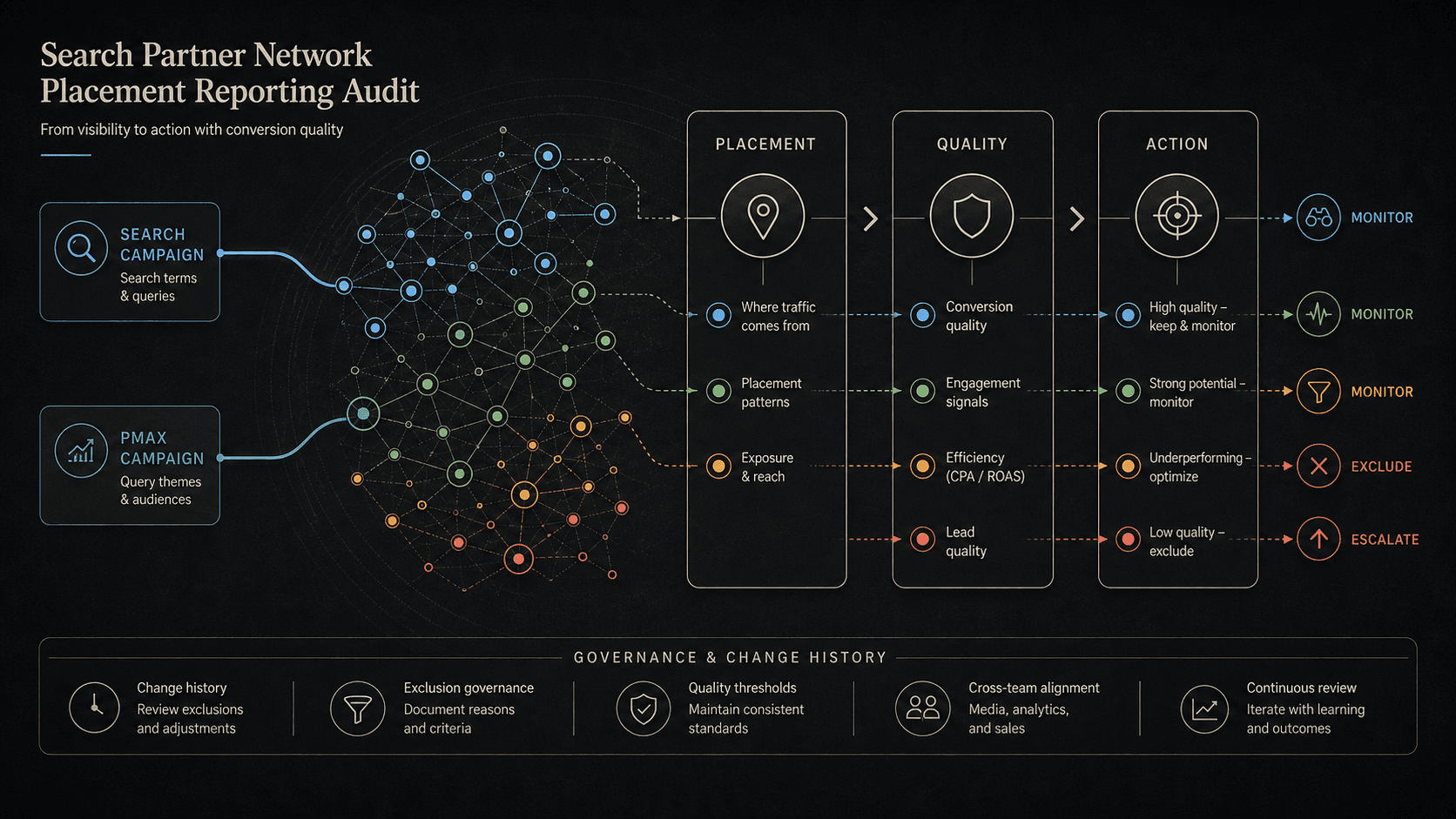
Illustrative concept graphic for Search Partner placement reporting audit, not a product screenshot.
Search Partner placement reporting made the SPN toggle auditable. Audit placements like inventory, not settings, before exclusions or budget shifts.
Key takeaway
Google's Search Partner Network announcements page documents full placement reporting for Search, Shopping, and App campaigns, including site-level impression data, and SPN segmentation inside Performance Max channel reporting. That visibility makes the SPN opt-in auditable in a way settings screens alone never could. The reporting shows where ads appeared. It does not, by itself, prove which placements caused a performance change.
The audit should compare placement patterns with conversion quality, search terms, CPA, ROAS, lead or purchase quality, budgets, campaign settings, exclusions, and change history before monitoring, exclusion review, or escalation. Parallel AI reads the connected Google Ads account, writes the placement audit in a doc or spreadsheet, and drafts exclusion notes for a person to approve.
Checked against current product behavior, account-review tools, and official Google materials so the explanation matches the real review process and live product boundaries.
- Google's Search Partner Network announcements page supplies full placement reporting and Performance Max SPN segmentation context; placement exclusion list Help defines reusable exclusion mechanics.
- Placements were compared with search terms, conversion actions, lead quality, CPA, ROAS, budgets, settings, exclusions, and change history before monitor, exclude, or escalate recommendations.
- Parallel's role stays limited to connected account review, finished audit notes, and drafted exclusions held for human approval.
The account lead used to argue about Search Partner Network in the abstract. February's reporting upgrade changed the shape of the debate. Google's Search Partner Network announcements page documents full placement reporting for Search, Shopping, and App campaigns with site-level impression data, plus SPN segmentation in Performance Max channel reporting. The toggle is still a setting. The audit target is now placement inventory.
DEFINITION
Search Partner Network placement reporting
Reporting that lists SPN sites where ads served, with impression data at the site level for Search, Shopping, and App campaigns, and SPN split visibility inside Performance Max channel performance reporting per Google's announcements page. It answers where ads appeared on partner inventory. It does not replace search term, conversion, or change history review for why outcomes moved.
Google Ads Help: Search Partner Network announcements
Teams that audit settings instead of placements recreate old arguments with new screenshots. The useful question is whether recurring site patterns align with poor conversion quality, brand suitability risk, or wasted spend after you compare dates, budgets, and query context.
Performance Max requires the same discipline with a different entry point. SPN segmentation in channel reporting tells you how much partner inventory contributed. Placement and search term surfaces still carry the why work when quality diverges.
Google's announcements also note parked domain removal from Search Partner inventory and content suitability controls elsewhere in the account. Placement reporting does not eliminate suitability work. It gives site-level evidence to prioritize that work.
Illustrative math: Search Partner placements show fourteen percent of impressions on three recurring domains while CPA on those rows runs thirty-two percent above account median over twenty-eight days. Total CPA looks flat because Google Search inventory still carries most conversions. Numbers are illustrative. The mechanism is blended performance hiding a placement pattern.
Pre-screen brand safety solutions from third parties appear in Google's announcements as an additional layer. Placement reporting still matters because curated lists and site-level reads answer different questions.
A visible site is not automatically a guilty site.
Once inventory is the frame, the audit mirrors search term discipline: pattern, corroboration, action.
Search terms and placements should be read together. A strange site list with aligned query waste is a stronger exclusion case than a strange site list with strong conversion quality on unrelated queries.
Placement exclusion lists are reusable across campaigns per Google's placement exclusion list Help page. That power makes sloppy exclusions expensive. Patterns deserve definitions, owners, and review dates.
Invalid activity credit reporting and adjusted metrics mentioned in Google's 2026 announcements change how net performance should be read after invoices finalize. Placement audits should use the same net mindset when credit reports are in play.
Placement signals mapped to follow-up surfaces.
| Placement signal | Corroboration surface | Next step |
|---|---|---|
| Recurring low-quality domains | Conversion actions and lead quality | Exclusion review with written pattern definition |
| High impressions, weak conversions | Search terms and query themes | Monitor or tighten query fit before exclusions |
| Performance Max SPN share shifts | Channel reporting and asset groups | Route to creative or feed surfaces if quality diverges |
| Recent suitability or geo changes | Change history and content suitability settings | Hold exclusions until settings review finishes |
Open placement reporting in Report editor
The most expensive mistake is treating impression share on a partner domain as proof that domain caused a CPA spike.
Compare placement patterns with conversion quality, lead or purchase quality, CPA, ROAS, budgets, and campaign settings in the same window. Visibility without quality movement is often a monitor case, not an exclusion case.
Separate Search campaign context from Performance Max context. The same domain can behave differently across campaign types, assets, and query mixes.
Document what the report can show and which questions still need broader review. That boundary keeps client conversations honest and reduces reactive exclusions.
Change history belongs beside the placement export. A bid strategy change, budget shift, or new creative asset can alter partner distribution without any single site becoming harmful.
Placement visibility starts the audit. It should not end it with a bulk exclusion.
With inventory as the frame, the weekly audit stays short and evidence-led.
Pull Search Partner placement reporting with correct Search versus Performance Max scope, date range, and conversion lag.
Compare top placement rows with conversion actions, lead quality, CPA, ROAS, budgets, search terms, and change history.
Write a pattern definition for any domain that might be excluded, including impression floor and quality gap.
Choose monitor, exclusion review, or escalation based on quality impact, not impression volume alone.
- Read placements with search terms, not instead of them.
- Define patterns before building exclusion lists.
- Check change history the same week as placement exports.
- Record net performance context when credit reports apply.
Bulk exclusions without patterns usually trade one waste story for another.
Monitor when placement visibility exists but quality impact is unclear after corroboration. Review exclusions when placement patterns repeatedly align with poor conversion quality, brand suitability risk, or wasted spend definitions the team can document. Escalate when placement concerns affect budget, lead quality, client trust, or account-level controls beyond a single list upload.
Exclude or escalate when
- Placement patterns repeat with poor conversion quality or documented brand suitability risk.
- Search term and conversion reads corroborate the same waste story.
- A written pattern definition and owner exist before exclusion lists change.
Monitor when
- Quality metrics are stable and the placement row is a low-impression outlier.
- Change history shows recent structural edits not yet fully lagged.
- Only impression volume is unusual without conversion or query corroboration.
Search Partner placement review is a connected-account workflow Parallel AI handles well. The agent reads placement reporting, search terms, conversion actions, lead quality, CPA, ROAS, budgets, exclusions, and change history from the connected Google Ads account, groups recurring site patterns, and writes monitor, exclude, or escalate notes in a doc or spreadsheet with corroboration rows. If the call is to draft a placement exclusion list or escalate to account-level suitability review, it waits for a person to approve that change. Raw site exports without quality corroboration recreate the same reactive exclusion cycle. See for adjacent SPN segmentation context. On Monday morning, export last week's Search Partner placements, flag only recurring domains with quality gaps, corroborate each with search terms and conversion actions, and send one monitor, exclude, or escalate line before any list upload.
Google documentation
Google's Search Partner visibility and control announcement for placement reporting.
Google's documentation for reusable placement exclusion lists across campaigns and accounts.
Official reference for using the search terms report to review which searches triggered ads and identify keyword or negative keyword updates.
Official Performance Max reference for campaign scope, inventory, goals, asset groups, and optimization context.
- Performance Max Search Partner Reporting GuideHelpful when Search Partner visibility finally arrived and the team needs a keep, narrow, or escalate loop instead of a blind toggle.
- Performance Max Placement Audit: Find Waste and Lead-Quality DriftHelpful when placement visibility outruns lead quality answers and the team needs subtractive rules before exclusions ship.
- How to Find Wasted Spend in Google Ads With AIFor accounts that need lower wasted spend without overblocking useful traffic.
- Google Ads Negative Keyword Builder With AI: Search Terms, Waste, and Review NotesFor building negative keyword lists from Google Ads search terms with AI and human review.