

Brand Review
Google Ads Power Pack Brand Controls
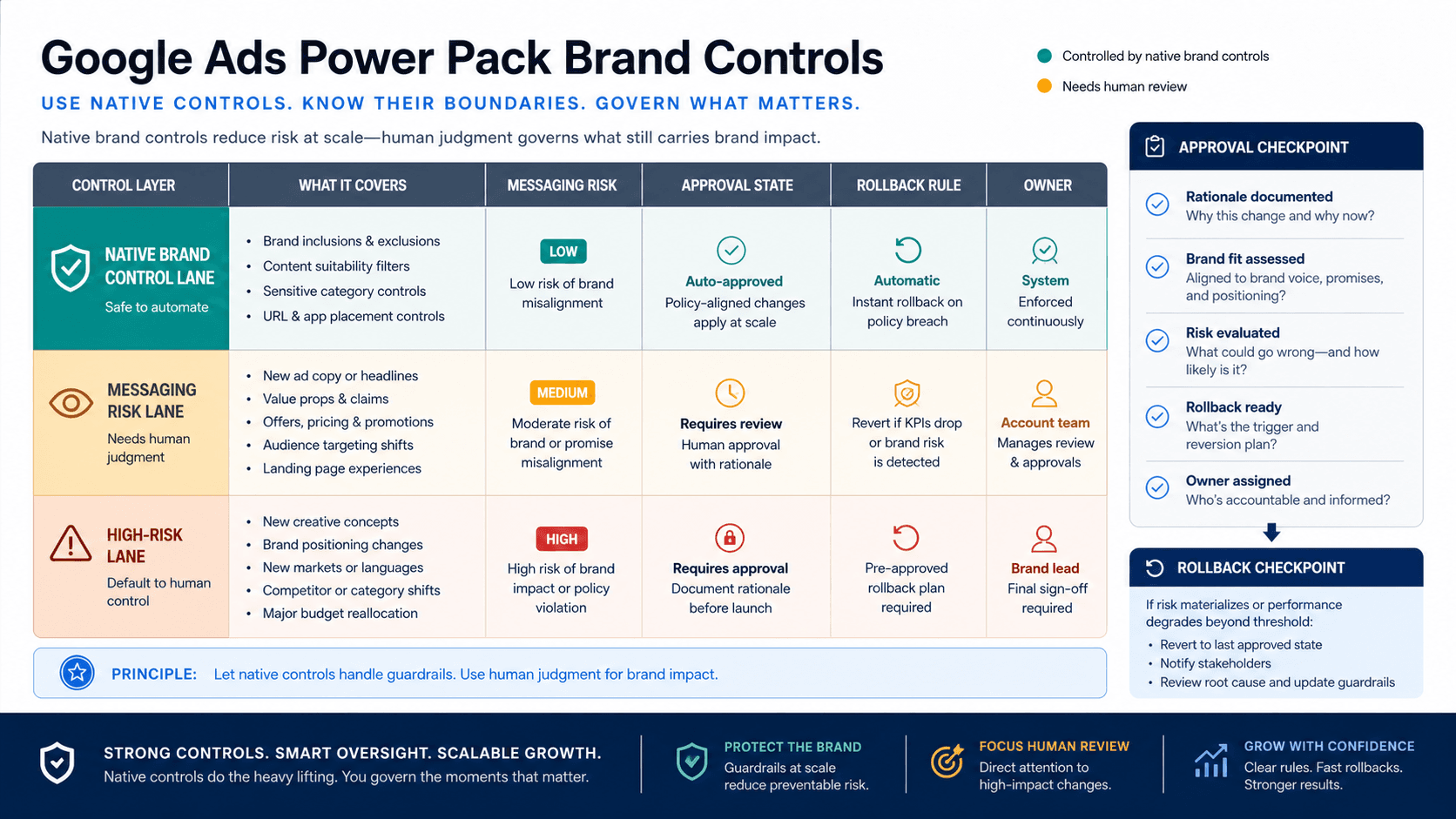
Illustrative concept graphic for Google Ads Power Pack brand controls review, not a product screenshot.
Power Pack bundles Search and YouTube automation; brand controls decide how much of that bundle the brand can wear before messaging and exclusion changes go live.
Key takeaway
The account turns on AI Max text guidelines and brand recommendations from the Power Pack rollout, and the client sees a headline variant that never went through legal. Google's Google Marketing Live roundup describes Power Pack as the next generation of AI-powered campaign solutions across Search and YouTube using Performance Max, AI Max for Search campaigns, and Demand Gen, with more choice, control, and transparency. Google's AI Max Help page and brand recommendations Help page describe native controls for messaging and suitability. That is the tension: automation arrives bundled; brand risk still lands on the account team.
The reframe is fit, not faith. Power Pack bundles automation across campaign types. Brand controls decide how much of that bundle the brand can wear without surprises in search terms, generated copy, exclusions, or suitability settings. Higher-risk changes still need written rationale, approval owners, and rollback rules. Parallel AI reads the connected Google Ads account, writes the brand control review in a doc or spreadsheet, and drafts campaign notes for a person to approve.
Checked against current product, pricing, trust, and official Google materials so the comparison, buying guidance, and fit criteria stay current and defensible.
- Google's Power Pack and AI Max Help pages supply native control language; text guidelines and brand recommendation availability should be verified in the live account.
- Messaging risk, exclusion boundaries, approval owners, and rollback rules were treated as joint gates before apply, limit, or hold recommendations.
- Parallel's role stays limited to connected account review, finished brand notes, and drafted changes held for human approval.
Power Pack is not one toggle. Google's GML roundup frames it as AI-powered solutions across Search and YouTube through Performance Max, AI Max for Search campaigns, and Demand Gen. Brand controls inside AI Max and brand recommendations can steer messaging and suitability, but they do not write your legal disclaimers or know which exclusion still carries commercial upside.
DEFINITION
Power Pack brand controls
Native Google Ads settings described in AI Max for Search campaigns Help and brand recommendations Help that shape automated copy, targeting, and suitability behavior across Power Pack campaign types. They reduce some manual work. They do not remove accountability for messaging, exclusions, or suitability tradeoffs that affect CPA, ROAS, and reach.
Google Ads Help: About AI Max for Search campaigns
Start by listing what the native control actually handles. AI Max text guidelines and related controls can constrain generated copy on Search surfaces per Google's AI Max Help page. Brand recommendations can flag suitability opportunities per Google's brand recommendations Help page. Neither replaces a human read on regulated claims, competitor language, or promo terms tied to live landing pages.
Exclusion and suitability changes carry reach costs similar to third-party lists. A control that removes sensitive categories may protect the brand while shrinking prospecting pools Performance Max or Demand Gen still needs. The control boundary doc should name expected reach impact, not only moral relief.
Approval owners cannot be abstract. Brand, legal, paid media, and client leads need named authority for apply, limit, and rollback. A native control with no owner becomes permanent once the quarterly business review moves on.
Illustrative math: an AI Max Search campaign enables expanded text automation with brand guidelines after a Power Pack rollout. CPA holds while search term insights show new queries around comparison language legal never approved. ROAS looks stable because spend shifted to queries that convert but create support load. Numbers are illustrative. The mechanism is partial native control with no commercial rollback rule.
Where Google's public Help pages do not confirm a specific control in your market or campaign type, verify settings in the live account rather than assume global rollout parity.
Pilot caps should name campaign types separately. A Search AI Max pilot with tight guidelines can run while Performance Max asset automation stays off until feed and landing page claims catch up to the same legal standard.
Quarterly wear-line reviews should revisit which modules graduated from pilot to default. A control that made sense in Q1 can become risky in Q2 when promos, feeds, or client claims change faster than native settings update.
A native control without rollback is still a brand bet.
Once Power Pack is a bundle, the review asks which modules the brand can wear now versus pilot later.
Write the wear line in plain language: which Power Pack modules are approved this quarter, which sit in pilot with caps, and which stay off until feed, landing page, or legal readiness catches up.
Rollback criteria belong beside approval. If search terms, disapprovals, or CPA floors breach written limits within fourteen or twenty-eight days, the control narrows or turns off with named authority.
Change history is the audit trail clients actually read. Pair native control edits with a one-line commercial rationale in the shared doc so QBR conversations do not rely on memory.
Shopping-heavy Performance Max accounts need separate wear lines for query steering and asset automation. A brand-safe Search constraint may still let Shopping tiles surface discount language from the feed that legal never cleared for AI-generated headlines.
Control types mapped to review depth.
| Control surface | Native scope | Still human-owned |
|---|---|---|
| AI Max text guidelines | Generated Search copy constraints | Legal claims, promos, regulated language |
| Brand recommendations | Suitability and brand adjacency suggestions | Exclusion tradeoffs versus reach and CPA |
| Performance Max negatives and themes | Query steering on Search and Shopping inventory | Shopping intent and hero SKU protection |
| Demand Gen channel controls | Surface selection across YouTube and Display | Creative fit per channel and frequency caps |
Review AI Max and brand recommendation settings
With the wear line as the frame, the pre-change review stays repeatable.
State what each native brand control handles inside Google Ads and what still needs brand, legal, or commercial review.
Name messaging, exclusion, suitability, or promo risks that remain sensitive after the control applies.
Assign reviewer and owner roles for apply, limit, hold, and rollback decisions.
Write reversal conditions before the change becomes a durable default.
- Document native scope versus human scope per control.
- Pair exclusion changes with expected reach impact.
- Log rationale in the same doc as approval state.
- Set rollback triggers before enable.
Controls without owners become folklore by the next agency handoff.
Apply when native controls, approval rationale, and rollback rules are clear for the campaign types in scope. Limit when the control helps but messaging, exclusion, or suitability risk remains sensitive on specific offers or markets. Hold when the team cannot name owners, reversal conditions, or expected reach and CPA impact.
Apply when
- Native control scope and remaining human review are documented per campaign type.
- Legal and brand leads approved messaging boundaries for generated copy or exclusions.
- Rollback owners and CPA, ROAS, or disapproval triggers are written before go-live.
Hold when
- Power Pack rollout pressure replaces written rationale.
- Exclusion or suitability changes lack expected reach impact notes.
- Nobody owns rollback after the first performance read.
Power Pack brand control review is a connected-account workflow Parallel AI handles well. The agent pulls search terms, disapprovals, CPA, ROAS, change history, and campaign settings from the connected Google Ads account, maps native control scope to remaining human review, and writes apply, limit, or hold rows in a doc or spreadsheet with rollback columns. If the call is to draft a negative keyword note, narrow an AI Max setting, or pause a test, it waits for a person to approve that change. Rollout speed without rationale recreates the same legal thread on Friday. See for adjacent control context. On Monday morning, open search term insights and change history for any new Power Pack control, log messaging or exclusion surprises against the wear line, and send one apply, limit, or hold line before the settings spread to more campaigns.
Google documentation
Google's Help reference for AI Max scope, controls, and reporting.
Google's Help reference for brand recommendations and suitability context.
Google's announcement context for native AI and control updates.
- AI Max Expansion After GML 2026: What to Audit Before You Adopt ItHelpful when Google Ads teams need to audit AI Max readiness without losing account-level review and approval.
- AI Max Text Guidelines: Keep Google Ads Copy On-BrandFor paid search and brand teams reviewing AI Max text customization before scale.
- Google Ads Automation vs AI Agents: Rules, Native AI, and Agent-Led ReviewHelpful when a team needs to sort Google Ads work into threshold-based automation, auction-time optimization, or account-level diagnosis with approval.