

CTV Commerce Readiness
Shoppable CTV in Demand Gen
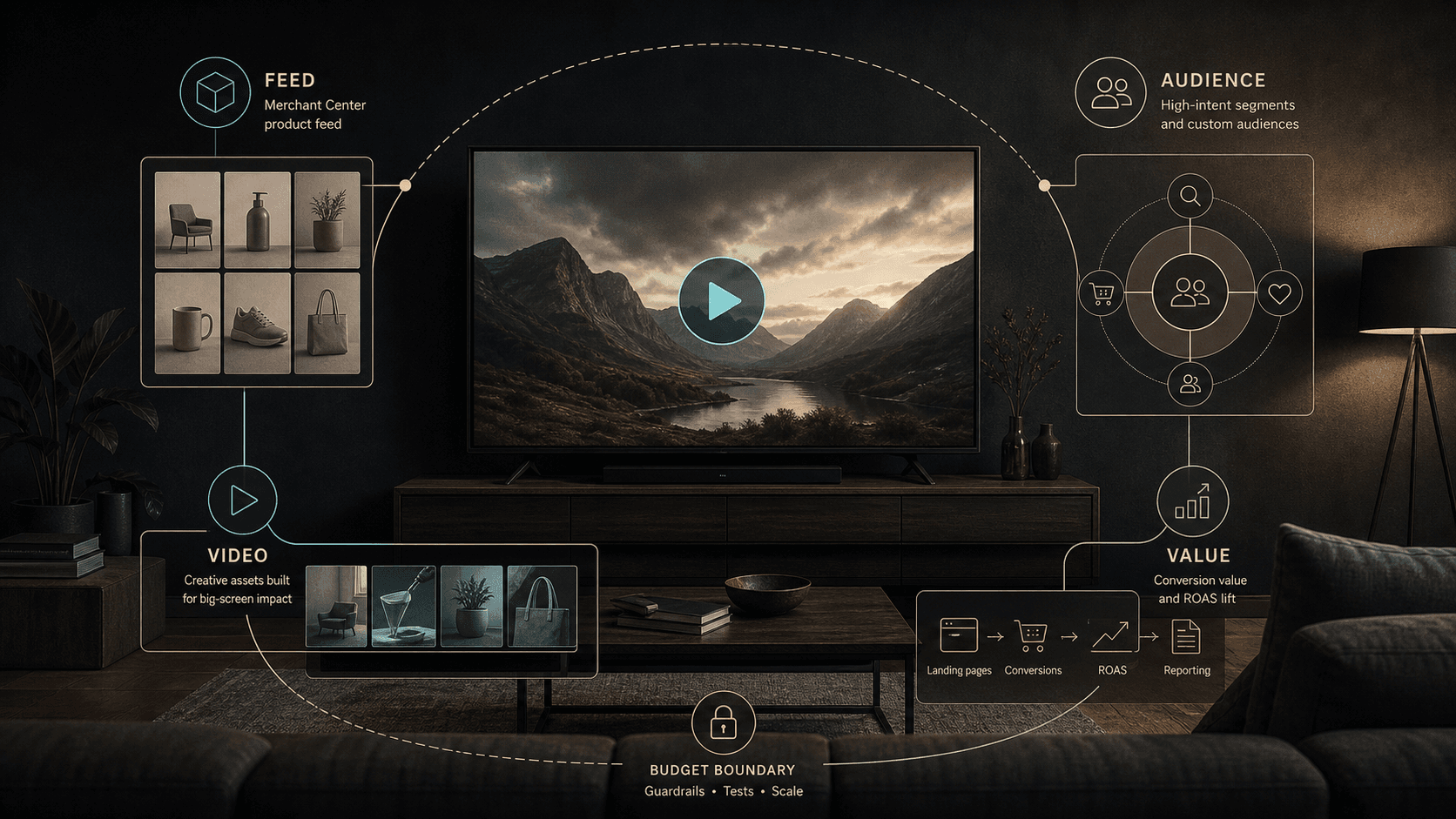
Illustrative concept graphic for shoppable CTV Demand Gen readiness, not a product screenshot.
Shoppable CTV readiness is whether you can see what the format starts: feeds, QR paths, conversion value, and CTV reporting before you scale Demand Gen TV spend.
Key takeaway
Retail leadership asks for shoppable CTV on the Q2 plan because the case study slide says incremental conversions. Google's January 2026 Demand Gen Drop says Demand Gen campaigns that include TV screens drive an average of 7 percent additional conversions at the same ROI in Google's internal testing. That number only helps if your account can see QR paths, product feed truth, and conversion value on the TV line item.
The reframe is visibility before scale. Shoppable CTV in Demand Gen and Performance Max lets viewers discover products on the big screen, often via QR codes, per Google's 2025 announcements. Readiness means Merchant Center health, video assets, audience fit, and reporting that can attribute what TV started. Parallel AI reads the connected account, writes the readiness sheet in a doc or spreadsheet, and drafts budget or feed notes for a person to approve.
Checked against current product behavior, account-review tools, and official Google materials so the explanation matches the real review process and live product boundaries.
- Google's GML 2025 roundup and Highlights of 2025 describe shoppable CTV with QR engagement across Demand Gen and Performance Max.
- Google's January 2026 Drop cites TV-screen Demand Gen campaigns driving incremental conversions at the same ROI in internal testing.
- Parallel's role stays limited to connected account review, finished readiness summaries, and drafted changes held for human approval.
The TV test gets credit in the weekly standup because views climbed. Finance asks which SKUs moved. The paid media lead realizes QR-assisted purchases land in a different conversion action than the deck assumes. Google's Highlights of 2025 describe shoppable CTV that lets viewers discover and engage with products from the big screen, including QR paths, across Demand Gen and Performance Max. The format is not the hard part. Seeing what it started is.
DEFINITION
Shoppable CTV
Connected TV commerce experiences described in Google's Google Marketing Live 2025 roundup and Highlights of 2025: viewers discover and engage with products on the big screen, often through QR codes, available across Demand Gen and Performance Max on CTV. Google's January 2026 Demand Gen Drop reports that Demand Gen campaigns including TV screens drove an average of 7 percent additional conversions at the same ROI in Google internal testing.
Google Ads Help: Google Ads Highlights of 2025
The tension is excitement versus proof. Shoppable CTV sounds like a scale lever. Your readiness question is narrower: can this account attribute TV-assisted product interest to feed rows, landing pages, and conversion value rules you trust? If not, the test can spend beautifully while teaching the team nothing.
Merchant Center product data specification guidance is blunt: incorrect price, availability, or identifier data causes disapprovals and weak ad performance. CTV magnifies that failure because the product moment is visual and immediate. A hero SKU with a broken link `[link]` or stale price `[price]` wastes both TV attention and bidder learning.
Video quality still matters. Google's Performance Four creative variety benchmark for Demand Gen expects horizontal, square, and vertical assets. CTV adds a living-room context where weak branding and unclear calls to action fail even when the feed is clean.
Include TV screen delivery in the test design explicitly. Google's January 2026 Drop cites incremental conversions when TV screens are in the mix; your account still needs a line item that shows whether QR paths produced product value.
Incrementality slides do not replace a visible QR-to-purchase path.
Once visibility is the gate, the readiness stack follows the same order every retail test should: catalog truth, creative fit, audience fit, then value read.
Illustrative TV test budget
$3,500/wk
Example cap for a 14-day CTV read.
Feed disapproval rate
<2%
Example Merchant Center threshold before scale.
Conversion value
Purchase
Primary value action for ROAS read.
Review window
14 days
Minimum before expand or stop.
In the illustrative example, a apparel brand runs shoppable CTV in Demand Gen at $3,500 per week with TV screens included. Merchant Center diagnostics show 4 percent of hero SKUs disapproved for image `[image_link]` size requirements under Google's product data specification. QR scans rise while purchase value flatlines because disapproved SKUs still appear in generic video fallback. Numbers are illustrative. The mechanism is clearing feed errors before reading TV ROAS.
Audience fit is the second gate. Prospecting audiences that work on Shorts may be too broad for living-room product scans. Hold scale when assisted conversions rise but purchase value per TV thousand impressions stays below your documented floor.
Reporting expectations should be written before launch. Google's Performance Four guidance says to account for conversion lag on Demand Gen. CTV paths can lag further through QR handoffs to mobile. A 7-day window may lie; a 14-day window with documented assumptions may still be directional only.
Assign one owner for Merchant Center fixes and one for creative revisions before scale debates begin. Split ownership prevents TV spend from continuing while catalog and video teams each assume the other surface is fine.
Review Merchant Center diagnostics and product feeds
With the proof stack named, the pre-scale list is about whether the account can see TV-started outcomes end to end.
Review product feeds and Merchant Center diagnostics for price `[price]`, availability `[availability]`, and link `[link]` integrity on SKUs featured in CTV creative.
Confirm video assets meet Demand Gen variety expectations and clearly show the products the feed will serve on QR paths.
Map conversion actions and values used for ROAS so QR-assisted purchases land in the same proof story finance expects.
Write the post-test read before launch: which SKUs must move, which ROAS floor must hold, and what lag window defines success. Without that script, the test ends in narrative instead of evidence.
- Clear Merchant Center disapprovals on hero SKUs before TV spend.
- Document QR-to-purchase path and lag assumptions.
- Set ROAS and conversion-value floors for the test window.
- Hold scale when TV views rise without visible product outcomes.
If you cannot see what TV started, you are not ready to scale it.
Test when feed, creative, audience, value tracking, and reporting visibility are ready together. Revise when product data, video assets, or landing paths weaken the QR story. Scale only when conversion value, ROAS, and asset performance support more TV budget for the full agreed window.
Scale when
- Merchant Center diagnostics are clean on featured SKUs for the test window.
- QR-assisted purchases appear in agreed conversion actions with stable value.
- ROAS or conversion value clears the documented floor after lag.
Revise when
- Feed disapprovals or price mismatches persist on hero products.
- TV views climb without product-level outcomes in reporting.
- The team cannot explain which SKUs TV started.
Shoppable CTV readiness is a natural Parallel AI workflow on connected Demand Gen accounts. The agent pulls campaign reports, conversion actions, Merchant Center notes your team tracks, and asset performance, then writes the readiness and post-test summary in a doc or spreadsheet with test, revise, or scale rows. If the call is to cap TV spend or fix feed priorities, it drafts that note and waits for a person to approve it. TV incrementality claims without SKU-level visibility become faith-based budget fights. See for another feed-first launch pattern. On Monday morning, open CTV-line performance alongside Merchant Center diagnostics, list any hero SKU still disapproved, and send one test, revise, or scale line to ecommerce and finance before anyone raises TV budget.
Google documentation
Google's highlights page for shoppable CTV, Smart Bidding Exploration, and recent launch context.
Google's Demand Gen reference for campaign scope and creative context.
Google's product data reference for feed quality and item requirements.
- Demand Gen for B2B and Ecommerce: Diagnose Quality Beyond CTRHelpful when CTR looks strong but B2B pipeline or ecommerce ROAS tells a different story.
- Demand Gen Travel Feeds Setup: Hotel Center Readiness Before LaunchFor hospitality teams where travel campaigns fail upstream in feeds, not downstream in creative.
- Merchant Center Video Hub for Google Ads: Ecommerce Prep GuideFor ecommerce teams with video libraries that outrun hero SKU coverage in live campaigns.
- Non-Skippable Video Reach Campaigns: When CTV Teams Should TestFor CTV and YouTube teams deciding whether non-skippable Video Reach deserves a guarded format test.