

Travel Feed Readiness
Demand Gen Travel Feeds Setup
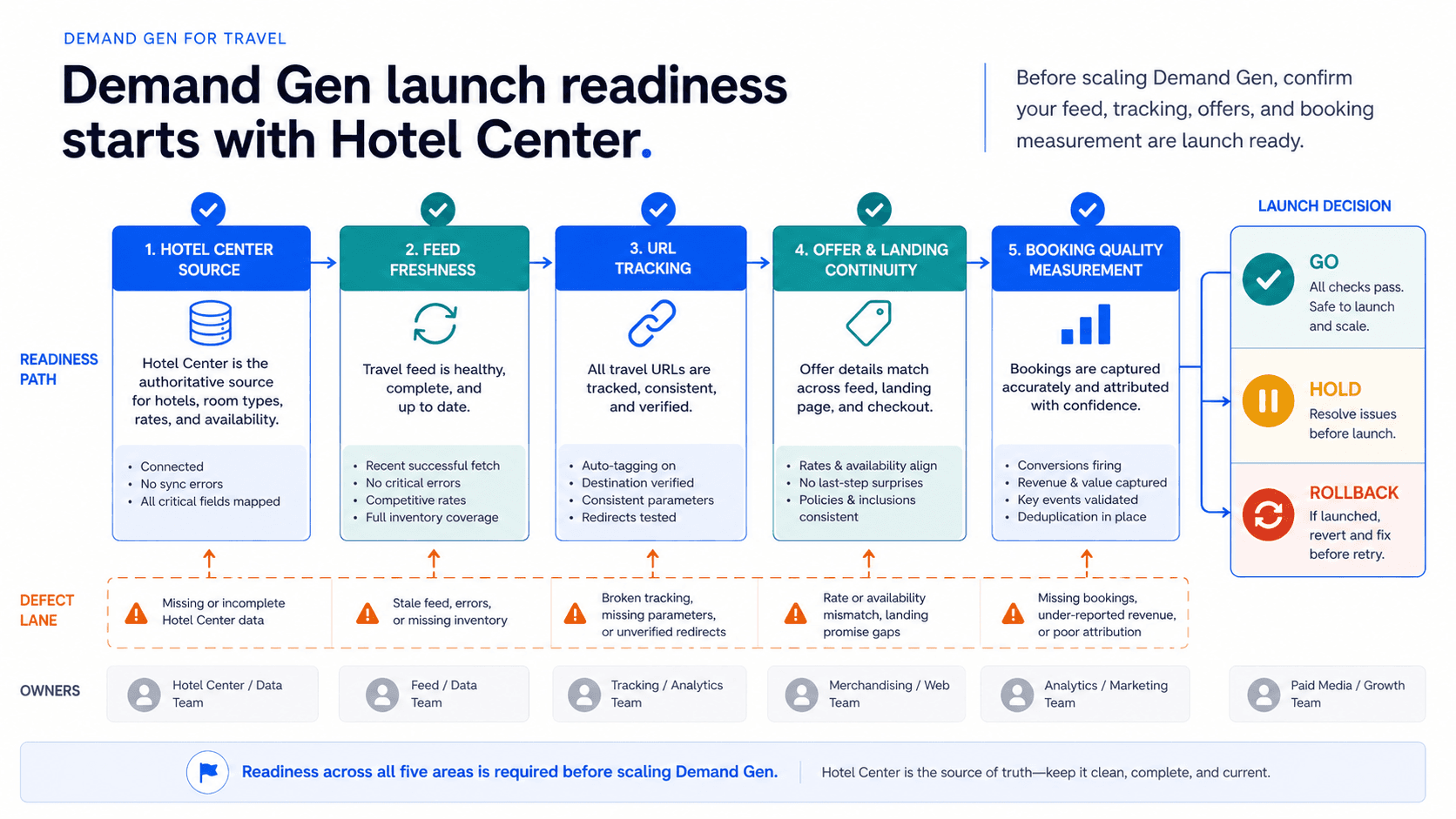
Illustrative concept graphic for Demand Gen travel-feed Hotel Center readiness, not a product screenshot.
Travel feeds fail in Hotel Center long before they fail in Demand Gen. Fix link state, price, availability, and booking measurement at the source first.
Key takeaway
The paid media lead launches Demand Gen with Travel Feeds enabled while Hotel Center still shows stale rates from Tuesday. Google's January 2026 Demand Gen Drop says Travel Feeds connect a Hotel Center feed to build dynamic video ads with hotel pricing, ratings, and availability. The campaign did not break first. The feed did.
The reframe is source-first readiness. Hotel Center link state, feed freshness, price and availability accuracy, URL tracking, and booking measurement must pass before budget expands. Parallel AI reads linked product context from the connected account, writes the readiness checklist in a doc or spreadsheet, and drafts campaign or feed notes for a person to approve.
Checked against current product, pricing, trust, and official Google materials so the explanation stays tied to the live product and current Google Ads context.
- Google's Demand Gen Drop documents Travel Feeds via Hotel Center for dynamic video with pricing, ratings, and availability.
- Readiness was mapped to link state, feed freshness, offer continuity, URL tracking, booking measurement, owners, and rollback rules.
- Parallel's role stays limited to connected account review, finished launch notes, and drafted changes held for human approval.
Week one of the travel launch shows strong video engagement and weak bookings. The creative team wants new assets. The feed owner finds expired rates on twelve properties. Google's January 2026 Demand Gen Drop describes Travel Feeds that connect Hotel Center to Demand Gen for dynamic video with pricing, ratings, and availability. That sentence hides the dependency: the video is only as honest as yesterday's feed row.
DEFINITION
Travel Feeds in Demand Gen
A Demand Gen feature announced in Google's January 2026 Drop that connects a Hotel Center feed to build dynamic video ads featuring hotel pricing, ratings, and availability. Google's Hotel Center Help covers hotel inventory and account setup. Demand Gen campaigns otherwise run across YouTube, Discover, Gmail, and Display under the YouTube Performance Four framework.
Google Ads & Commerce Blog: Demand Gen Drop January 2026
Campaign toggles feel like the launch moment. For travel, the launch moment is when the feed, link, and booking tag were already true. A dynamic ad that shows Friday's price on a sold-out room trains Smart Bidding on clicks that cannot convert. The paid media dashboard blames creative. The defect lived in availability.
Cross-system ownership is the hard part. Hotel revenue management owns rates. Analytics owns booking confirmation events. Paid media owns the campaign switch. Without a shared readiness doc, each team can pass its local check while the connected system still fails.
Rollback rules belong in the same doc as launch criteria. If booking measurement drops or price mismatch tickets spike, the campaign should narrow or pause while Hotel Center fixes land, not after a month of budget bleed.
Dynamic video makes stale rates visible fast. A five-star property showing Tuesday's rate on Friday erodes trust before Smart Bidding has enough honest conversions to learn.
Treat Hotel Center diagnostics like Merchant Center diagnostics for retail: a daily read while travel spend is live, not a launch-week checkbox.
Dynamic video cannot fix a stale Hotel Center row.
Once source-first discipline is agreed, the weekly review follows the feed truth chain from Hotel Center to the booking event.
Google's Performance Four guidance for Demand Gen stresses data strength as the first performance multiplier. Travel feeds add catalog strength to that list. Incorrect or missing hotel data creates the same learning poison as a broken conversion action: the bidder optimizes toward offers that cannot close.
Illustrative math: a campaign spends $6,000 in a 7-day window with a 2.8 percent click-through rate and a 0.4 percent booking rate against a 1.2 percent historical site average. The video assets are unchanged from prospecting. Feed diagnostics show 18 percent of properties with availability conflicts. Numbers are illustrative. The mechanism is fixing source rows before rewriting creative.
Offer continuity means the hotel name, star rating, price, and dates in the ad match the landing experience. Travel shoppers punish mismatch faster than generic ecommerce shoppers. One broken chain poisons trust for the whole campaign read.
Property-level reporting beats campaign-level averages for travel. A handful of flagship hotels can carry the row while long-tail properties leak bookings silently in the feed.
Hotel sales teams often spot rate conflicts before dashboards do. Include them in the weekly readiness read while dynamic offers are live.
Where travel-feed failures usually start.
| Symptom in Demand Gen | Likely upstream surface | What to verify |
|---|---|---|
| Strong views, weak bookings | Hotel Center availability | Sold-out rooms still advertised, date rules, min stay |
| High CTR, low conversion rate | Price mismatch | Feed rate versus checkout rate, taxes and fees |
| Tracking gaps in reports | URL parameters and tags | Landing URL template, gclid or gbraid capture |
| Asset disapprovals or generic hotels | Link state and property mapping | Hotel Center to Google Ads link, property IDs |
Confirm Hotel Center link and feed status
With the feed truth chain mapped, the pre-launch review is a short sequence any owner can rerun after feed edits.
Confirm Hotel Center and Google Ads link state for the properties in scope. A broken link can leave campaigns running on cached or partial inventory.
Review feed freshness and price and availability rules after every revenue management push. Launching on Monday with weekend stale data is a recurring failure mode.
Check travel URL tracking and booking conversion actions before spend expands. Demand Gen lag is real; missing tags are not lag.
Schedule feed audits after revenue management pushes, not only at launch. Travel catalogs change daily; a Monday launch on stale weekend inventory is a recurring failure mode.
Document which property IDs are in scope for week one. Expanding to the full chain before source health is proven repeats the same failure at larger spend.
- Verify link state and property mapping in Hotel Center.
- Audit price, availability, and landing-page continuity.
- Confirm booking measurement and attribution windows.
- Name defect owners and rollback triggers in writing.
A green campaign switch is not proof the feed was green.
Launch when link state, feed freshness, tracking, and booking measurement are ready together. Stay narrow when one source needs close monitoring after a partial fix. Hold or roll back when feed, tracking, or booking data cannot be trusted for the spend level on the calendar.
Launch when
- Hotel Center link, feed freshness, and offer continuity pass the same-day check.
- Booking conversion actions fire in test paths with correct values.
- Owners for feed, tracking, and campaign budget are named in the readiness doc.
Roll back when
- Availability or price mismatches persist after revenue management updates.
- Booking volume in reports diverges from property management confirmations.
- Nobody owns Hotel Center fixes versus creative tests.
Travel-feed launches are a coordination job Parallel AI handles well on connected accounts. The agent pulls campaign settings, conversion actions, and launch notes, attaches Hotel Center readiness checks your team documents, and writes the go, narrow, or rollback recommendation in a doc or spreadsheet. If the decision is to pause spend or narrow properties, it drafts that change and waits for a person to approve it. Campaign postmortems without feed timestamps repeat the same Tuesday rate bug. See for proof splits by business model. On Monday morning, open Hotel Center diagnostics and booking conversion trends together, log any price or availability conflict, and send one launch, narrow, or hold line to revenue management and paid media before anyone raises daily budget.
Google documentation
Google's Demand Gen reference for campaign scope and creative context.
Google's Hotel Center Help surface for hotel inventory and account setup context.
- Google Ads AI Agent for Ecommerce: Search Terms, Shopping, and PMax ReviewFor when Search, Shopping, Merchant Center, and Performance Max need one ecommerce review instead of separate meetings.
- Demand Gen for B2B and Ecommerce: Diagnose Quality Beyond CTRHelpful when CTR looks strong but B2B pipeline or ecommerce ROAS tells a different story.
- Direct Offers in AI Mode: Retail Pilot Readiness for Google AdsFor ecommerce teams testing Direct Offers when economics and feeds must keep the public promise.