

Retail Pilot
Direct Offers in AI Mode
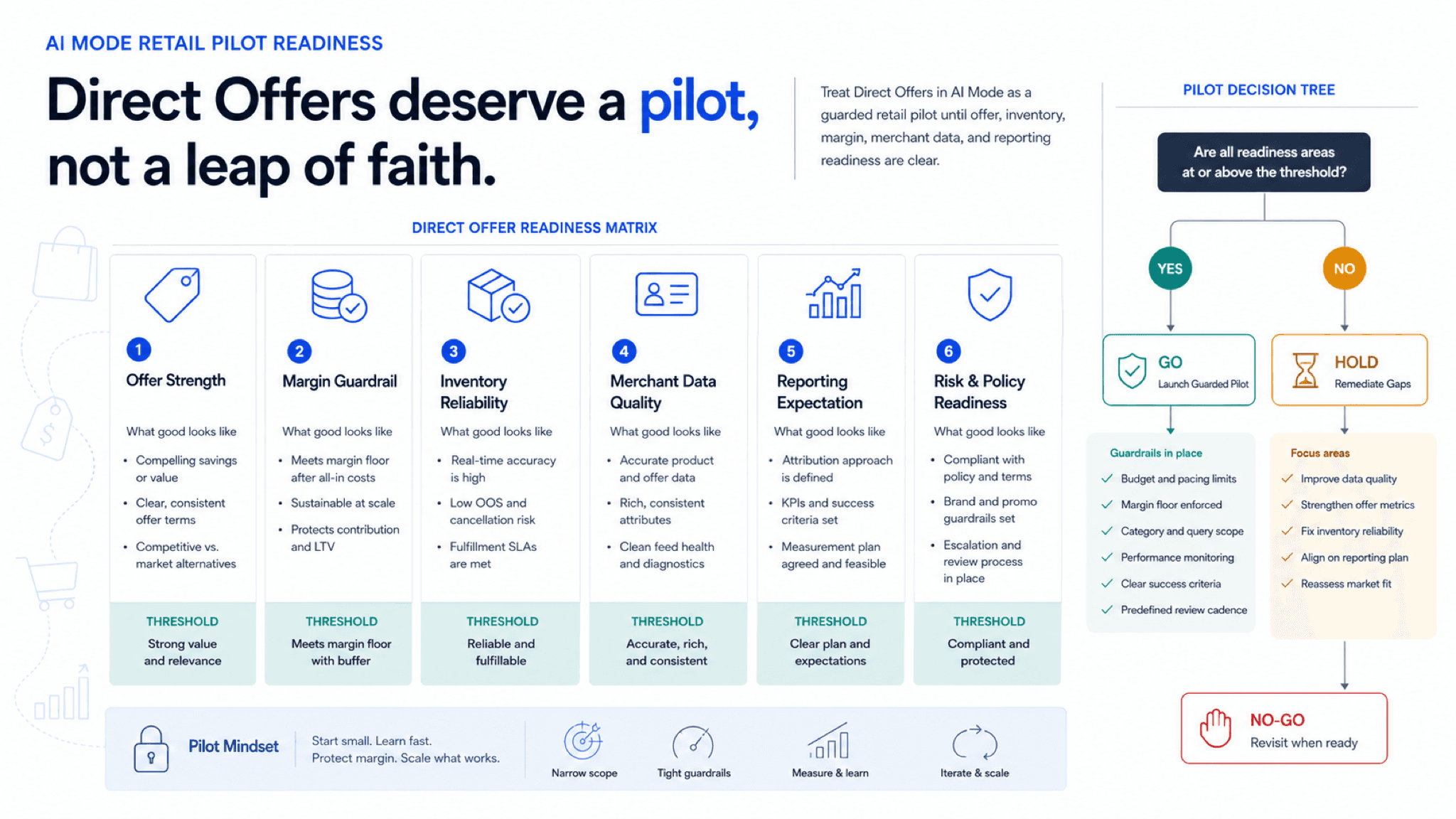
Illustrative concept graphic for Direct Offers in AI Mode retail pilot review, not a product screenshot.
Direct Offers put the deal inside the AI Mode answer. Readiness is whether margins, inventory, and the product feed can keep that promise before pilot budget moves.
Key takeaway
The ecommerce lead wants Direct Offers live because the AI Mode demo looked compelling, and finance has not yet modeled what a tailored discount inside an answer does to margin on hero SKUs. Google's digital advertising and commerce 2026 post describes Direct Offers in AI Mode as a way for businesses to share a tailored offer with a shopper ready to buy without changing what they offer everyone else, with expansion toward loyalty benefits and bundles. That is the tension: the deal moves inside the answer, so feed rows, promo rules, inventory, and landing pages must keep the promise visible to everyone else too.
The reframe is promise integrity, not pilot excitement. Direct Offers put the deal inside the answer. Readiness is whether margin guardrails, Merchant Center or product feed accuracy, inventory reliability, ownership, and reporting expectations can keep that promise under scrutiny. Parallel AI reads the connected Google Ads account, writes the pilot review in a doc or spreadsheet, and drafts campaign or offer notes for a person to approve.
Checked against current product, pricing, trust, and official Google materials so the explanation stays tied to the live product and current Google Ads context.
- Google's 2026 commerce post supplies Direct Offers concept language; rollout, eligibility, and setup detail should be verified against current Google documentation and the live account.
- Offer economics, merchant data, inventory, margin, landing paths, and reporting expectations were treated as joint gates before go, hold, or no-go recommendations.
- Parallel's role stays limited to connected account review, finished pilot notes, and drafted changes held for human approval.
Site-wide promos hide inconsistency because shoppers forget the path they took. Direct Offers embed the deal inside an AI Mode answer per Google's commerce announcements. The shopper sees one tailored promise in the most visible moment. Your product feed, sale price attributes, and landing page must match that promise or the pilot trains distrust faster than it trains conversion.
DEFINITION
Direct Offers in AI Mode
A commerce experience described in Google's 2026 advertising and commerce materials where businesses can present a tailored offer inside AI Mode when a shopper is ready to buy, without changing the public offer for everyone else. Google's public language emphasizes closing the sale at the moment of intent. Rollout, categories, and setup paths remain limited in public documentation and should be verified before scale.
Google Ads & Commerce Blog: Digital advertising and commerce in 2026
Margin guardrails come first. A direct offer inside an answer is still a discount decision. Finance should sign the floor for hero SKUs before marketing signs the pilot brief. Google's blog language mentions expansion toward loyalty benefits and bundles; each variant adds accounting and feed complexity.
Merchant Center and primary feed rows are the truth layer. Price, availability, sale price effective dates, and bundle contents must align with what the offer shows in AI Mode and what the landing page delivers after the click. A mismatch that might survive on a long-tail query becomes a screenshot in a client Slack channel when the offer is featured.
Inventory reliability matters because AI Mode moments spike short windows. A direct offer on a SKU that stockouts in two days burns more trust than a Display promo that few people noticed.
Illustrative math: a pilot offers twelve percent off three hero SKUs inside AI Mode while the primary feed still lists last week's sale price on one SKU. Conversion rate on pilot traffic looks strong for seven days while support tickets about price mismatch rise forty percent and blended margin falls two points. Numbers are illustrative. The mechanism is promise drift under spotlight traffic.
Where Google's public posts do not document setup or eligibility for your market, treat Direct Offers as a guarded pilot with explicit rollout caveats rather than a production budget line.
A compelling offer with a wrong feed row is worse than no pilot.
Once promise integrity is the frame, the pilot exists to learn whether Direct Offers close incremental sales, not to prove the team was early.
Write what the pilot can prove before launch: incremental conversion value on named SKUs, offer take rate, margin impact, or support load. Also write what it cannot prove in four weeks so leadership does not treat a directional test like a channel forecast.
Go, hold, and no-go criteria should fit on one page. Go when economics, inventory, feed accuracy, ownership, and reporting align. Hold when the surface is promising but measurement or margin risk is unclear. No-go when the pilot cannot answer a useful retail question without overclaiming rollout availability.
Parallel the public offer story. Direct Offers are described as tailored without changing what you offer everyone else. Operationally that means promo rules, feed attributes, and site merchandising still agree when the pilot ends.
Client-facing decks should repeat the same caveat Google uses in public posts: rollout is limited, categories vary, and a strong pilot on three SKUs is not proof the offer belongs in every AI Mode session next quarter.
Support and merchandising should join the weekly pilot read so price mismatch tickets surface before finance sees margin drift.
Pilot gates mapped to owners.
| Gate | Evidence | Owner |
|---|---|---|
| Margin floor | Contribution margin by hero SKU | Finance and ecommerce lead |
| Feed truth | Primary feed price, sale price, availability | Merchandising or feed owner |
| Landing path | Checkout or cart continuity from offer click | CRO and paid media lead |
| Reporting plan | What the pilot can and cannot prove | Analytics lead |
Review Merchant Center diagnostics and primary feed attributes
With promise integrity as the frame, the pre-pilot review is a short commercial gate.
Review offer strength, margin floor, inventory reliability, and primary feed accuracy for every SKU in the pilot scope.
Confirm landing path, checkout or cart continuity, ownership, and reporting expectations for the pilot window.
Define go, hold, or no-go criteria and what incremental outcome would justify more budget.
Document rollout caveats when Google's public documentation does not confirm eligibility or setup for your market.
- Sign margin floors before offer copy.
- Match feed rows and landing pages to the pilot offer.
- Cap pilot budget and duration in writing.
- Separate learning goals from scale forecasts.
Pilot enthusiasm without a no-go rule becomes a permanent discount habit.
Go when offer economics, inventory, merchant data, landing paths, ownership, and reporting expectations are ready for a bounded pilot. Hold when the surface is promising but margin, measurement, or feed risk is still unclear. No-go when the pilot cannot answer a useful retail question or public availability details does not match account access.
Go when
- Margin floor, feed accuracy, and inventory coverage hold for pilot SKUs.
- Landing paths and promo rules match the offer shown in AI Mode.
- Go, hold, and no-go criteria plus reporting owners are written before spend.
No-go when
- Hero SKUs show feed, price, or availability drift during prep.
- Nobody owns support, finance, and merchandising escalation paths.
- Leadership expects full-channel scale from a rollout-limited pilot.
Direct Offers pilot review is a connected-account workflow Parallel AI handles well. The agent pulls campaign performance, conversion value, product-level notes, and change history from the connected Google Ads account, pairs that with feed and margin assumptions your team documents, and writes go, hold, or no-go rows in a doc or spreadsheet the ecommerce and paid media leads share. If the call is to pause a promo, narrow SKU scope, or draft a feed fix note, it waits for a person to approve that change. Early pilots without margin floors recreate the same finance review every month. See for adjacent commerce presentation discipline. On Monday morning, open feed diagnostics and pilot SKU performance together, log any price or availability mismatch against the live site, and send one go, hold, or no-go line before anyone raises pilot budget.
Google documentation
Google's commerce and advertising update context for emerging retail surfaces.
Google's AI Mode commerce context for shopping experiences.
- AI Overviews and AI Mode Ads: Reporting Limits in Google AdsFor teams writing client updates when AI Overview and AI Mode placement reporting stays aggregated.
- Google Ads AI Agent for Ecommerce: Search Terms, Shopping, and PMax ReviewFor when Search, Shopping, Merchant Center, and Performance Max need one ecommerce review instead of separate meetings.
- Merchant Center Video Hub for Google Ads: Ecommerce Prep GuideFor ecommerce teams with video libraries that outrun hero SKU coverage in live campaigns.