

Campaign Quality
Demand Gen for B2B and Ecommerce
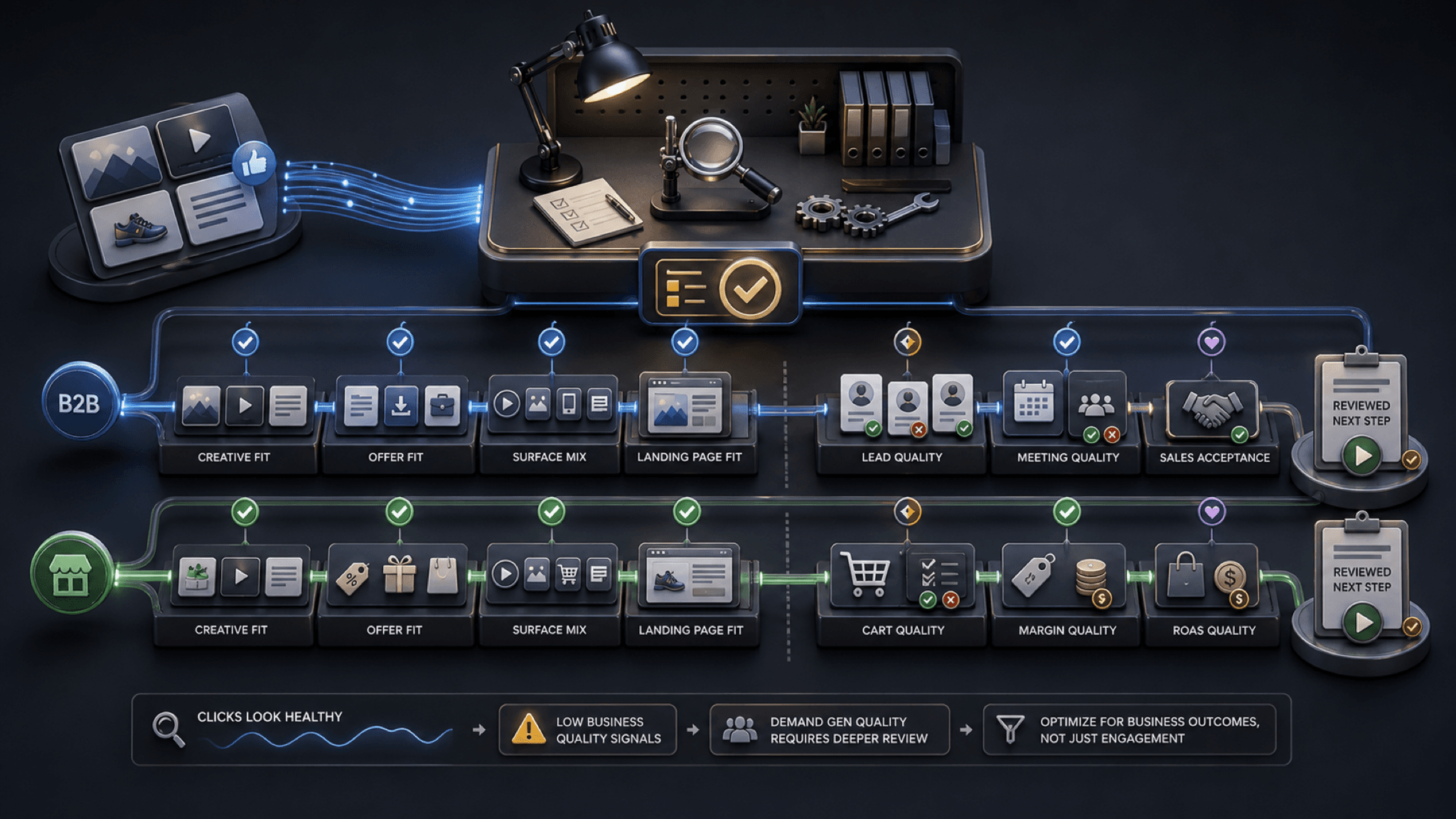
Demand Gen B2B and ecommerce quality graphic for proof-horizon scorecards.
Ecommerce can prove Demand Gen results this week; B2B has to design for the proof gap. Separate scorecards by proof horizon before anyone scales on CTR.
Key takeaway
The same Demand Gen dashboard can look healthy for two business models that need opposite conclusions. Ecommerce can often tie clicks to purchase value within a 7-day window when product feeds, Merchant Center links, and purchase conversion actions are clean. B2B frequently waits weeks between click and qualified pipeline, which means CTR and cheap CPC can look fine while sales acceptance quietly weakens. The reframe is proof horizon: how quickly this business model can validate that spend bought something worth scaling.
Google's YouTube Performance Four guidance for Demand Gen warns to account for conversion lag and to evaluate trends over longer stretches, not yesterday's incomplete data. That advice lands differently when your proof arrives in days versus quarters. Ecommerce teams should anchor on revenue quality, ROAS, product feed fit, and landing-page match. B2B teams should anchor on lead quality, sales acceptance, assisted conversions, and invalid lead rate. One scorecard cannot serve both. Parallel AI reads the connected account, writes separate B2B and ecommerce quality notes in a doc or spreadsheet, and drafts budget or creative changes for a person to approve.
Checked against current product, pricing, trust, and official Google materials so the explanation stays tied to the live product and current Google Ads context.
- Google's YouTube Performance Four evaluating-performance section names conversion lag and day-to-day volatility as normal Demand Gen behavior.
- Google's January 2026 Demand Gen Drop and case-study context supply campaign-quality benchmarks without replacing first-party CRM or purchase data.
- Parallel's role stays limited to connected account review, separate business-model write ups, and drafted changes held for human approval.
Friday's QBR opens on a Demand Gen slide with rising CTR and falling CPC. Ecommerce nods. B2B smiles politely because their CRM will not tell the truth for three more weeks. Both teams are reading the same chart. Only one team can validate it on time.
DEFINITION
Proof horizon
How long after a Demand Gen click this business model can validate useful outcomes. Ecommerce with clean purchase tracking can often judge revenue quality within days. B2B with long sales cycles must govern through conversion lag, assisted conversions, and CRM feedback instead of same-week platform conversions alone.
Google Ads Help: The YouTube Performance Four
Google's Performance Four guidance says to expect intrinsic volatility and to review performance over longer stretches rather than single days. For ecommerce, longer stretches might mean 7 to 14 days of purchase value and ROAS. For B2B, longer stretches might mean 30 to 60 days of lead grade movement, invalid lead rate, and pipeline creation. The platform metric updates daily. The business proof does not.
The January 2026 Demand Gen Drop highlighted case-study outcomes such as LG Electronics reporting higher conversion rate and lower CPA versus paid social in Google's published summary. Case studies prove what is possible. They do not replace your CRM or Merchant Center truth. Proof horizon work is writing which signal decides scale for each business model before the campaign launches.
Creative fit still matters for both models even when scorecards split. A strong B2B offer with weak form friction shows up in invalid leads. A strong ecommerce promo with weak feed coverage shows up in product-level ROAS drift before campaign CPA moves.
Shared CTR is a weak shared scorecard when proof arrives on different calendars.
B2B Demand Gen fails quietly when teams scale on platform conversions that sales would not accept. The proof gap is the weeks between click and qualified opportunity. Governance lives in that gap.
The illustrative B2B example: CPA holds at $52 while invalid lead rate rises from 8 percent to 14 percent in the CRM export over four weeks. Platform conversions still look stable because the form fill fires on time. The proof gap hid quality erosion until sales complained. The fix is not pausing Demand Gen by default. It is holding budget until lead grade and assisted conversion patterns match the pre-scale baseline.
Ecommerce's illustrative mirror: ROAS holds at 3.2 on a 7-day view while hero SKU feed disapprovals rise in Merchant Center. CTR can stay pretty while product coverage shrinks. Ecommerce proof arrives faster, which means feed and landing-page checks should run weekly, not monthly.
Agency pods running both models in one MCC should split the client update, not blend headlines. B2B gets lag language and pipeline caveats. Ecommerce gets purchase value and feed language. The account may be shared; the proof horizon is not.
B2B versus ecommerce quality signals on Demand Gen.
| Signal | B2B emphasis | Ecommerce emphasis |
|---|---|---|
| Primary proof | Lead quality, sales acceptance, pipeline | Purchase value, ROAS, product feed fit |
| Typical review window | 30 to 60 days with lag noted | 7 to 14 days when purchase tracking is clean |
| Early warning metric | Invalid lead rate, assisted conversions | Cart abandonment, product-level ROAS drift |
| Scale trigger | Pipeline quality holds through lag | Revenue quality holds at target ROAS |
Once proof horizon is explicit, the weekly review splits cleanly. B2B and ecommerce each get checks matched to how fast they can validate results.
For B2B, pull lead quality, invalid lead rate, assisted conversions, and conversion lag beside CPA. Compare against the baseline from before the last audience or creative change. For ecommerce, pull purchase value, ROAS, product-level performance, and Merchant Center diagnostics beside CPA. Compare against the promo calendar and feed freshness.
For both, review creative fit, offer fit, and conversion action quality in the same window. Shared checks do not imply a shared scale rule. A hold on B2B can coexist with scale on ecommerce in the same account when proof horizons differ.
- B2B: lead grade, sales acceptance, pipeline, invalid leads, assisted conversions, lag.
- Ecommerce: purchase value, ROAS, feed fit, landing-page match, margin context.
- Both: creative fit, offer fit, conversion action quality, budget pacing.
- Write separate scale criteria before the weekly status meeting.
One blended Demand Gen scorecard hides which business model is actually working.
Scale B2B when pipeline quality and assisted conversion patterns support spend through the lag window you documented. Scale ecommerce when revenue quality, ROAS, and product fit support spend in the shorter window you documented. Hold either side when CTR improves but downstream proof does not.
Scale when
- B2B: lead quality and pipeline signals hold through the agreed lag window.
- Ecommerce: revenue quality and ROAS hold with clean feed and landing-page fit.
- Both: the scale rule was written before the campaign launched, not invented after a good CTR week.
Hold when
- CTR or CPC improved but CRM grades, invalid leads, or purchase value weakened.
- Conversion lag has not cleared and the team is debating scale from incomplete data.
- B2B and ecommerce share one scorecard even though proof horizons differ.
Demand Gen accounts that serve B2B and ecommerce at once are a natural Parallel AI workflow. The agent reads campaign performance from the connected account, drafts separate B2B and ecommerce quality sections in a doc or spreadsheet, and attaches the lag window and scale rule each side uses. If the call is to hold B2B spend while scaling a product line, it drafts those changes and waits for a person to approve them. Shared slides hide proof gaps when two business models share one CTR chart. See for upper-funnel measurement context. On Monday morning, open the Demand Gen campaigns by business model, write one proof sentence per side (what validates scale and by when), and send the split note to sales and ecommerce owners before anyone edits budgets.
Google documentation
Google's Demand Gen reference for campaign scope and creative context.
Google's Demand Gen update context for advertisers reviewing campaign quality.
- Attributed Branded Searches in Demand Gen: How to Use the MetricFor teams where brand search lift looks compelling but downstream proof is not ready yet.
- Demand Gen Asset Optimization Audit: Review Controls Before Weekly ScaleHelpful when creative reviews ignore the asset report and debate taste instead of spend concentration.
- Google Ads AI Agent for Ecommerce: Search Terms, Shopping, and PMax ReviewFor when Search, Shopping, Merchant Center, and Performance Max need one ecommerce review instead of separate meetings.