

Portfolio Visibility
Performance Max Channel Performance Audit
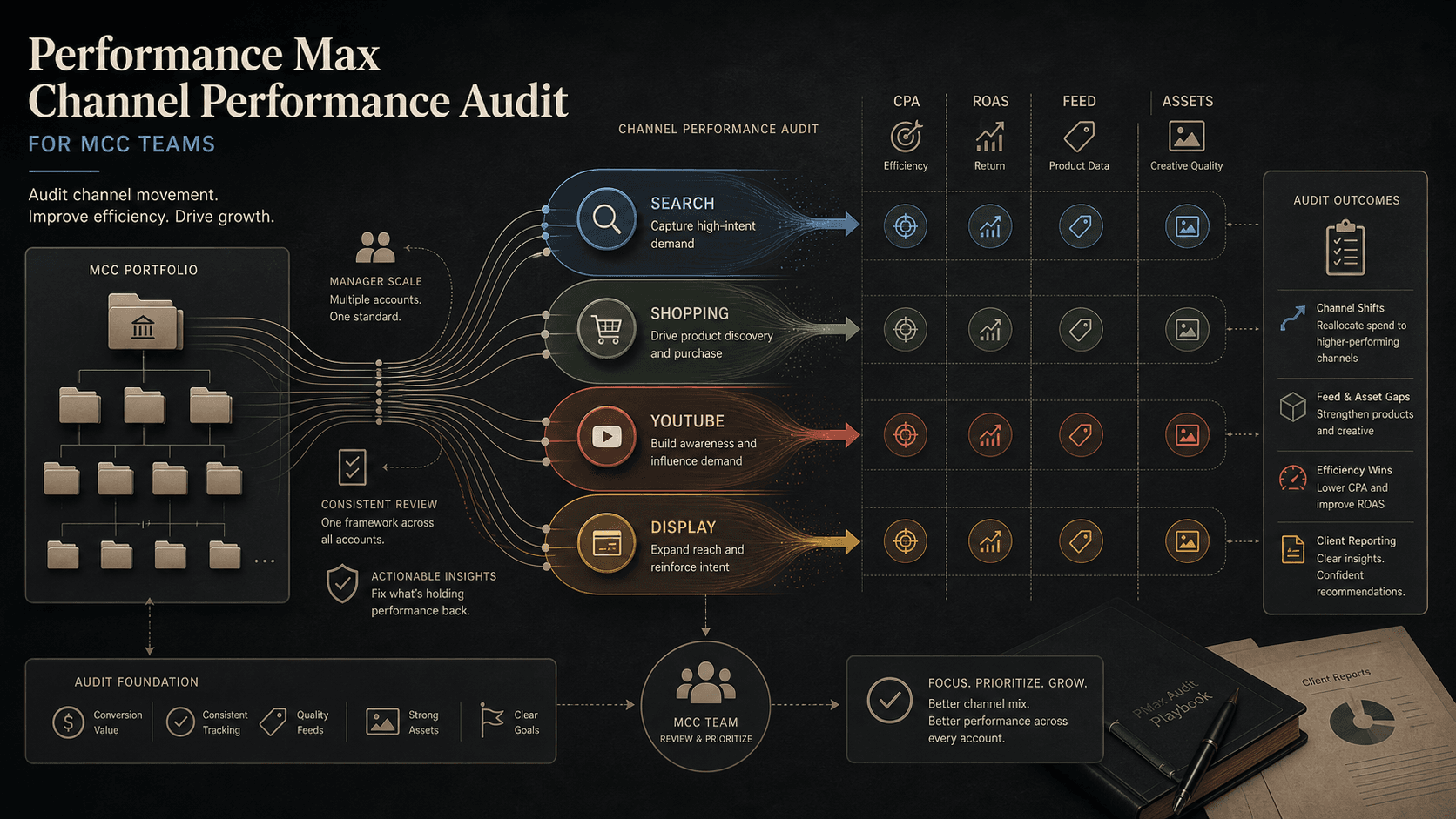
Graphic: Editorial guide to Performance Max channel performance audit.
At MCC scale the question is which accounts break the channel pattern, not what one campaign's pie chart says. This audit flags portfolio outliers before client decks overread them.
Key takeaway
Monday portfolio review, twelve PMax accounts, and every channel pie chart looks fine in isolation. Then you sort by deviation from the pod's median Shopping share and three accounts jump out. That is the manager account question: not what one campaign's channels look like, but which accounts break the pattern the portfolio already expects.
Google documents channel performance as a PMax reporting surface and manager accounts as the structure agencies use to review multiple clients. The audit combines them: establish the portfolio baseline, flag outliers, then route each outlier to account-level feeds, assets, or search terms before anyone recommends a budget move in the QBR deck.
Checked against current product, pricing, trust, and official Google materials so the explanation stays tied to the live product and current Google Ads context.
- Google's Performance Max Help page lists channel performance among reporting options intended to show how campaigns perform across inventory types.
- Portfolio comparisons grouped accounts by business model and feed dependency before channel outliers were escalated.
- Parallel's role stays limited to cross account summaries, finished client ready reviews, and drafted changes held for human approval.
The portfolio lead opens five PMax campaigns before coffee and each channel chart tells a plausible story. Retail client A is Shopping heavy. Lead gen client B is Search heavy. Nobody looks wrong until you ask the manager account question: which accounts diverged from the cohort they should resemble.
DEFINITION
Manager account (MCC) portfolio review
A review rhythm across multiple linked Google Ads accounts. Google's manager account documentation describes the structure agencies use to access and report on client accounts from one top level account. Channel performance reporting, documented for Performance Max, adds a channel-level view inside each child account.
Google Ads Help: About Google Ads manager accounts
Single campaign channel reads are seductive because they feel complete. Portfolio reads are messier and more honest. A ecommerce pod might normally run 55 to 65 percent Shopping share on feed driven PMax. When one account drops to 38 percent while CPA rises, that is an outlier worth account-level follow-up. When another account sits at 58 percent with stable ROAS, it is background noise even if the pie chart colors changed week over week.
The channel performance report is directional at every level. At MCC scale that limitation becomes an advantage if you stop asking it to explain clients and start asking it to sort them. Pattern first. Story second. Account owner third.
Agency pods already do this informally when they know which clients are feed heavy, which are lead gen, and which are hybrid. The MCC audit makes that informal knowledge explicit. Without cohort bands, every channel chart becomes an emergency and the standup never ends.
The portfolio question is who broke pattern, not what one chart says.
Once the question shifts to deviation, the math is plain even when the portfolio is large.
The illustrative portfolio has eight retail accounts with a median Shopping share of 61 percent. Three accounts sit between 58 and 64 percent. One account is at 47 percent with CPA up 18 percent. That account owns the Monday follow-up. The other seven do not need channel narration in the client deck this week. The numbers here are illustrative, but the shape is the one portfolio reviews keep finding: one real outlier, a cluster of normal variance, and a median that hides both.
Google's reporting tools let manager account teams pull performance views across linked accounts, but the interpretation still happens account by account. The MCC audit is a triage board: severity, likely surface, owner. Feed issue accounts route to Merchant Center diagnostics. Creative heavy drift routes to asset groups. Search heavy drift routes to search term insights. The portfolio meeting decides who gets time, not what the platform should do to everyone at once.
Client reporting benefits from the same discipline. A QBR slide that says Shopping rose 9 points across the portfolio sounds insightful until a client asks which account drove it and why. The outlier table answers that question with names, severity, and account-level next checks instead of a portfolio average that hid the real story.
Illustrative portfolio channel baseline by cohort (numbers are illustrative).
| Cohort | Typical Shopping share | Outlier trigger |
|---|---|---|
| Feed driven retail PMax | 55% to 65% | Shopping share below 45% or above 75% with CPA or ROAS drift |
| Lead gen PMax | 15% to 30% Shopping | Shopping share above 40% without lead quality support |
| Mixed catalog and services | Case by case band | Any channel moves more than 12 points from the account's own 8 week median |
| All cohorts | Directional only | Channel shift plus conversion value drop earns account review, not immediate target change |
Review PMax channel performance across linked accounts
With baselines set, the weekly MCC pass is a sorting exercise that protects client trust from overread charts.
Group accounts by business model, feed dependency, budget tier, and conversion volume before comparing channel percentages. A lead gen account will never share a retail pod's Shopping band. Comparing them directly creates false outliers every week.
For each true outlier, open the child account and check conversion value, CPA, ROAS, budget pacing, asset groups, feed status, and change history in the same window. The portfolio flag is only the door. Account evidence is still the room.
In house portfolio teams use the same method when business units share a manager account but not a business model. One unit's normal Search heavy mix is another unit's alarm. Cohort labels prevent the larger company from reacting to channel noise that is actually just different products sharing one login.
Refresh cohort bands after major seasonal events. Black Friday can move every retail account together and look like portfolio health when it is only calendar demand.
- Record median channel mix per cohort and refresh the band monthly or after major feed or creative launches.
- Flag accounts that cross the outlier trigger with severity: watch, investigate, or urgent.
- Assign one account-level owner and one next surface before the finding enters a client or QBR deck.
A portfolio outlier without an account owner is just an anxiety spike.
The failure mode at MCC scale is recommending budget or tROAS changes from aggregate channel movement. The fix is forcing every recommendation to cite account-level corroboration first.
Escalate to account review when
- Channel share deviates from the cohort band and conversion value, CPA, or ROAS moves with it.
- The outlier persists across two review windows while the rest of the pod stays stable.
- The client narrative would change if the channel shift is real and unexplained.
Keep at portfolio watch when
- The account moved inside its own historical band with stable efficiency metrics.
- The pod shifted together because of seasonality, promo calendars, or shared feed changes.
- Only the channel chart moved. Account level feeds, assets, and search terms still look clean.
MCC channel audits break when outlier notes live in twelve tabs and zero docs. Parallel AI compares PMax channel performance across connected accounts in a workspace, applies the cohort baseline your pod already uses, and writes the portfolio summary in a doc or spreadsheet with severity, owner, and account-level next checks. When an outlier justifies a target or budget draft, it prepares that change and waits for a person to approve it. That keeps the manager account meeting focused on which accounts deviated, not on re-reading pie charts aloud. See and . On Monday morning, sort PMax accounts by deviation from cohort median Shopping share, flag the three largest outliers, and assign account owners before the portfolio standup.
Google documentation
Google's documentation for channel-level visibility in Performance Max.
Official manager-account reference for agencies and teams managing multiple Google Ads accounts from one place.
Official Performance Max reference for campaign scope, inventory, goals, asset groups, and optimization context.
Official reporting reference for Report editor, predefined reports, saved reports, and manager-account reporting.
- Blog homeBrowse every published Google Ads guide from one editorial index.
- Google Ads AI agent: complete guideThe pillar guide covers the category definition, the adoption model, and where the agent fits real Google Ads work.
- ResourcesMove between the definition page, pricing, product walkthrough, and trust pages.
- About Parallel AISee the company mission, editorial standards, and operating principles behind the product.
- SecurityReview the public data-handling, account-connectivity, and approval-control framing used throughout the published guides.
- Author profileSee the background, specialties, and editorial responsibilities behind the published guides.
- Editorial reviewReview how pricing, trust, and capability claims are checked before public content ships.
- Performance Max Channel Reporting PlaybookHelpful when channel mix shifts every week and the team needs a routed follow-up instead of another dashboard debate.
- AI Tool for Multiple Google Ads Accounts: Reviews and ReportsFor agencies and portfolio teams comparing AI tools by pattern detection and approvable multi-account output.
- Google Ads AI Agent for Agencies: Reviews, Reports, and ControlsFor agencies that need a repeatable multi-account review and reporting model that cuts rework without loosening approvals.
- Performance Max Placement Audit: Find Waste and Lead-Quality DriftHelpful when placement visibility outruns lead quality answers and the team needs subtractive rules before exclusions ship.