

Agency Use Case
Google Ads AI Agent for Agencies: Reviews, Reports, and Controls
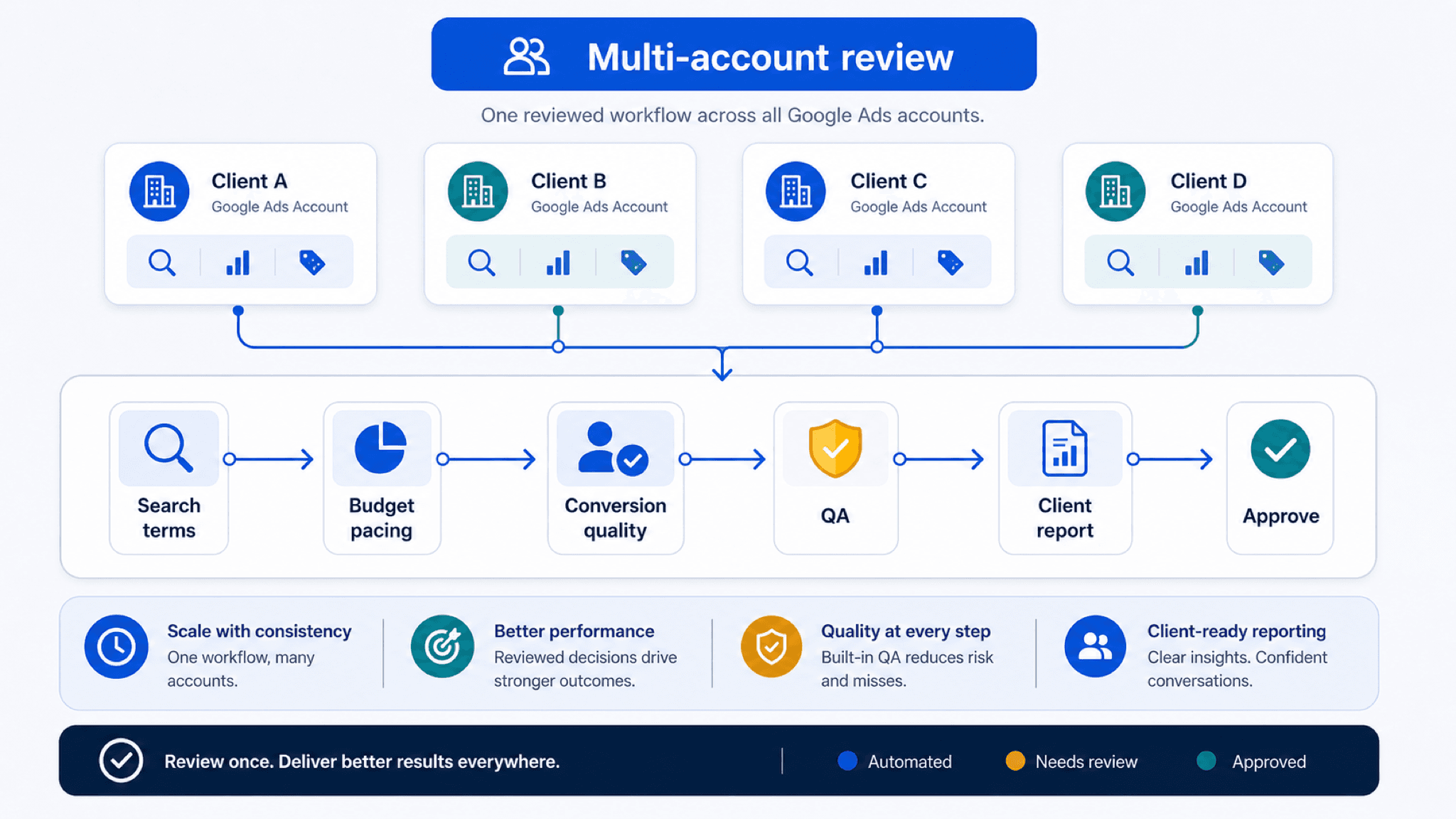
The agency gains leverage when the review is repeatable across account managers and still clear enough for a pod lead to approve.
See where agency margin actually leaks in Google Ads delivery, then standardize multi-account reviews, client-ready reporting, quality review, and approvals around that handoff.
Key takeaway
Agencies should evaluate a Google Ads AI agent around the weekly work that quietly absorbs margin: manager-account review, budget pacing, search term cleanup, Recommendations review, conversion-quality checks, client reporting, and quality control before any change affects spend or structure.
Parallel AI handles this kind of Google Ads work as an agent on the connected account: it runs the analysis, writes the report or spreadsheet, and drafts any account changes for a person to approve.
The real gain is not one more source of recommendations. It is a repeatable way to compare accounts, decide what matters, produce client-ready summaries, and keep approval notes coherent across a pod.
The right model is hybrid: use Google Ads manager accounts, Report editor, Recommendations, Smart Bidding, Performance Max, and AI Max inside the platform, then judge the agent by whether it can carry the write-up and handoff work those surfaces do not finish.
Checked against current product, pricing, trust, and official Google materials so the explanation stays tied to the live product and current Google Ads context.
- Measure the workflow at the pod level, not one teammate in isolation.
- Track rework and report-quality drift as carefully as raw cycle time.
- Seat and shared-account limits are treated as operating constraints, not just commercial details.
- Product fit here means real Google Ads jobs: review speed, shared reporting, and account changes that stay under human control, not generic AI helper claims.
Thursday at 4:43 PM, three client dashboards are technically done and none of the work that makes them usable is done. Spend is in, conversions are in, the account manager can see the budget spike in one account and the soft lead quality in another. What remains is the part an agency cannot turn into another billable block: deciding what matters, explaining it cleanly, and getting the pod to say the same thing in the deck, the email, and the next call.
That is why agencies need a different test for AI than in-house teams do. The campaign mechanics already live inside Google Ads: manager accounts, Report editor, Recommendations, Smart Bidding, Performance Max, and AI Max each handle part of execution or platform-native guidance. The margin leak shows up after that layer, when the team has to turn many account surfaces into one client-ready judgment.
Different account managers naturally handle that handoff differently. One person over-checks, another under-explains, a third ships a strong report with weak next steps. Delivery drift follows, especially when account load rises or staffing shifts. The agency is not really selling clicks in that moment. It is selling consistent interpretation under time pressure.
In agency work, the handoff is the job.
DEFINITION
Agency-grade workflow
A repeatable pod review path that carries portfolio context into standardized diagnosis, client-ready output, and explicit human approval on higher-impact changes.
Marketing reference
Once the real leak is clear, feature checklists get less interesting. Portfolio-level context matters because agencies do not experience Google Ads one account at a time. The Monday question is which account deserves the pod first, what connects the issues, and where the client conversation will get hard. A tool built for isolated prompts misses the agency shape of the work.
Standardized diagnosis matters for the same reason. The point is not to flatten judgment. It is to make sure the first pass across health checks, opportunity ranking, and action planning does not depend on which person happened to open the account first. Consistency is what lets a pod lead review the week instead of redoing it.
Client-ready output and human approval finish the standard. If the analysis still has to be rebuilt into a summary, recommendation pack, or review-ready report, the expensive work is still manual. If budget, bid, or structural changes can move without explicit signoff, the handoff gets faster and less safe at the same time.
If the output still needs a blank page, the handoff still is not done.
Google documentation·Google Ads Help
Google Ads passkeys for account protection
Use the official passkeys documentation when the discussion turns to account security, agency access, or MCC hardening.
Open passkeys helpOnce the handoff problem is named, the weekly blueprint stops looking like process theater and starts looking like risk control.
The table is simple on purpose. Most agency review chaos comes from hiding ownership in casual habits. If the health scan has no validating owner, priorities drift. If reporting prep has no final editor, client language drifts. If execution prep has no approving specialist, the queue becomes a suggestion pile.
A pod does not become repeatable because every step exists. It becomes repeatable because each step ends with one person who can accept, reject, or reshape the work before it moves on.
A repeatable pod is built from visible ownership, not shared optimism.
| Step | AI agent role | Human owner |
|---|---|---|
| Account health scan | Surface prioritized issues across the selected client pod | Pod lead validates priorities |
| Optimization planning | Draft ranked recommendations and likely next-step sequence | Account manager finalizes the plan |
| Execution prep | Package action items and dependencies into a review-ready queue | Specialist approves or executes |
| Reporting prep | Generate narrative summaries and tables for client or leadership review | Manager edits final client output |
From there, the best adoption metrics are delivery metrics before they are time metrics. Time-to-first-action matters because it shows whether the review turns into an approvable next step quickly. Rework rate matters more than teams expect because it reveals whether the pod is actually saving labor or simply moving cleanup from one role to another.
On-time report delivery rate, recommendation acceptance rate by account manager, and weekly throughput to a defined quality standard all ask the same question from different angles: can the agency ship the same level of judgment twice in a row, or is every cycle still dependent on the strongest person in the room. Speed without consistency is only a faster route to drift.
The useful metric is whether the second pod can ship the same quality as the first.
That logic lands hardest in client reporting. Most agencies already have enough charts. What burns the week is the write-up around them: explaining what changed, checking whether the explanation is accurate, and turning diagnosis into something a client or exec can read without another hour of cleanup. Reporting is where the handoff becomes visible because it forces the agency to translate account truth into commercial language.
A stronger workflow therefore does more than export metrics. It packages account context, movement summary, and recommended next steps into a draft another human can approve quickly. That is the line between a reporting surface and an agency system. One shows numbers. The other preserves the account story as it moves from analyst to manager to client.
The report is where agency margin either survives the week or leaks out of it.
Because reporting is where the handoff gets tested, rollout has to start where the agency can review the whole path, not just the easy parts.
01
Week 1: baseline and governance
Measure cycle times, define approval thresholds, and document what stays manual by design.
02
Week 2: pilot one pod
Run one standardized workflow across a representative account set and capture throughput and output quality.
03
Weeks 3-4: calibrate and expand
Refine the template, document the handoff rules, and expand to a second pod only after the first one is stable.
Scale the handoff only after one pod can hold it through a real client week.
That is why the pod, not the individual account manager, is the operating unit that matters. One shared workflow template for health checks, action ranking, and reporting prep gives the team one weekly account review and reporting process to hold everyone to. A shared KPI view and review cadence keep quality from drifting by personality or by whoever had the louder client last week.
Approval boundaries matter here as much as templates do. Before the agency expands beyond the pilot pod, budget, bidding, and structural changes need explicit thresholds for who reviews what. Otherwise the template scales faster than the judgment around it.
Standardization is real when a new week applies pressure and the line holds.
From there, the agency should distrust the first easy success. A workflow that makes one pod move faster may simply have matched the style of the strongest manager in that pod. The better test is whether a second pod can produce the same quality with the same template, review notes, and client-facing standards. If it cannot, the issue is not scale. It is that the handoff was never really standardized.
The review loop should compare more than task completion. It should compare whether recommendations are prioritized in the same way, whether reports and summaries still need the same amount of human cleanup, and whether pod leads are approving the same kinds of changes for the same reasons. Those are the signals that tell you whether the process can travel.
A workflow is portable when the second pod inherits it without a meeting.
That portability is what turns feature depth into staffing economics. A workflow that saves analyst time but increases pod-lead review load can still be a net loss because the cleanup has merely moved to a more expensive role. Agencies should model time recovered by role, not by total hours alone.
The same logic explains why a shared model matters only if new account managers can inherit it without weeks of retraining. The right workflow reduces rework on client-ready output, not just the time required to draft an internal recommendation. If every summary still depends on the same senior editor, the handoff has not narrowed. It has only become easier to start.
The expensive role still doing cleanup is where the margin leak lives.
Once staffing is part of the model, pod economics stop being abstract and become a map of where the handoff still breaks.
The owner-plus-specialist pod needs fewer context switches and less owner rewrite. The pod-lead-plus-account-managers shape needs delivery consistency across managers. A shared specialist bench needs handoff quality strong enough that specialists do not re-diagnose the same account from scratch. Each staffing shape is a different handoff problem wearing the same software label.
Leverage in the abstract is not the question. The question is whether the workflow fixes the handoff your actual staffing shape leaks time on.
One agency can call the same tool cheap while another experiences it as expensive because they are paying for different leaks.
| Pod shape | Where time comes back | What can still break |
|---|---|---|
| Owner + one specialist | Shared diagnostic reviews reduce context switching and keep reporting from falling back onto the owner every week. | If the owner still rewrites every summary, the workflow is not actually standardized yet. |
| Pod lead + account managers | The biggest win is delivery consistency across managers and faster quality control on recurring review cycles. | Review can become a new bottleneck if the review quality is inconsistent from one manager to the next. |
| Specialist bench shared across pods | Review-ready action packs make specialist time easier to allocate without re-diagnosing each account from scratch. | The model fails if handoff quality stays weak and specialists still rebuild the plan manually. |
Late in the rollout, this becomes the object to inspect: the delivery review itself. A real review includes one ranked account-health view for the pod, one client-ready narrative block that can survive manager review, and one clean record of what the pod lead changed or rejected. Those three elements tell you whether the judgment can move across the agency without being rebuilt.
This is where Parallel AI fits naturally for agency work. It works from the connected Google Ads account, finishes the review in docs, spreadsheets, and reports the pod can edit or send, and drafts higher-impact account changes that wait for a person to approve. That is not a cosmetic add-on. It is the review-to-client handoff made explicit.
If the client deck or weekly summary can travel without the person who created it, the handoff is finally working.
Most failures look obvious in hindsight. Agencies buy by feature list instead of pod-level day-to-day fit. They skip pod standardization and expect the tool alone to fix delivery drift. They remove human approvals too early on higher-impact changes because the first draft arrived quickly and feels persuasive. Or they roll the system account-wide before proving that one pod can use it consistently.
Those are all versions of the same mistake. The agency scales access before it scales judgment. When that happens, the handoff gets longer instead of tighter, and the extra software only makes the inconsistency easier to circulate.
On Monday morning, choose one live pod, run its weekly manager-account review from triage through the client summary, and mark every place the story still has to be rewritten by hand.
Google documentation
Official manager-account reference for agencies and teams managing multiple Google Ads accounts from one place.
Official reporting reference for Report editor, predefined reports, saved reports, and manager-account reporting.
Official reference for Google Ads Recommendations and how they use account history, campaign settings, and trends.
Official reference for using the search terms report to review which searches triggered ads and identify keyword or negative keyword updates.
Google's current business-learning reference for conversion quality, reporting reliability, and measurement setup.
Google's current documentation for AI Mode and AI Max built on broad match, Smart Bidding, and responsive search ads.
Official Smart Bidding reference for Google's automated bid optimization systems.
Official overview of AI Max for Search campaigns, including matching, creative, reporting, and controls.
Additional documentation
Practical review of which Google Ads AI features are safe starting points and which ones still require tighter human oversight.
Workflow-oriented comparison of native Google Ads editing and rule tooling versus a team-scale automation layer.
- Blog homeBrowse every published Google Ads guide from one editorial index.
- Google Ads AI agent: complete guideThe pillar guide covers the category definition, the adoption model, and where the agent fits real Google Ads work.
- ResourcesMove between the definition page, pricing, product walkthrough, and trust pages.
- About Parallel AISee the company mission, editorial standards, and operating principles behind the product.
- SecurityReview the public data-handling, account-connectivity, and approval-control framing used throughout the published guides.
- Google Ads AI Agent Pricing: Seats, Account Limits, and Total CostFor testing pricing against account load, team shape, day-to-day fit, and the manual hours still left after rollout.
- Google Ads AI Agent vs Manual Management: ROI Framework for PPC TeamsFor deciding whether an AI-assisted Google Ads workflow will fund the reviews manual management keeps deferring.
- Google Ads AI Agent for Ecommerce: Search Terms, Shopping, and PMax ReviewFor when Search, Shopping, Merchant Center, and Performance Max need one ecommerce review instead of separate meetings.
- AI Assistant for Google Ads Client Reports: Account Context and Client-Ready SummariesFor faster Google Ads client reporting with live account context and human review.
- Google Ads Copilot Alternatives: Native AI, PPC Platforms, Scripts, and AgentsFor buyers searching copilot alternatives who need the right category before comparing brands.