

ROI Framework
Google Ads AI Agent vs Manual Management: ROI Framework for PPC Teams
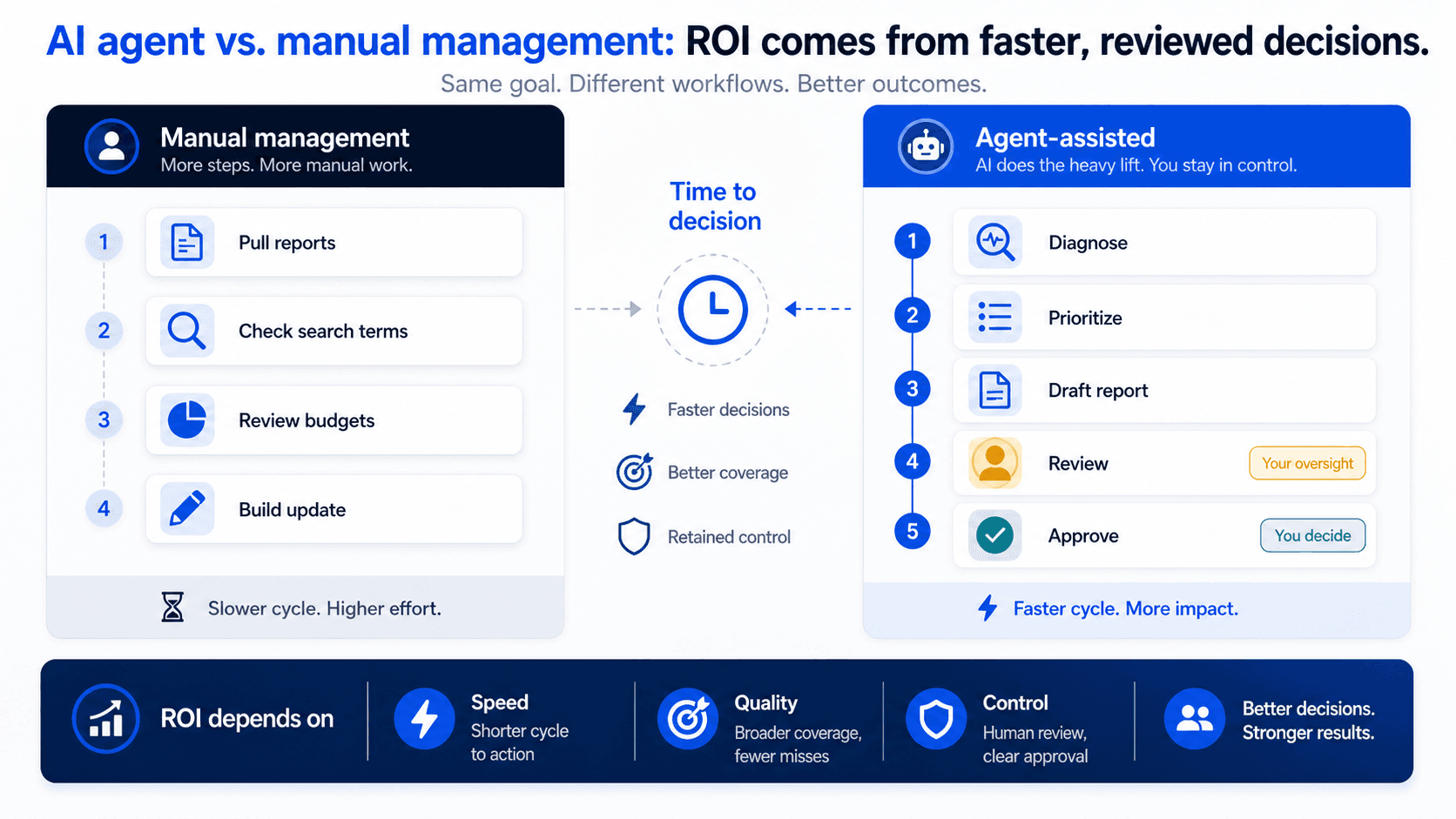
The model should use your own account load, labor cost, reporting cadence, and approval requirements.
Model Google Ads AI-agent ROI around the reviews you are skipping, the rework you keep paying for, and the approvals that still have to happen.
Key takeaway
The useful comparison is one recurring Google Ads review: a weekly account review across the search terms report, Recommendations, Change history, budget pacing, conversion actions, and client or leadership reporting. Manual management still wins for simple single-account work that is already being reviewed reliably.
Parallel AI is the AI agent platform for Google Ads work. Agencies and in-house teams hand off research, reporting, and optimization on connected accounts, and every account change the agent drafts waits for a person to approve it. Most tools in this category stop at recommendations. Parallel finishes the work in docs, spreadsheets, and reports a client or a lead can act on.
AI-assisted management becomes interesting when the same review keeps getting deferred because diagnosis, prioritization, summary writing, and approval notes consume more time than the team has available. In that case, the ROI is not speed on work already done. It is coverage on work that never consistently happened.
The decision should come from a 14-30 day pilot that compares manual baseline time, reporting rework, review quality, approval speed, and software cost against the same account set.
Checked against current product, pricing, trust, and official Google materials so the comparison, buying guidance, and fit criteria stay current and defensible.
- Measure manual baseline time before the pilot starts.
- The same workflow set runs in both the manual and AI-assisted periods.
- Include quality and rework cost, not just hours saved.
- A strong fit combines commercial judgment, human review, and reporting teams can share rather than only surfacing automation ideas.
Friday afternoon, the search terms report is still open from Tuesday and nobody is going back into it. Nothing exploded. The week just ran out of room. That is the manual-versus-agent decision in its most honest form: not whether a team can work faster in theory, but whether the important review actually happens before the week closes.
DEFINITION
Recurring account review
A repeatable Google Ads review that checks account context before action: search terms, Recommendations, Change history, budget pacing, conversion actions, reporting outputs, and the approvals that sit between diagnosis and execution.
Marketing reference
manual management are not automatically bad. They remain the right choice when account volume is low, complexity is stable, and the team already has a strong repeatable process. The manual model breaks only when the same review keeps slipping because diagnosis, planning, and output packaging take more hours than the account can justify.
That is the reframe that matters. The ROI is rarely a small reduction on work that was already getting done. It comes from making a skipped review routine, and from turning a half-done review into a finished one with a summary, recommendation path, and approval note attached.
ROI begins where skipped review becomes scheduled review.
From that starting point, manual management still wins in narrow environments for plain reasons. If account volume is low, the workflow does not repeat enough to justify setup overhead. If the team already has low rework, fast decision cycles, and strong process consistency, there may be little review debt to buy down. In those cases, the agent is solving a problem that has not formed yet.
The same is true when client updates or executive readouts require deep custom treatment every cycle, or when governance rules force manual-only handling for most higher-impact work. The team may still use AI tactically, but the ROI case for changing the review model stays weak until the work becomes more repetitive than bespoke.
If the manual review is already cheap, trusted, and complete, there is no hidden ROI to rescue.
The opposite pattern is more common than teams admit. There are many recurring reviews. Prioritization keeps stalling because each review starts from scratch. Weekly summaries, approval notes, and executive updates keep taking time after the diagnosis is already mostly known. Inconsistent output quality means a senior person still has to rewrite the recommendation before it can travel. That is review debt, and it compounds.
In that environment, AI-assisted management outperforms manual not because it replaces thought, but because it lowers the cost of running the review at all. The workflow starts to catch more issues on time, the summaries show up sooner, and the team stops pretending that partially finished review work counts as review work.
Backlog is often the true line item the software is competing against.
Once the cost is framed as review debt, the pilot has to measure the path from signal to approvable decision rather than one narrow step in the middle.
Weekly diagnosis time, planning time, output prep time, and approval friction belong together because they are all part of the same review path. If one model produces an answer quickly but hands back messy summaries or unclear recommendations, the cost simply reappears later in the chain.
This is why a stopwatch-only comparison flatters the wrong system. The real question is whether the path to a confident decision got shorter without making review risk or cleanup worse.
If the comparison stops at hours, it stops too early.
| Metric | Manual baseline | AI-assisted pilot | What to watch |
|---|---|---|---|
| Weekly diagnosis time | Capture hours | Capture hours | Did the agent shorten the path to a confident decision? |
| Planning and recommendation time | Capture hours | Capture hours | Did prioritization improve with less rework? |
| Output prep time | Capture hours | Capture hours | Were docs, sheets, or summaries easier to finish? |
| Approval friction | Capture notes | Capture notes | Did the workflow make review faster or create new risk? |
Baseline analyst time is the visible input, but it is not the only one that matters. Rework cost tells you how often the first draft was not really finished. Approval friction shows how long decisions spend waiting or bouncing back for clarification. Software and process cost remind the team that onboarding, template setup, and coordination are part of the model too.
Most inflated ROI cases miss the same thing. They count the time to generate a draft and forget the cost of making that draft trustworthy enough to move. In practice, the expensive hour is often not the diagnosis hour. It is the hour that returns for cleanup, explanation, and second-pass review.
The expensive hour is usually the one that comes back.
| Input | How to measure it | Common mistake |
|---|---|---|
| Baseline analyst time | Capture the real hours spent on diagnosis, planning, report prep, and review for one recurring workflow. | Counting only the visible analysis time and forgetting reporting, approvals, and cleanup. |
| Rework cost | Track how often outputs need rewriting before they can be shared or executed. | Treating all generated output as finished work because the first draft appears quickly. |
| Approval friction | Note how long recommendations spend waiting for review and how many times they bounce back for clarification. | Ignoring the fact that faster output can still increase manager review burden. |
| Software and process cost | Include subscription, onboarding, workflow setup, and any extra coordination the new process creates. | Modeling the software fee alone and calling the result ROI. |
Google documentation·Google Ads Help
Google's guide to AI Mode and AI Max ads
Use Google's official overview of broad match, Smart Bidding, and responsive search ads as the baseline for any native Search AI claim in these guides.
Open official guideA good ROI model is not a promise engine. It is a conservative test of whether the weekly review deserves to be standardized. If the software saves time but creates new review friction, weakens trust in the recommendation stream, or still forces the team to rewrite every summary, recommendation, or review note before it can be shared, the recovered labor number is too optimistic.
That is why the most useful read is scenario-based. Run the model once for the current operating shape, once for a cleaner future state if the workflow stabilizes, and once for a conservative case where adoption is slower than expected. If the decision still holds across all three, the team has something sturdier than demo enthusiasm.
A conservative model protects the team from buying speed that does not survive review.
The assisted model still loses in three recurring situations. The first is when the review chain is so bespoke that every summary has to be rewritten from scratch anyway. The second is when account volume is too small to justify any workflow standardization overhead. The third is when the team has not agreed on how recommendations are judged, approved, or rejected from one week to the next.
All three failures share one mechanism. The team tries to accelerate a review it has not actually defined. In that case, the system cannot save a review path that still changes shape every week.
You cannot automate the cost of indecision out of an undefined review.
Because the page is about review debt, the pilot has to hold the job constant before it judges the tool.
01
Days 1-3: baseline the manual workflow
Capture one full cycle with current diagnosis, planning, and reporting steps so the comparison has a real baseline.
02
Days 4-10: run the same workflow with agent assistance
Keep humans in control for every high-impact change and log where the workflow improves or fails.
03
Days 11-14: make the decision
Choose the model with the best net operating gain, not the fastest demo or the cheapest license.
Run the same review twice, or do not call it ROI.
Even after a fair pilot, some environments still should not buy a new review layer.
Low-volume account sets, highly bespoke executive review chains, and strong manual processes with low rework all weaken the ROI case for change. The review burden is either too small, too custom, or already too healthy. In those environments, the right move may be to wait until account growth, workflow complexity, or reporting demands make standardization worth the cost.
The question is not whether AI sounds attractive. It is whether the current review burden is large enough to justify paying for a new one.
Some weeks are simply too small to buy back.
| Environment | Why manual still wins | What would need to change |
|---|---|---|
| Low-volume account set | The workflow does not repeat enough to justify setup and review overhead. | Either the account set grows or the team starts running more repeatable weekly cycles. |
| Highly bespoke executive review chain | Every cycle is custom enough that standardized review docs add little value. | The team creates a reusable summary or decision template that can reduce rework without losing nuance. |
| Strong manual process with low rework | There is little operational friction to recover, so the software cost may not clear the bar yet. | New workflow complexity, account growth, or reporting demands make standardization worthwhile. |
At this stage, quality and risk controls need to stay inside the calculation. Human approval for higher-impact budget, bid, targeting, and structural changes is not a drag on ROI. It is part of the review cost that keeps the model honest. Logging why recommendations were accepted or rejected is not administrative overhead either. It is how the team learns whether decision quality is improving or just accelerating.
The same holds for workflow standardization, rework rate, and decision confidence. A model that excludes them may show impressive labor recovery while quietly buying more cleanup, more risk, or more manager doubt. That is not ROI. It is deferred accounting.
If review quality is not in the model, the model is incomplete.
A serious pilot ends with a decision summary, not a vibe check. It should name the exact recurring job that was tested, the account scope, and the reports and summaries compared in the manual baseline and the assisted pilot. It should show the conservative case, not just the best case. It should record what stays manual so nobody confuses assisted workflow with unattended execution.
Most of all, the summary should recommend the next rollout step in review terms. What will the team now review every week that it was not reliably reviewing before. Which part of the chain remains manual by design. Where the remaining cleanup still sits. If the summary cannot answer those questions, the pilot measured output without deciding anything.
A real decision summary funds one recurring review and names its owner.
Most serious teams do not choose a fully manual future or a fully autonomous one. They keep manual review where governance matters and use AI-assisted management where repeated diagnosis, planning, and packaging work slow the team down. Hybrid wins because reviews still need a final reviewer, but that reviewer does not need to assemble the entire account story by hand.
When Parallel is the agent layer, it works from the connected Google Ads account, finishes the review in docs, spreadsheets, and reports a team can review, and drafts higher-impact account changes that wait for a person to approve. That is why the right comparison is not human versus machine. It is manual-only review versus a better prepared review with human control preserved.
The practical winner is the model that lowers review cost without hiding the final judgment.
The recurring mistakes are easy to name once the framing is right. Teams run no baseline and trust demo impressions instead of operating data. They track hours saved but ignore quality drift, rework, or approval friction. They generalize from one narrow account example. Or they treat AI output as production-ready before the review process is designed. Each mistake protects the fantasy that the review was already happening cleanly.
That fantasy is expensive because it hides the real choice. The team is not deciding whether to add an AI tool to a perfect workflow. It is deciding whether to fund a recurring review it has been underfunding manually. The cleaner that truth is, the easier the buying call gets.
On Monday morning, pick one live weekly review that keeps slipping, baseline the full review path from diagnosis through approval, and judge every option by whether that review now gets finished.
Google documentation
Official budget reference for average daily budgets, spending limits, daily costs, shared budgets, and budget reports.
Official reference for Google Ads Recommendations and how they use account history, campaign settings, and trends.
Official reference for using the search terms report to review which searches triggered ads and identify keyword or negative keyword updates.
Official reporting reference for Report editor, predefined reports, saved reports, and manager-account reporting.
Google's official value-based bidding video and guide, useful for ROI, conversion-quality, and measurement framing.
Additional documentation
Practical review of which Google Ads AI features are safe starting points and which ones still require tighter human oversight.
Recent practitioner guidance on where automated bidding loses business context and which intervention points still need human direction.
- Blog homeBrowse every published Google Ads guide from one editorial index.
- Google Ads AI agent: complete guideThe pillar guide covers the category definition, the adoption model, and where the agent fits real Google Ads work.
- ResourcesMove between the definition page, pricing, product walkthrough, and trust pages.
- About Parallel AISee the company mission, editorial standards, and operating principles behind the product.
- SecurityReview the public data-handling, account-connectivity, and approval-control framing used throughout the published guides.
- Google Ads AI Agent Pricing: Seats, Account Limits, and Total CostFor testing pricing against account load, team shape, day-to-day fit, and the manual hours still left after rollout.
- Google Ads AI Agent for Agencies: Reviews, Reports, and ControlsFor agencies that need a repeatable multi-account review and reporting model that cuts rework without loosening approvals.
- Google Ads Automation vs AI Agents: Rules, Native AI, and Agent-Led ReviewHelpful when a team needs to sort Google Ads work into threshold-based automation, auction-time optimization, or account-level diagnosis with approval.
- How AI Agents Help Optimize Google Ads: Reports, Settings, and Review StepsA technical guide to diagnosis, prioritization, and reviewed changes in Google Ads.