

Commerce Governance
Merchant Center Brand Profile Governance Guide
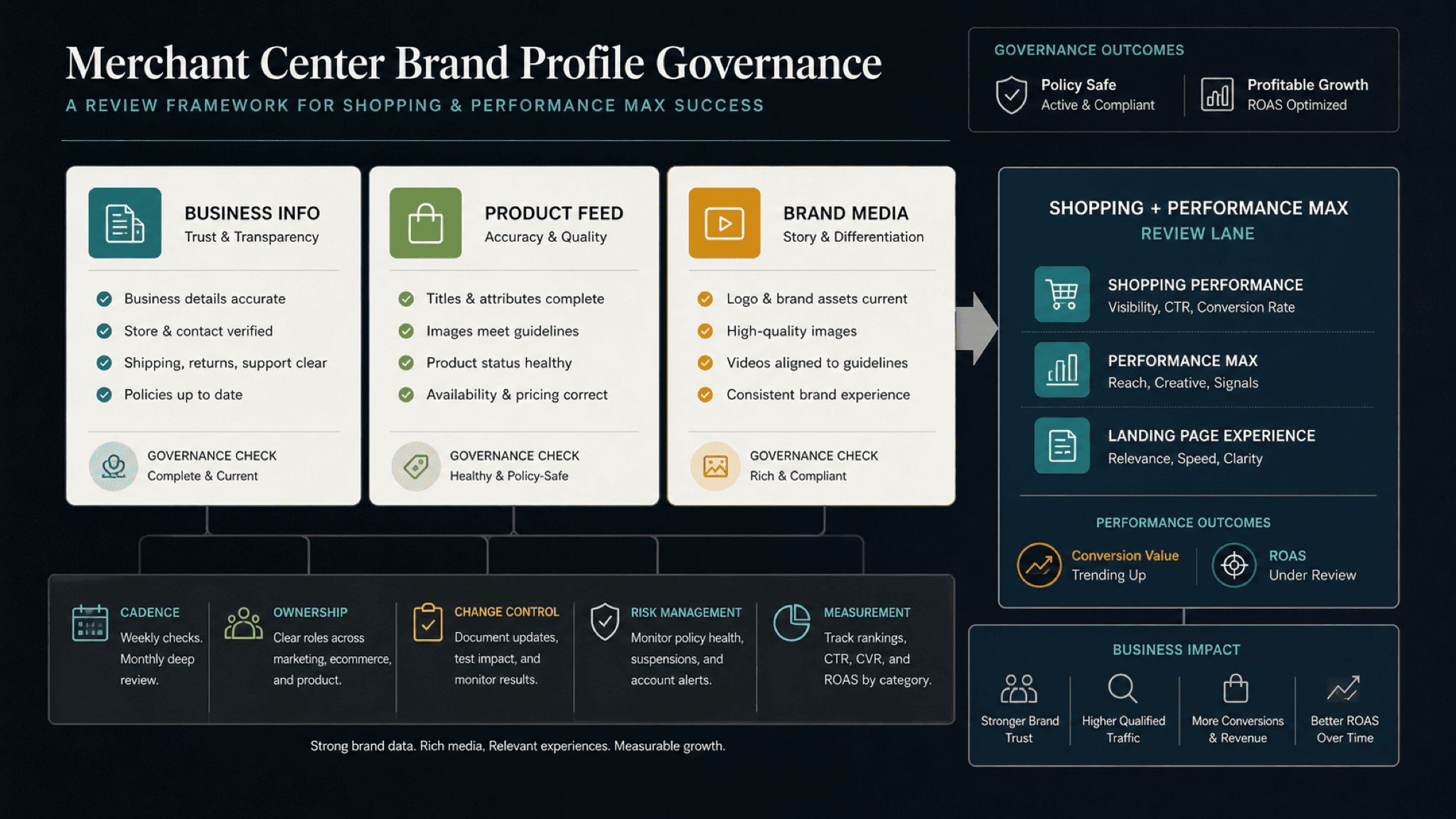
Illustrative concept graphic for Merchant Center brand profile governance review, not a product screenshot.
Merchant Center brand profiles are shelf space Google fills with or without you. Governance names who stocks it, what changed, and how Shopping and PMax stay aligned.
Key takeaway
The ecommerce lead opens Merchant Center after a rebrand and finds the logo updated but the hero copy still describing last season's collection. Shopping ads still serve from the product feed, yet the brand surface shoppers see on Google does not match the site the paid media team is scaling this week. Google's Merchant Center announcement describes brand profile and advanced Merchant Center features as part of modern commerce tooling, but the public detail on every field is thinner than the product data specification. That gap is normal. The work is governance: who owns the profile, what changed, and whether feeds, policy status, and campaign performance still agree.
The reframe is shelf space, not settings. Google will populate commerce presentation from business information, catalog data, and media whether or not the brand team treats the profile as a launch surface. Governance names the owner who stocks that shelf weekly, ties profile edits to feed-level checks and item disapprovals, and records how Shopping and Performance Max should be read after a change. Parallel AI reads the connected Google Ads account, writes the governance review in a doc or spreadsheet, and drafts campaign or feed notes for a person to approve.
Checked against current product, pricing, trust, and official Google materials so the explanation stays tied to the live product and current Google Ads context.
- Google's Accelerate with Google Merchant Center article supplies announcement-tier context for brand and advanced features; field-level detail was verified against the product data specification where available.
- Shopping ads depend on Merchant Center product data per Google's Shopping ads Help page; brand presentation drift can diverge from feed truth before diagnostics show it.
- Parallel's role stays limited to connected account review, finished governance notes, and drafted changes held for human approval.
Most brand profile problems do not start in Google Ads. They start when marketing updates the website on Friday and nobody tells Merchant Center until Tuesday's Shopping review shows mismatched business information, stale logos, or hero copy that contradicts the live offer. Google's Merchant Center announcement describes powering modern shopping experiences from product catalog and business capabilities. That is the tension: the catalog can be accurate while the brand shelf still shows last quarter.
DEFINITION
Merchant Center brand profile governance
The recurring practice of naming who owns public commerce presentation in Merchant Center, tying profile edits to product feed health, policy status, and landing-page continuity, and reading Shopping and Performance Max performance after changes. Google's product data specification defines feed fields and item requirements; brand-facing surfaces should not drift from those rows without a documented owner and rollback path.
Google Merchant Center Help: Product data specification
Treat the profile as shelf space, not a biography field. Shoppers encounter brand presentation on Google surfaces before they hit your product detail page. When the shelf says free shipping and the feed says flat rate, the paid media team argues about CPA while the fix lives in business information consistency.
Google's Shopping ads Help page ties ad eligibility to Merchant Center product data and account health. Brand presentation is adjacent to that chain. A profile that overpromises relative to feed rows creates the same trust gap as a price mismatch, except the symptom shows up as quality score noise and support tickets before it shows up as disapprovals.
Governance starts with a simple roster: who may edit business information, who approves images and video, who checks item-level status after a profile push, and who reads Performance Max asset reports the week after a rebrand. Without that roster, Google still fills the shelf from whatever was last saved.
Illustrative math: a $28,000 weekly Performance Max budget on tROAS bidding holds steady while return on ad spend loosens from 4.1 to 3.6 over ten days after a brand refresh. Feed diagnostics show no new disapprovals. Landing pages match the new creative. Business information in Merchant Center still lists the old return policy. Numbers are illustrative. The mechanism is profile drift masquerading as bidding decay.
Where Google's public documentation does not spell out a specific brand profile field or workflow, the account team should verify the live Merchant Center UI rather than assume parity with product feed screens. Honest boundaries here read as authority, not hesitation.
An empty owner column is still a governance decision.
Once shelf space is the frame, the weekly review follows catalog reality before brand preference. The merchandising lead and paid media lead share one doc: what changed in the profile, which feed attributes must match, and which campaign reports answer whether the change helped.
Rollback belongs in the same doc as publish criteria. If conversion value drops on hero SKUs while profile messaging shifts, the team should know whether to revert business information, narrow campaign geo, or fix feed attributes first. Debating creative taste without that sequence wastes a week.
Policy status and item disapprovals are the early warning layer. Google's Merchant Center diagnostics surface account and product issues that can block Shopping participation. Profile governance that ignores diagnostics treats the shelf as decoration while the catalog is on hold.
Performance Max channel reporting helps separate brand presentation effects from inventory effects. A profile push during a clearance event can look like a bidding win or loss depending on which SKUs carried the week. Product-level context keeps the read honest.
Profile edits mapped to commerce checks.
| Profile change | Feed or policy check | Campaign read |
|---|---|---|
| Logo or hero image | Image link requirements and brand consistency in primary feed | Performance Max asset report and Shopping impression trends |
| Business information or policies | Return and shipping attributes versus site footer | Conversion rate and support ticket themes post-click |
| Seasonal messaging | Sale price and availability windows in feed | ROAS and conversion value by top SKU for 7-day window |
| New video or brand media | Product page continuity and item disapprovals | Demand Gen or PMax video asset spend share |
Review Merchant Center diagnostics after profile edits
With ownership named, the pre-publish review is a short sequence any lead can rerun after seasonal updates or agency handoffs.
Confirm business information, return policy language, and shipping claims match the live site and primary product feed attributes for the SKUs in scope this month.
Compare images and video against brand standards and Google's product data image requirements. A hero asset that crops differently in Merchant Center than on site is a recurring post-rebrand failure mode.
Pull item disapprovals and account-level policy flags the same day as profile edits. Shopping visibility can hold while the brand shelf already changed.
Document who reads Shopping and Performance Max performance one week and four weeks after publish, and which ROAS or conversion value floor triggers rollback.
- Match business information to site and feed attributes before publish.
- Review item disapprovals and diagnostics the day profile edits land.
- Name campaign owners for 7-day and 28-day post-change reads.
- Write rollback criteria before the rebrand email goes out.
A polished shelf with a broken catalog still loses money.
Publish when business information, media, feed rows, policy status, and landing pages tell one offer story. Revise when any layer disagrees or when campaign reads are still ambiguous after one full lag window. Pause broader campaign scale when profile messaging outruns catalog or policy reality.
Publish when
- Business information, feed attributes, and site policies match for in-scope SKUs.
- Item disapprovals and account diagnostics are clear or owned with a dated fix.
- Rollback owner and ROAS or conversion value floor are written before go-live.
Pause when
- Hero messaging promises terms the feed or site cannot support.
- Policy or disapproval tickets spiked after the last profile edit.
- Nobody owns the post-publish campaign read calendar.
Brand profile governance is a connected-account review Parallel AI handles well. The agent pulls Shopping and Performance Max performance, conversion actions, and item-level context your team documents from Merchant Center, then writes the publish, revise, or pause recommendation in a doc or spreadsheet with owner, rollback, and campaign read rows. If the call is to narrow geo, pause a campaign, or draft feed fix notes, it waits for a person to approve that change. Rebrand decks without a Merchant Center row recreate the same Tuesday argument. See for adjacent media governance. On Monday morning, open Merchant Center diagnostics and Performance Max asset reports together, log any business information mismatch against the live site, and send one publish, revise, or pause line to merchandising and paid media before anyone scales budget.
Google documentation
Google's commerce and Merchant Center explainer for merchandising-heavy teams.
Google's product data reference for feed quality and item requirements.
Official Shopping ads reference for product data, Merchant Center, and how Shopping ads appear across Google surfaces.
Official Performance Max reference for campaign scope, inventory, goals, asset groups, and optimization context.
- Merchant Center Content Hub Video Recommendations GuideFor ecommerce teams where Content Hub suggestion volume outruns creative review capacity.
- Merchant Center Predictive Insights: Review Guide for EcommerceFor merchandising and paid media teams where predictive flags need corroboration before budget or feed changes.
- Merchant Center Video Hub for Google Ads: Ecommerce Prep GuideFor ecommerce teams with video libraries that outrun hero SKU coverage in live campaigns.
- Google Ads AI Agent for Ecommerce: Search Terms, Shopping, and PMax ReviewFor when Search, Shopping, Merchant Center, and Performance Max need one ecommerce review instead of separate meetings.