

Market Reality
Why Google Ads Feels Harder in 2026
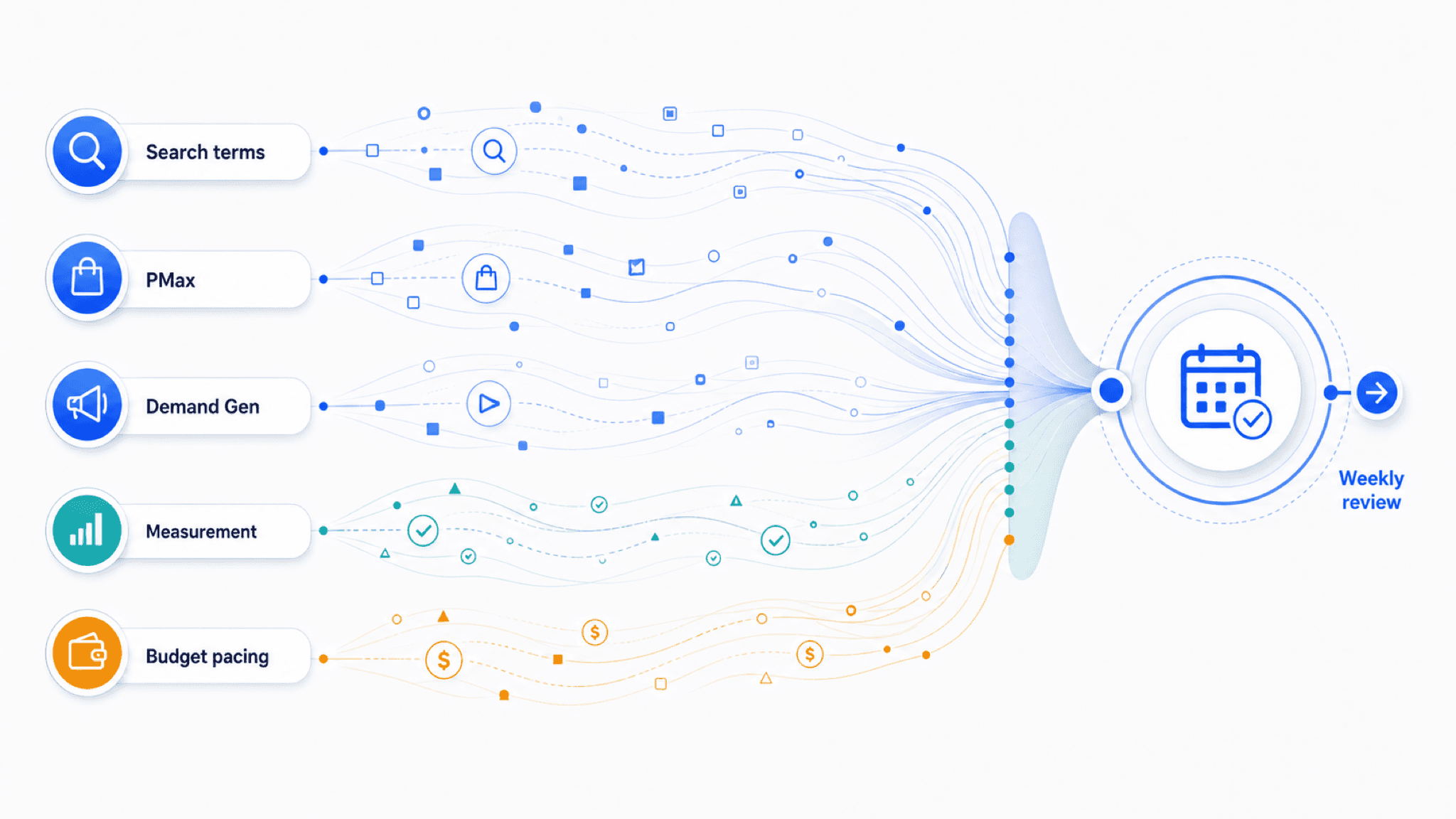
Editorial graphic for Google Ads weekly review signal convergence.
Google Ads feels harder because the platform moved the work from pulling levers to explaining outcomes across AI Max, PMax, Demand Gen, measurement, Search terms, budgets, CPA, and ROAS.
Key takeaway
Friday QBR prep: the paid media lead has twenty minutes to explain why CPA rose while spend held flat. The dashboard still populates. Auctions still clear. Smart Bidding still runs. Yet the room wants a story the old keyword-and-bid narrative cannot supply. Google Ads feels harder in 2026 because the platform moved the work. The hours went from pulling levers to explaining outcomes.
Google's AI Max for Search campaigns documentation describes broader matching, responsive search ads, and Smart Bidding working together. Performance Max and Demand Gen add feed, asset, audience, and channel layers on top. Measurement now runs through GA4, consent, conversion actions, Data Manager, attribution, and conversion lag. Reporting limits on AI Overviews and AI Mode surfaces add another translation job. None of that is a single broken setting. It is a wider explanation burden on the same calendar.
The teams that feel least overwhelmed are not the ones with more toggles memorized. They are the ones with a weekly review path across search terms, conversion quality, budgets, CPA, ROAS, lead or purchase quality, channel reporting, Merchant Center, and Change history. Parallel AI fits when that path needs a finished doc, sheet, or report from the connected account, with drafted changes waiting for a person to approve.
Checked against current product behavior, account-review tools, and official Google materials so the explanation matches the real review process and live product boundaries.
- Google Ads Help and the Google Ads and Commerce Blog supplied the platform surfaces named in the weekly review path.
- The explanation was framed as outcome narrative work rather than generic AI anxiety.
- Parallel claims stay limited to connected account review, finished summaries, and human-approved changes.
Once the QBR asks for a story instead of a toggle list, the old job description stops fitting. The work did not disappear. It relocated.
DEFINITION
Outcome explanation work
The recurring job of tying Google Ads surface changes to qualified business results using search terms, conversion actions, channel reporting, CPA, ROAS, and Change history. Google's AI strategies for marketing in 2026 framing describes more automation and broader inventory; the practitioner job is explaining what that automation did with your budget.
Google Ads and Commerce Blog: AI strategies to master marketing in 2026
Search still has keywords, but broad match, responsive search ads, AI Max matching, and Smart Bidding mean much of the daily lever work is intent interpretation and landing-page fit. You are not choosing every query. You are defending which queries deserve spend and which need negatives.
Performance Max and Demand Gen compress campaign types into feed, asset, audience, and channel questions. A single keyword report cannot carry the account anymore. Merchant Center diagnostics, asset groups, product feeds, and channel reporting each hold part of the answer.
Measurement got harder to narrate at the same time bidding got more automated. GA4 joins, consent mode, conversion lag, Data Manager product links, and purchase value quality all affect whether CPA and ROAS moves are trusted enough to brief upstairs.
Reporting itself became a skill. AI Overviews ads and AI Mode surfaces carry reporting limits documented in Google Ads Help. A metric move might be performance, coverage, or visibility. Teams that skip that split overreact or underreact.
Illustrative week: $18,400 in Search and PMax spend, CPA up 9 percent, ROAS flat, search terms report showing broader coverage, channel report showing a PMax shift into YouTube. Numbers are illustrative. The mechanism is familiar. The hard part is explaining which surface moved and whether conversion quality supports the next budget call.
Harder is not broken. Harder is a wider explanation job on the same clock.
If explanations replaced levers, the counterweight is a disciplined weekly read across the surfaces that actually steer outcomes.
Start with search terms on your highest-spend Search or AI Max campaigns. Sort by cost for the last 14 days. Mark queries above your waste threshold that have not been reviewed since the last negative upload. That single pass often explains CPA drift faster than a bid change debate.
Open channel reporting for Performance Max and Demand Gen before you open creative folders. Channel and asset moves frequently arrive before the brand team sees new assets in market.
Pull conversion actions and purchase value alongside CPA and ROAS. Smart Bidding documentation treats conversion volume and value quality as bidding inputs. A target move without a conversion-quality read is another lever fantasy.
End the weekly pass in Change history. The explanation for leadership should name what changed in the account, what changed in the auction, and what is still uncertain because of reporting limits or conversion lag.
| Review area | Google Ads surfaces | Question to answer |
|---|---|---|
| Search quality | Search terms, AI Max, broad match, final URLs, responsive search ads, and negative keywords. | Did broader coverage improve qualified intent or just increase spend? |
| Campaign mix | Performance Max, Demand Gen, Merchant Center, asset groups, product feeds, and channel reporting. | Which surface changed, and does conversion quality support the shift? |
| Measurement | GA4, Data Manager, conversion actions, attribution, conversion lag, CPA, ROAS, and lead or purchase quality. | Can the team trust the signal enough to change bids, budgets, or targets? |
Control returns when the weekly path is fixed, not when someone finds a hidden toggle.
The weekly review only matters if the QBR story improves. That is where explanation work becomes visible.
Open with the surface that moved: Search query mix, PMax channel mix, Demand Gen audience, or a conversion action change. Name the metric that moved with it: CPA, ROAS, conversion rate, or purchase value. Separate performance movement from measurement uncertainty when GA4, consent, or reporting limits could distort the read.
State what you will inspect before recommending budget, bid, target, or structure changes. A credible brief sounds like: search terms and negatives this week, channel report next, conversion action review if CPA drift continues. It does not sound like: monitor AI and hope.
Use budget pacing and Change history as anchors. Leadership hears less panic when spend is contextualized against pacing and recent account edits rather than against a single yesterday number.
When the team cannot yet explain a move, say so plainly and name the missing input. Epistemic honesty reads as authority. Guessing reads as anxiety.
A good brief names the surface, the metric, and the next review step.
Explanation work collapses when signals stay scattered across tabs. That is where a connected account review tool earns its place.
Parallel AI reads the connected Google Ads account and finishes the weekly story in docs, spreadsheets, or reports the pod can share with finance, clients, or leadership. Search terms, channel reporting, conversion actions, budgets, CPA, ROAS, and Change history can land in one narrative instead of five screenshots.
Drafted budget, target, negative keyword, and structure changes wait for a person to approve them. The product does not replace Smart Bidding, Merchant Center, or GA4. It shortens the path from scattered signals to a reviewed next step.
See how AI agents optimize Google Ads. On Monday morning, pick your highest-spend campaign, pull search terms and channel reporting for the last 14 days, and write one paragraph that names the surface that moved, the metric that moved, and the review you will run before the next budget change.
The lever era ended. The explanation era needs better notes.
Google documentation
Google's current high-level framing for AI-era marketing and account-change work.
Official overview of AI Max for Search campaigns, including matching, creative, reporting, and controls.
Official Performance Max reference for campaign scope, inventory, goals, asset groups, and optimization context.
Official Smart Bidding reference for Google's automated bid optimization systems.
Official reference for using the search terms report to review which searches triggered ads and identify keyword or negative keyword updates.
Official reporting reference for Report editor, predefined reports, saved reports, and manager-account reporting.
- Blog homeBrowse every published Google Ads guide from one editorial index.
- Google Ads AI agent: complete guideThe pillar guide covers the category definition, the adoption model, and where the agent fits real Google Ads work.
- ResourcesMove between the definition page, pricing, product walkthrough, and trust pages.
- About Parallel AISee the company mission, editorial standards, and operating principles behind the product.
- SecurityReview the public data-handling, account-connectivity, and approval-control framing used throughout the published guides.
- Author profileSee the background, specialties, and editorial responsibilities behind the published guides.
- Editorial reviewReview how pricing, trust, and capability claims are checked before public content ships.
- AI-Driven Google Ads Management: What Teams Should Automate in 2026For teams designing a Google Ads management model that separates intent from drafted execution.
- How AI Agents Help Optimize Google Ads: Reports, Settings, and Review StepsA technical guide to diagnosis, prioritization, and reviewed changes in Google Ads.
- Google Ads Automation vs AI Agents: Rules, Native AI, and Agent-Led ReviewHelpful when a team needs to sort Google Ads work into threshold-based automation, auction-time optimization, or account-level diagnosis with approval.