

App Measurement Readiness
Web-to-App Acquisition Measurement
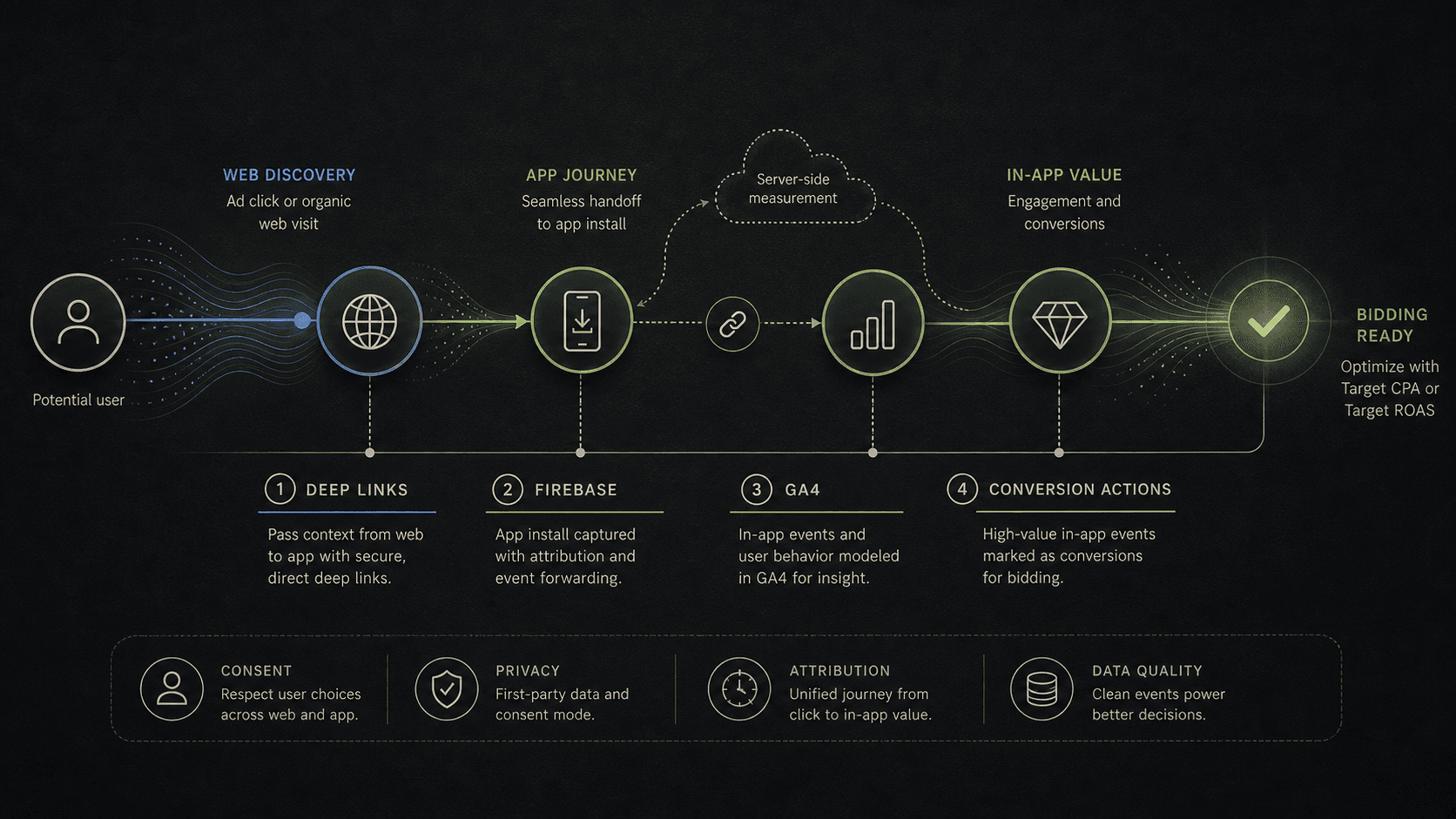
Illustrative concept graphic for web-to-app acquisition measurement readiness, not a product screenshot.
Web-to-app moves the conversion across a measurement boundary. Readiness is keeping install credit, in-app value, and bidding signals visible after the jump.
Key takeaway
App growth celebrates rising web campaign spend while Firebase shows installs and the Google Ads report still argues with GA4 about which click deserved credit. Google's Web to App Connect Help page and related app measurement documentation describe linking web acquisition paths to app outcomes through deep links, app install tracking, and linked Google Ads and Analytics accounts. That is the tension: the conversion crosses a boundary, and Smart Bidding only optimizes what survives the crossing.
The reframe is boundary visibility, not connector checkboxing. Web-to-app measurement is ready when web visits, app installs, deep links, Firebase or GA4 events, Google Ads conversion actions, in-app value, attribution settings, and campaign reports tell one story long enough for tCPA or tROAS to trust. Parallel AI reads the connected Google Ads account, writes the measurement readiness review in a doc or spreadsheet, and drafts campaign notes for a person to approve.
Checked against current product behavior, account-review tools, and official Google materials so the explanation matches the real review process and live product boundaries.
- Google's Web to App Connect and conversion tracking Help pages supply linking and event language; deep-link behavior should be verified on live devices before scale.
- Firebase or GA4 events, Google Ads conversion actions, attribution, conversion lag, and campaign reports were treated as joint gates before proceed, fix, or hold recommendations.
- Parallel's role stays limited to connected account review, finished readiness notes, and drafted changes held for human approval.
Web campaigns can generate clicks all day. App growth wins when the install and the downstream in-app action still carry credit after the handoff. Google's Web to App Connect Help page describes connecting web acquisition to app engagement through deep linking and linked measurement. Google's conversion tracking Help page frames conversion actions as the bidding inputs Google Ads can optimize. Anything lost between web click, app open, and in-app event becomes invisible to tCPA and tROAS.
DEFINITION
Web-to-app acquisition measurement
The practice of linking web campaign traffic to app installs and in-app outcomes through deep links, Firebase or GA4 events, Google Ads conversion actions, and linked accounts so reporting and bidding reflect the full path. Google's documentation emphasizes Web to App Connect and app conversion tracking as core setup surfaces. Readiness is whether credit remains visible across the boundary, not whether a connector toggle is on.
Google Ads Help: About Web to App Connect
Deep links are the first honesty test. A campaign can show healthy click volume while deferred deep links, broken universal links, or wrong app store fallbacks send value into a black hole. Device testing on iOS and Android beats dashboard optimism.
Firebase or GA4 events must map cleanly to Google Ads conversion actions with priorities that match business value. Install volume alone is not optimization readiness if tROAS depends on purchase or subscription events that report late or not at all in Google Ads.
Attribution and conversion lag stretch the boundary further. A seven-day web click to thirty-day in-app purchase path needs report windows long enough for humans and algorithms to agree. Google's Smart Bidding documentation assumes sufficient conversion volume and reliable value signals.
Illustrative math: a web acquisition campaign on tCPA bidding shows CPA improving from $18 to $14 while Firebase installs rise and Google Ads primary in-app purchase conversions stay flat for twenty-one days. Spend scales twenty percent. LTV dashboards later show low-quality installs from the same window. Numbers are illustrative. The mechanism is optimizing to visible web-era proxies while in-app value never crossed.
Where Google's public Help pages do not document a specific Web to App Connect workflow for your stack, verify linking, deep links, and event import in the live account and on devices rather than assume Analytics linking alone finished the job.
Linked accounts with broken deep links still fail the boundary test.
Once boundary visibility is the frame, the readiness doc is an event map with owners, not a list of toggles.
Separate setup readiness from optimization readiness. Setup means events fire and links exist. Optimization readiness means enough valued conversions return within the lag window Smart Bidding needs.
Hold scale when Google Ads cannot distinguish install volume from valuable in-app outcomes. The campaign may look cheap while the app team sees retention collapse.
Document fix owners for engineering, analytics, and paid media before scale. Boundary breaks never belong to one function alone.
Consent and platform privacy settings can truncate the path between web click and app event even when linking looks correct in admin screens. iOS ATT choices, limited ad tracking, and delayed SDK initialization show up as healthy clicks with silent in-app revenue until someone tests on a fresh device install.
Web-to-app tests should include uninstall and day-seven retention reads alongside install CPA. A cheap install that churns before monetization still looks like a win in Google Ads until product analytics disagrees in the same meeting.
Store listing and deferred deep-link fallbacks should be tested on the same devices used for paid traffic, not only on developer builds.
Handoff points mapped to bidding inputs.
| Boundary step | Verify | Google Ads read |
|---|---|---|
| Web click to store or app open | Deep link and fallback paths on devices | Install or first-open conversion action |
| Firebase or GA4 in-app events | Event names, parameters, value logic | Imported conversion actions and values |
| Analytics and Ads linking | Property, account, and audience links | Campaign reports and conversion columns |
| Lag and attribution windows | Business cycle for purchase or subscribe | tCPA or tROAS lookback adequacy |
Review linked accounts and app conversion actions
With cross-boundary credit as the frame, the readiness review fits one working session.
Confirm Web to App Connect paths, deep links, app install tracking, Firebase or GA4 events, and linked Google Ads and Analytics accounts on live devices.
Map Google Ads conversion actions to the in-app events and value signals that actually support tCPA or tROAS goals.
Review attribution settings, conversion lag, campaign reports, and quality movement over a full lag window.
Hold scale when reports still disagree about which touchpoint earned the install or purchase.
- Test deep links on iOS and Android before scale.
- Match conversion action priorities to business value.
- Read reports on lag-aligned windows, not seven-day slices alone.
- Name engineering and analytics owners for gaps.
Install growth without in-app value in Google Ads is a warning, not a win.
Proceed when deep links, events, conversion actions, in-app value, attribution, and campaign reports align over a full lag window. Fix setup when events exist but mapping, deep links, linking, or value import is incomplete. Hold scale when Google Ads still optimizes to installs or web proxies that do not predict valuable in-app outcomes.
Proceed when
- Deep links and fallback paths work on devices for pilot audiences.
- Primary conversion actions reflect valued in-app events with stable import.
- Campaign reports, Firebase or GA4, and Google Ads agree within written tolerance.
Hold when
- Only install volume is visible while purchase or subscribe events lag in Google Ads.
- Attribution windows are shorter than the business conversion cycle.
- Web and app teams use different definitions of qualified conversion.
Web-to-app measurement readiness is a connected-account review Parallel AI handles well. The agent pulls campaign performance, conversion actions, CPA, ROAS, and change history from the connected Google Ads account, pairs that with event and deep-link notes your analytics team documents, and writes proceed, fix, or hold rows in a doc or spreadsheet with owner columns. If the call is to pause a web campaign, adjust conversion action priorities, or draft a measurement fix memo, it waits for a person to approve that change. Scale meetings without a handoff map recreate the same attribution argument every month. See for adjacent first-party measurement work. On Monday morning, open app conversion actions and campaign reports together, test one deep link path on a live device, and send one proceed, fix, or hold line before web acquisition budget rises.
Google documentation
Google's Help page for Web to App Connect, deep linking, and web-to-app campaign paths.
Google's reference for linking Analytics properties and Google Ads accounts.
Google's conversion tracking reference for conversion actions and value measurement.
Official Smart Bidding reference for Google's automated bid optimization systems.
- Google Tag Upgrade Checklist for Paid Media Teams After GML 2026Helpful when Google tag upgrades need a paid media measurement review before teams trust reports or change campaign targets.
- Data Manager Conversion Diagnostics: Fix Drift Before Bid ChangesFor analytics and paid media teams where conversion drift needs plumbing review before Smart Bidding moves.
- Ask Advisor in Google Analytics for Google Ads Teams: What to Review NextFor analytics diagnosis that must become a clear paid media next step.
- AI-Driven Google Ads Management: What Teams Should Automate in 2026For teams designing a Google Ads management model that separates intent from drafted execution.