

API Budget Checks
Demand Gen Minimum Budget API Playbook
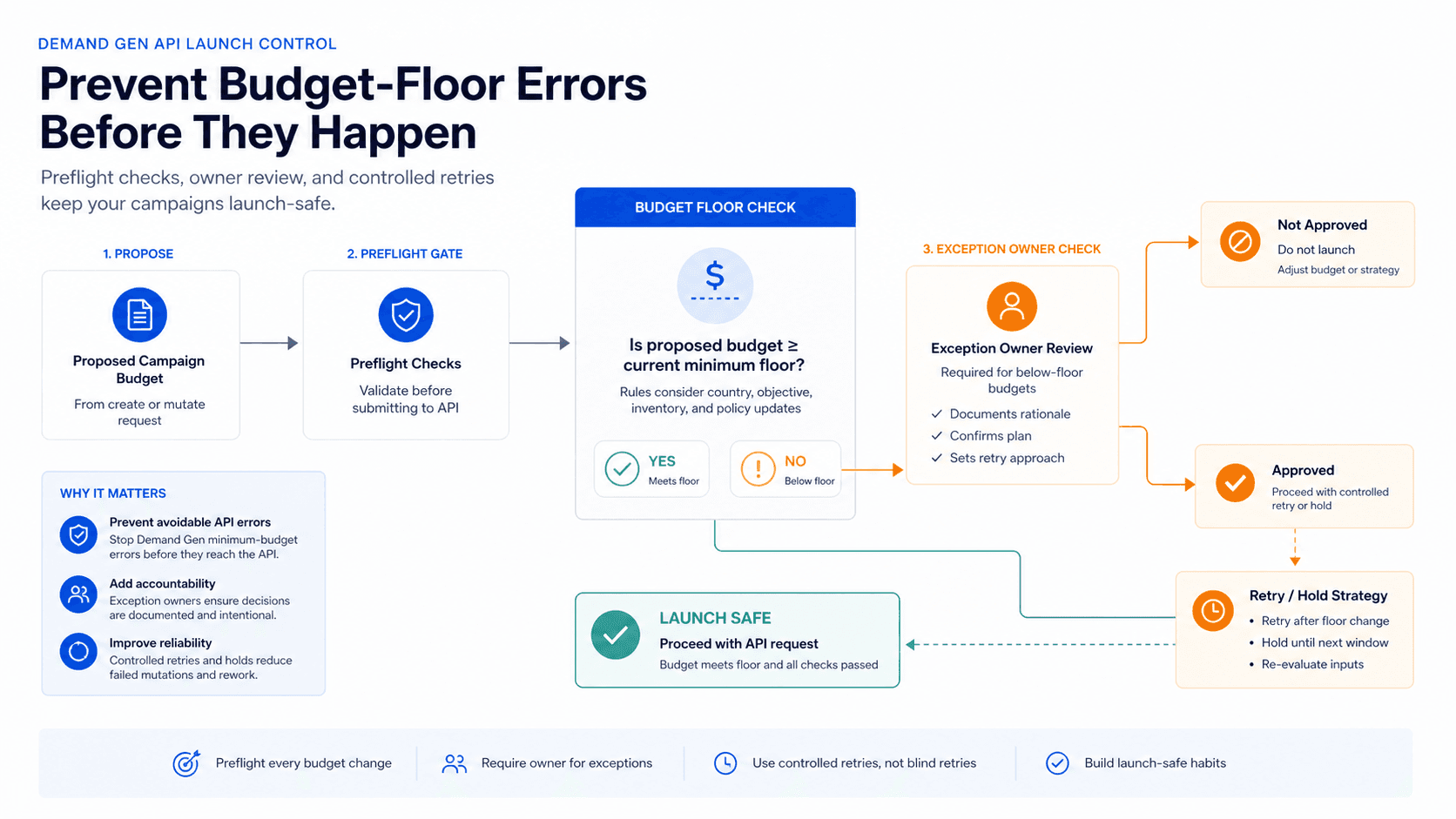
Illustrative concept graphic for Demand Gen minimum-budget API preflight, not a product screenshot.
Demand Gen minimum budgets are a commitment test. If the API floor exceeds your test budget, the launch decision was made before the mutation ran.
Key takeaway
The script fails on the third retry with a below-floor budget error, and the team treats it like a typo. On Demand Gen, Google's YouTube Performance Four guidance ties minimum daily budgets to bidding intent: Maximize Conversions or Maximize Conversion Value campaigns should use at least $100 per day, and Target CPA or Target ROAS campaigns should use daily budgets of at least 10 times the target CPA. The API enforces what the UI already implied.
The reframe is preflight honesty. A minimum budget is a commitment test. If the documented floor exceeds the test budget finance approved, the launch should stop before the mutation runs, not after the third failed retry. Parallel AI reads campaign settings from the connected account, writes the floor check in a doc or spreadsheet, and drafts budget changes for a person to approve.
Checked against current product behavior, account-review tools, and official Google materials so the explanation matches the real review process and live product boundaries.
- Google's Performance Four page documents $100 minimum daily budgets for Maximize strategies and 10x target CPA for Target strategies on Demand Gen.
- API launch flows were mapped to floor checks, owner review, exception notes, and retry rules before mutation calls.
- Parallel's role stays limited to connected account documentation, finished preflight sheets, and drafted changes held for human approval.
Engineering pings paid media because the Demand Gen create call failed again. The submitted daily budget is $40 on a tCPA campaign targeting $45 leads. Google's Performance Four guidance says Target strategies need daily budgets of at least 10 times the target CPA. That implies $450 before learning even gets a fair chance. The API error is not the surprise. The budget was.
DEFINITION
Demand Gen minimum daily budget
Budget floor tied to bidding strategy in Google's YouTube Performance Four guidance for Demand Gen. Maximize Conversions and Maximize Conversion Value strategies should use daily budgets of $100 or more. Target CPA and Target ROAS strategies should use daily budgets of at least 10 times the target CPA. Google's documentation also recommends waiting for 50 conversions before judging performance and limiting weekly bid or budget changes to no more than 15 percent during learning.
Google Ads Help: The YouTube Performance Four
Teams using the Google Ads API feel this as a hard stop on mutation. Teams using the UI sometimes negotiate the number in a meeting first. Both paths need the same preflight row: strategy type, submitted budget, computed floor, owner, and exception note if finance insists on a smaller test.
The commitment test framing prevents a common failure mode. A stakeholder approves a symbolic budget to get the campaign live, planning to raise it later. Smart Bidding never clears learning, the launch is labeled a failure, and engineering burns cycles on retries that were doomed on spreadsheet one.
Google's API release notes remain the authority when field behavior shifts. The playbook here does not invent a separate floor. It translates Performance Four budget guidance into a pre-mutation gate your scripts and humans share.
Engineering should log floor outcomes like product incidents: submitted value, computed floor, strategy type, pass or fail, owner. That log becomes the audit trail when a client asks why launch slipped two weeks.
Client services should see the floor row before launch day. When the API fails late on a Friday, everyone already agreed what minimum learning budget meant for this strategy.
A below-floor error often means finance never approved a real test.
Once strategy is fixed, the floor math is arithmetic the API team and the paid media lead can audit together.
Target CPA
$45
Illustrative lead gen target.
Computed floor
$450/day
10x target CPA per Performance Four guidance.
Submitted budget
$40/day
Example value that fails preflight.
Learning threshold
50 conv.
Google's minimum before judging performance.
In the illustrative example, a Maximize Conversions test at $75 per day also fails the $100 minimum for volume strategies under Performance Four. Numbers are illustrative. The mechanism is comparing submitted budget to documented strategy floors before any mutate call.
Preflight should also name the learning window. Google's guidance says not to evaluate performance until the campaign generates at least 50 conversions. A budget that clears the floor but cannot reach 50 conversions in a reasonable calendar window is still a planning failure, even if the API accepts the mutation.
Exception paths belong in writing. If leadership approves a sub-floor test for political reasons, the doc should say so and set a calendar date to raise budget or pause. Silent exceptions become mystery defaults in the next account transition.
Bid Strategy Report trends belong in the same preflight doc once the campaign is live. Google's Performance Four guidance points teams there for bidding performance over time rather than judging from one failed mutate attempt.
Finance sometimes asks for a phased ramp after preflight passes. Document the ramp schedule in the same row so engineering does not treat a temporary exception as the new permanent floor.
Open campaign budget and bidding settings
With floor math documented, the launch script should fail fast in staging, not in production retries.
Confirm campaign type and bidding strategy match the floor table you are using. Target CPC and Maximize Clicks follow click-strategy rules; tCPA, tROAS, and Maximize strategies follow the Performance Four bands cited above.
Compare submitted daily budget micros in the API payload to the computed floor for that strategy and market. Log the pass or fail reason on every run.
Name the owner who can approve a corrected budget or a written exception. Automated retries without an owner recreate the same error with better uptime.
Staging payloads should mirror production strategy enums. A test environment that accepts sub-floor budgets teaches false confidence before the production mutate fails again.
- Compute strategy floor before the mutation call.
- Block retries until corrected budget or exception is logged.
- Record owner and launch reason on every attempt.
- Align test window with 50-conversion learning guidance.
Preflight in staging is cheaper than cleanup in production.
Launch when submitted budget clears the documented floor and the business reason for the test is logged. Retry only after the corrected value and reviewer are named. Hold when the floor, exception, or spend owner is still unclear.
Launch when
- Submitted daily budget meets Performance Four minimums for the chosen strategy.
- Owner, launch reason, and review date appear in the preflight log.
- The test calendar can plausibly reach 50 conversions before judgment.
Hold when
- Submitted budget is below the documented floor and no exception is written.
- Retries run without a corrected value or named reviewer.
- Finance approved a deck test, not a learning budget.
Minimum-budget preflight is a strong Parallel AI task on connected Demand Gen accounts. The agent reads bidding strategy, daily budget, and recent launch errors, writes the floor table in a doc or spreadsheet, and drafts budget corrections for a person to approve before engineering retries the API call. Failed mutations without a floor row waste engineering time and teach Smart Bidding nothing. See for click-strategy guardrails. On Monday morning, open any Demand Gen campaign stuck in learning with sub-floor spend, recompute the Performance Four minimum for its strategy, and send one launch, raise, or pause line to the account owner before the script runs again.
Google documentation
Google's official release notes for current Google Ads API behavior.
Google's Demand Gen reference for campaign scope and creative context.
- Demand Gen Platform-Comparable Conversions: Report the Metric CarefullyHelpful when client decks compare Demand Gen to social CPAs without aligning counting rules first.
- Demand Gen Target CPC Controls: Set Guardrails Before ScaleHelpful when cheaper clicks arrived but lead quality or ROAS did not follow.
- Demand Gen Asset Optimization Audit: Review Controls Before Weekly ScaleHelpful when creative reviews ignore the asset report and debate taste instead of spend concentration.