

Bid Guardrails
Demand Gen Target CPC Controls
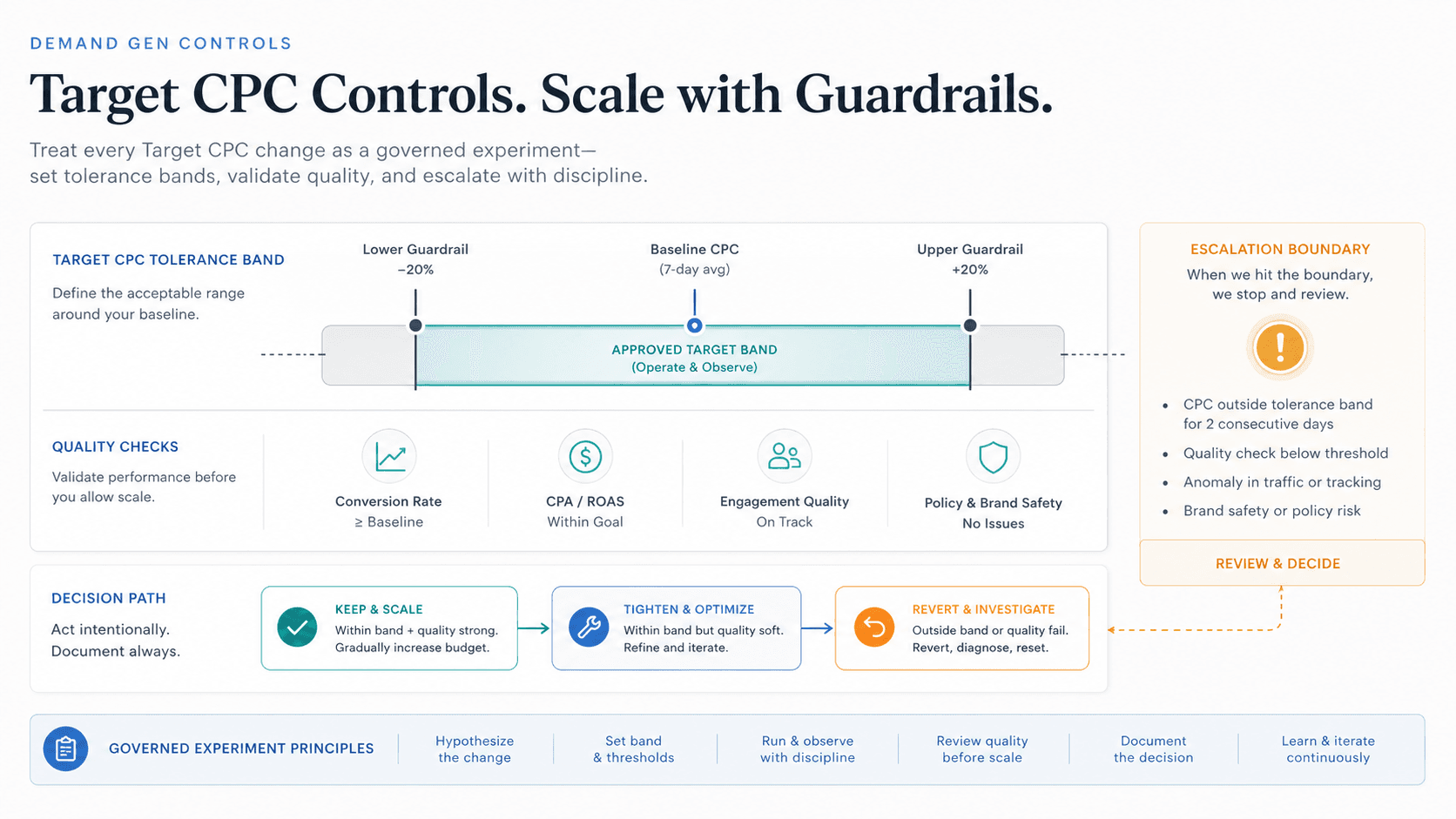
Illustrative concept graphic for Target CPC guardrails, not a product screenshot.
Target CPC only works when the team decides what a click is worth before the auction does. Set guardrails, baseline quality, and revert rules on Demand Gen.
Key takeaway
Someone lowers Target CPC on a Demand Gen campaign because clicks look expensive, and two weeks later volume collapses while the dashboard still shows a green efficiency arrow. Target CPC is click-based bidding in Google's Performance Four framework: it pursues clicks within a ceiling you set, not downstream conversions by itself. The control only works when the team decided what a click is worth to this offer before the auction started chasing cheaper inventory.
Google's guidance separates click strategies (Maximize Clicks or Target CPC) from efficiency strategies (tCPA or tROAS) and volume strategies (Maximize Conversions or Maximize Conversion Value). It also recommends waiting for 50 conversions before judging performance and changing bids or budgets by no more than 15 percent per week during learning. Parallel AI reads the connected account, records baseline CPC and quality, writes the guardrail review in a doc or spreadsheet, and drafts bid or budget changes for a person to approve.
Checked against current product behavior, account-review tools, and official Google materials so the explanation matches the real review process and live product boundaries.
- Google's YouTube Performance Four page defines Target CPC under click-based bidding and tCPA or tROAS under efficiency bidding.
- The same guidance names the 50-conversion learning threshold and the 15 percent weekly change cap during learning.
- Parallel's role stays limited to baseline documentation, finished bid reviews, and drafted changes held for human approval.
Target CPC meetings often start with the average CPC number and end with a new ceiling nobody can defend. The better start is a value question: what is a click worth to this campaign goal when conversion quality still has to clear finance or sales?
DEFINITION
Target CPC
A click-based bidding strategy listed in Google's YouTube Performance Four guidance alongside Maximize Clicks. Click strategies optimize toward traffic volume at a cost per click you set. Efficiency strategies such as tCPA or tROAS optimize toward conversion goals instead. Google's documentation recommends choosing the strategy that matches whether you want clicks, volume, or efficiency.
Google Ads Help: The YouTube Performance Four
The tension is familiar. Finance wants cheaper clicks. Sales wants qualified leads. Ecommerce wants purchase value. Target CPC can deliver cheaper clicks while moving away from the conversion goal if nobody wrote the downstream check that must hold. Pre-auction value work states the maximum CPC that still leaves room for acceptable CPA, ROAS, or lead quality once lag clears.
Google's Performance Four guidance also says tCPA target strategies should use daily budgets of at least 10 times the target CPA to give the bidder room to learn. Target CPC campaigns still need enough budget and time to produce meaningful click and conversion patterns before anyone declares victory or failure.
Agency workflows benefit from a single guardrail row in the weekly sheet: strategy type, max CPC, quality floor, last change date, and owner. When the client asks why clicks changed, the answer is in the row, not in a thread nobody saved.
A CPC target without a value story is just a number on a slider.
Once click value is stated in plain language, the tolerance band is arithmetic anyone on the account can audit.
Illustrative max CPC
$2.40
Example ceiling set before the bid change.
Baseline CPC
$2.05
Seven-day average before the change.
Quality floor
$48 CPA
Example lead gen target; numbers are illustrative.
Weekly change cap
15%
Google's Performance Four learning guidance maximum.
In the illustrative example, baseline CPC is $2.05 on a B2B lead gen campaign with a $48 CPA target and 2.4 percent landing-page conversion rate. Rough math says clicks above about $2.40 leave little room for error before CPA breaks, so the team sets $2.40 as the escalation ceiling and $2.15 as the comfort band. Numbers are illustrative. The mechanism is deciding the band before someone tightens Target CPC reactively after one expensive day.
Google recommends waiting for 50 conversions before evaluating performance and limiting bid or budget changes to 5 to 10 percent weekly, no more than 15 percent, so the campaign is not forced to relearn from large swings. A Target CPC tighten that skips that cadence can look efficient for a week and hollow for a month.
The Bid Strategy Report documented in Google Ads Help is the surface for reviewing bidding performance over time rather than judging from a single day's CPC spike.
Finance sometimes asks for cheaper traffic while sales asks for better leads. The guardrail sheet resolves that fight with one row: maximum CPC, expected landing-page rate, and quality floor. If the row math does not work, the strategy conversation belongs on tCPA or tROAS, not on a tighter click ceiling alone.
Maximize Clicks without a ceiling behaves differently from Target CPC with one. Name which click strategy is live before comparing weeks.
Open bid strategy settings for the campaign
With baseline CPC and click value documented, the pre-change review is short and repeatable.
Confirm campaign goal alignment first. Target CPC belongs when the job is traffic or upper-funnel learning with eyes open about conversion risk. tCPA or tROAS belongs when efficiency is the job. Mixing the story confuses every downstream review.
Record baseline CPC, conversion quality, lead quality or purchase value, CPA, and ROAS in the same lookback window. Compare after any change only once enough conversions and lag have cleared.
Document who approved the band. Bid changes without a named owner become mystery defaults in the next account transition. One owner field in the weekly sheet prevents that drift.
- State click value and downstream quality floor before changing Target CPC.
- Record baseline CPC, CPA, ROAS, and quality metrics in one window.
- Set approved CPC band and escalation point in writing.
- Plan changes within the 15 percent weekly cap during learning.
Cheaper clicks that fail the quality floor are not savings.
Keep when CPC stays inside the band and downstream quality holds or improves. Tighten when clicks cheapen but leads or purchases weaken. Revert when the target chases low CPC without quality improvement and volume or pipeline suffers.
Keep or tighten when
- CPC movement stays inside the documented band with stable CPA, ROAS, or lead quality.
- The campaign cleared the learning window you set before judging the change.
- Bid changes stayed within gradual change guidance during learning.
Revert when
- CPC fell while invalid leads, weak purchases, or pipeline slippage rose.
- The change exceeded 15 percent in a week and learning restarted without a quality win.
- Nobody wrote the click value story before the target moved.
Target CPC reviews are a recurring Parallel AI task on connected Demand Gen accounts. The agent reads baseline CPC, bid strategy settings, and conversion quality, writes the guardrail table in a doc or spreadsheet, and drafts Target CPC or strategy changes for a person to approve. That keeps finance, sales, and paid media aligned on what cheaper clicks were supposed to buy. Reactive CPC tweaks without a baseline row age badly in the next QBR. See for broader bid context. On Monday morning, open campaigns on Target CPC, compare this week's average CPC to the documented band, and send one keep, tighten, or revert line to the account owner before anyone edits bidding settings.
Google documentation
Google's official release notes for current Google Ads API behavior.
Google's Demand Gen reference for campaign scope and creative context.
- Cross-Channel Bid Optimization: Review Budget Moves Before You ReallocateFor teams about to reallocate Google Ads budget when channel ROAS rows use different counting rules.
- Demand Gen Minimum Budget API Playbook: Prevent Below-Floor ErrorsFor API and paid media teams stopping below-floor Demand Gen launch retries before they start.
- Demand Gen Asset Optimization Audit: Review Controls Before Weekly ScaleHelpful when creative reviews ignore the asset report and debate taste instead of spend concentration.