

Local Pilot
Demand Gen Maps Inventory Pilot
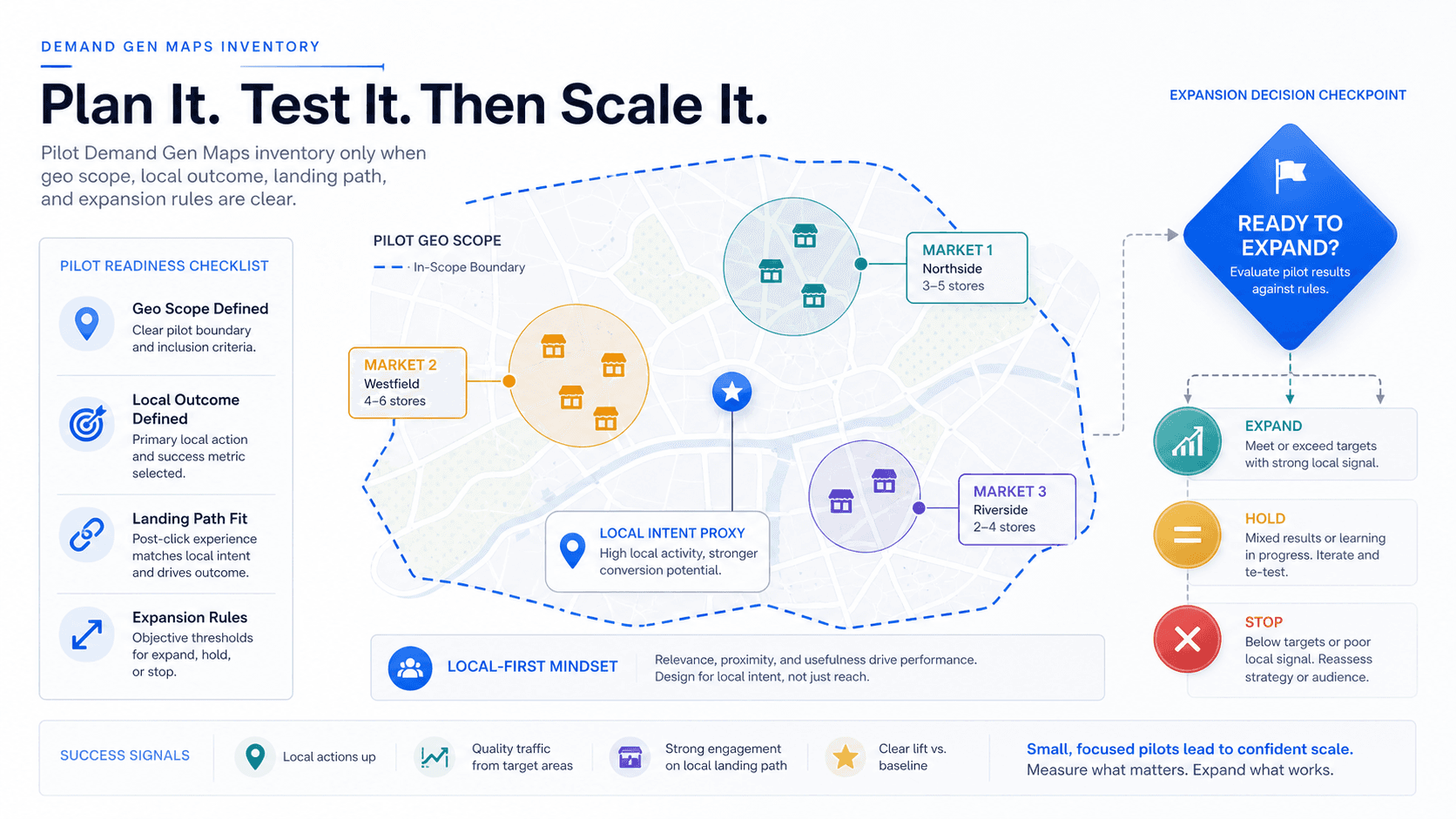
Illustrative concept graphic for Demand Gen Maps inventory pilot scope, not a product screenshot.
Maps inventory in Demand Gen earns a store-by-store pilot before any account-wide rollout. Scope geo, local outcomes, landing paths, and stop rules first.
Key takeaway
The regional lead wants Maps on the Demand Gen plan because the deck says Promoted Pins can drive foot traffic. That is the right instinct and the wrong scale. Google's Google Marketing Live 2025 roundup describes Demand Gen Maps inventory as Promoted Pins that reach people browsing businesses and locations on Maps. Google frames the outcome as store visits and in-store sales, not a blended CPA on a national line item.
The reframe is pilot discipline. Maps inventory earns a bounded test in named markets with a local outcome you can verify, a landing path that matches the pin promise, and expand, hold, or stop rules written before budget moves. Parallel AI reads the connected account, writes the pilot scope in a doc or spreadsheet, and drafts geo or budget changes for a person to approve.
Checked against current product, pricing, trust, and official Google materials so the explanation stays tied to the live product and current Google Ads context.
- Google's GML 2025 roundup names Promoted Pins on Maps as Demand Gen inventory aimed at foot traffic and in-store sales.
- Pilot scope was mapped to geo boundaries, local-intent signals, landing-path fit, budget caps, and written stop rules.
- Parallel's role stays limited to connected account review, finished pilot notes, and drafted changes held for human approval.
Friday's QBR slides show Demand Gen CPA holding while store traffic flatlines in two districts. The account average looks fine because three flagship stores carry the row. Maps inventory is local by nature. Google's GML 2025 announcement describes Promoted Pins that reach people browsing on Maps to drive foot traffic. That promise only clears finance when you can tie spend to stores, not to a national average.
DEFINITION
Demand Gen Maps inventory
Maps placement in Demand Gen described in Google's Google Marketing Live 2025 roundup: Promoted Pins that reach users browsing businesses and locations on Maps, aimed at foot traffic and in-store sales. Google's Demand Gen overview treats the campaign type as multi-surface visual demand creation across YouTube, Discover, Gmail, and Display. Maps inventory adds a local proof burden the account-wide dashboard cannot carry alone.
Google Ads Help: Google Marketing Live 2025 roundup
The tension is scale versus proof. Leadership hears Maps and imagines a switch that turns on nationwide store lift. The platform delivers auctions store by store. A pilot names the cities, clusters, or service areas in scope, caps budget per market, and picks one local outcome that can fail visibly: verified store visits, direction requests, appointment bookings, or coupon redemptions tied to location IDs.
Google's YouTube Performance Four guidance for Demand Gen also warns against fragmenting campaigns without reason, but local inventory is the exception where geo truth matters more than consolidation speed. One campaign can hold multiple markets if reporting splits by location and each market has its own stop rule. Without that split, a pilot becomes a rollout in disguise.
Agency pods benefit from a pilot charter row: market list, local KPI, landing URL pattern, weekly budget cap, review owner, and expand date. When the client asks why Maps spend differs by city, the charter answers before anyone opens change history.
Store managers should see the same charter. They often know first when foot traffic diverges from ad spend. A pilot that ignores their weekly read confuses correlation with causation and burns trust faster than budget.
A national average is not proof that Maps worked in your weakest store.
Once the pilot frame is set, the weekly review stops debating whether Demand Gen works and starts asking which stores earned the next dollar.
Illustrative pilot budget
$800/week
Example cap per market cluster; numbers are illustrative.
Markets in scope
3 cities
Named geos with separate landing paths.
Local signal
Directions
Example proxy tied to Maps intent.
Review window
14 days
Minimum window before expand or stop.
In the illustrative example, a home services brand pilots Promoted Pins in three metro areas at $800 per week each. Directions and call clicks rise in two cities while booked jobs flatline in the third because the landing page still routes to a national form without local phone numbers. The account-level CPA looks acceptable. The pilot fails one market honestly, which is the point.
Compare each in-scope store or service area to its own baseline, not to the account hero locations. Pull location reports, call extensions, and offline conversion imports where available. Google's Performance Four guidance reminds teams to account for conversion lag on Demand Gen; local pilots need the same patience, but lag is not an excuse to skip weak markets.
Landing-path fit is the silent killer. Promoted Pins promise proximity. A generic homepage breaks that promise even when clicks are cheap. Local teams should verify hours, inventory messaging, and map links on the destination before anyone expands budget.
Finance will ask whether Maps duplicated Search spend. Document overlap rules up front: branded Search still defends high-intent queries while Maps tests discovery on local browse behavior. Without that split, incremental read becomes a turf war.
Review location and geo targeting for the pilot campaign
With store-level baselines named, the pre-flight list is short and repeatable every Monday.
Confirm geo scope in writing: cities, ZIP clusters, or store radii tied to live locations. If a store closed last month, the pilot should not still pay for its pin radius.
Pick one local-intent signal per market that finance will accept as directional proof alongside platform conversions. Directions, calls, and store visit imports each behave differently; name which one decides expand versus hold.
Review landing paths per market. The URL, phone number, and offer copy should match the local promise in the creative. Mismatch here shows up as clicks without appointments even when Maps delivery looks strong.
Pull change history alongside location reports. A geo edit, budget shift, or creative swap mid-pilot can look like a market win or loss when the lever was structural, not local.
- Name markets, budget caps, and review owners before launch.
- Split reporting by location instead of trusting one account average.
- Match landing paths to local creative promises.
- Set expand, hold, and stop thresholds per market.
A pilot without per-store stop rules is already a rollout.
Expand a market when local signals and downstream quality move together for the full review window. Hold when Maps delivery looks promising but landing or measurement still wobbles. Stop a market when geo, offer, or quality stays unclear after a fair window.
Expand when
- Local-intent signals and downstream outcomes rise in the same market for the agreed window.
- Landing paths, hours, and offers match the Promoted Pin promise.
- Budget caps and lag assumptions were documented before the read.
Stop when
- Account averages look fine while named markets fail local proof.
- Landing paths still route to generic national experiences.
- Nobody can name which stores were in scope after four weeks.
Maps pilots are a natural Parallel AI workflow on connected Demand Gen accounts. The agent pulls geo targeting, location reports, conversion actions, and landing-page notes, then writes the pilot charter in a doc or spreadsheet with per-market expand, hold, and stop rows. If the routed decision is to narrow geo or adjust budget caps, it drafts that change and waits for a person to approve it. Pilot debates without a written market list repeat every month. See for business-model proof splits. On Monday morning, open location performance for the pilot campaign, mark each in-scope market as expand, hold, or stop, and send the charter to local marketing and finance before anyone raises account-wide budget.
Google documentation
Google's announcement context for Demand Gen and local inventory updates.
Google's Demand Gen reference for campaign scope and creative context.
- Demand Gen for B2B and Ecommerce: Diagnose Quality Beyond CTRHelpful when CTR looks strong but B2B pipeline or ecommerce ROAS tells a different story.
- Demand Gen Asset Optimization Audit: Review Controls Before Weekly ScaleHelpful when creative reviews ignore the asset report and debate taste instead of spend concentration.
- Google Ads AI Agent for Ecommerce: Search Terms, Shopping, and PMax ReviewFor when Search, Shopping, Merchant Center, and Performance Max need one ecommerce review instead of separate meetings.