

Consolidated Comparison
Google Ads AI Agent vs Manual Management
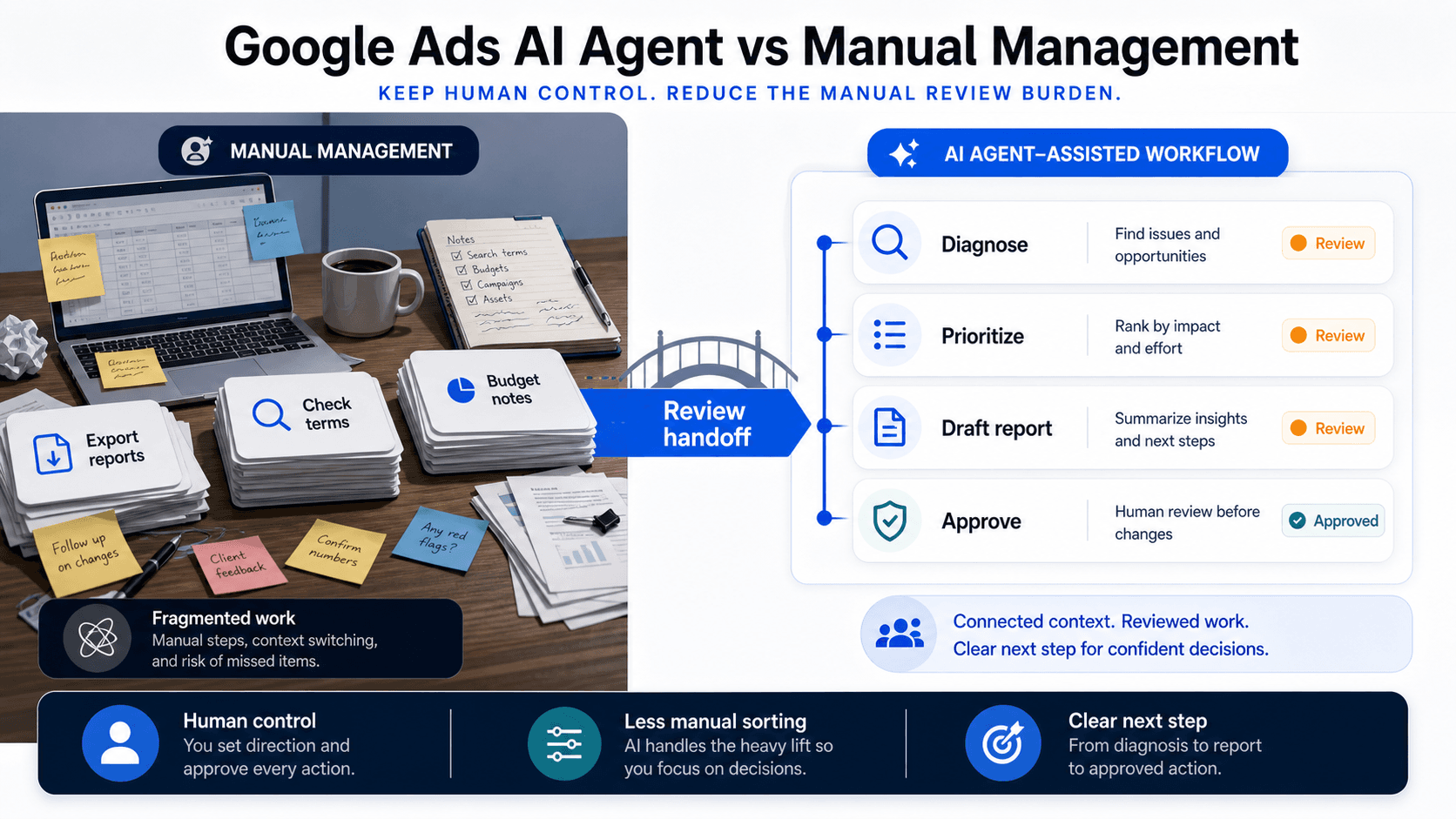
Manual can still work for low-volume accounts. Agent-assisted review becomes more useful when account volume and reporting burden compound.
Use this short comparison to decide whether manual Google Ads management is still enough, then continue to the ROI guide.
Key takeaway
The deeper comparison now belongs in the Google Ads AI agent vs manual ROI guide. The short decision is simple: stay manual when account volume is low, campaign scope is narrow, and the team can still produce reliable reviews and reports on time.
Evaluate an AI agent when the manual work is slowing account diagnosis, budget review, search-term cleanup, Recommendations review, client reporting, or cross-account prioritization. Parallel supports that recurring work when it needs to become a report, sheet, summary, or reviewed next step.
Reviewed the manual-versus-agent comparison against the stronger ROI guide and narrowed this route to a short decision path with noindex consolidation.
- Route detailed ROI modeling to the stronger manual ROI guide.
- Keep this route focused on the practical decision boundary.
- Compare manual work and agent-assisted work by account volume, reporting burden, review quality, and team capacity.
| Situation | Better first path |
|---|---|
| One simple account, low change volume, simple reporting | Manual management |
| Multiple accounts, weekly reporting, recurring search-term or budget review | AI-agent-assisted review |
| Leadership or client asks for clearer explanations every week | AI-agent-assisted reports and summaries |
- Search-term review gets delayed because exports and grouping take too long.
- Budget pacing and tCPA or ROAS movement are reviewed only after a client or leader asks.
- Recommendations are accepted, rejected, or ignored without a consistent review note.
- Client or leadership reports take longer to rebuild than the account diagnosis itself.
Use the ROI guide when the team needs a full model for labor recovery, reporting rework, and pilot measurement. It is the stronger destination for anyone comparing manual management with an AI agent.
Google documentation
Official budget reference for average daily budgets, spending limits, daily costs, shared budgets, and budget reports.
Official reference for Google Ads Recommendations and how they use account history, campaign settings, and trends.
Official reference for using the search terms report to review which searches triggered ads and identify keyword or negative keyword updates.
Official reporting reference for Report editor, predefined reports, saved reports, and manager-account reporting.
Official Smart Bidding reference for Google's automated bid optimization systems.
About Parallel
Current security, data-handling, and connectivity framing.
Company mission and editorial review context behind the published guides.
- Google Ads AI agent: complete guideThe pillar guide covers the category definition, the adoption model, and where the agent fits real Google Ads work.
- Blog homeBrowse every published Google Ads guide from one editorial index.
- ResourcesMove between the definition page, pricing, product walkthrough, and trust pages.
- About Parallel AISee the company mission, editorial standards, and operating principles behind the product.
- SecurityReview the public data-handling, account-connectivity, and approval-control framing used throughout the published guides.
- Google Ads AI Agent vs Manual Management: ROI Framework for PPC TeamsFor deciding whether an AI-assisted Google Ads workflow will fund the reviews manual management keeps deferring.
- Google Ads AI Agent Pricing: Seats, Account Limits, and Total CostFor testing pricing against account load, team shape, day-to-day fit, and the manual hours still left after rollout.
- Best AI Agents for Google Ads: How to Evaluate the ShortlistUseful when buyers need a category-aware framework for evaluating Google Ads AI-agent options by review quality, reporting, and approval fit.