

Audience Quality
Demand Gen Lookalike Signals Migration
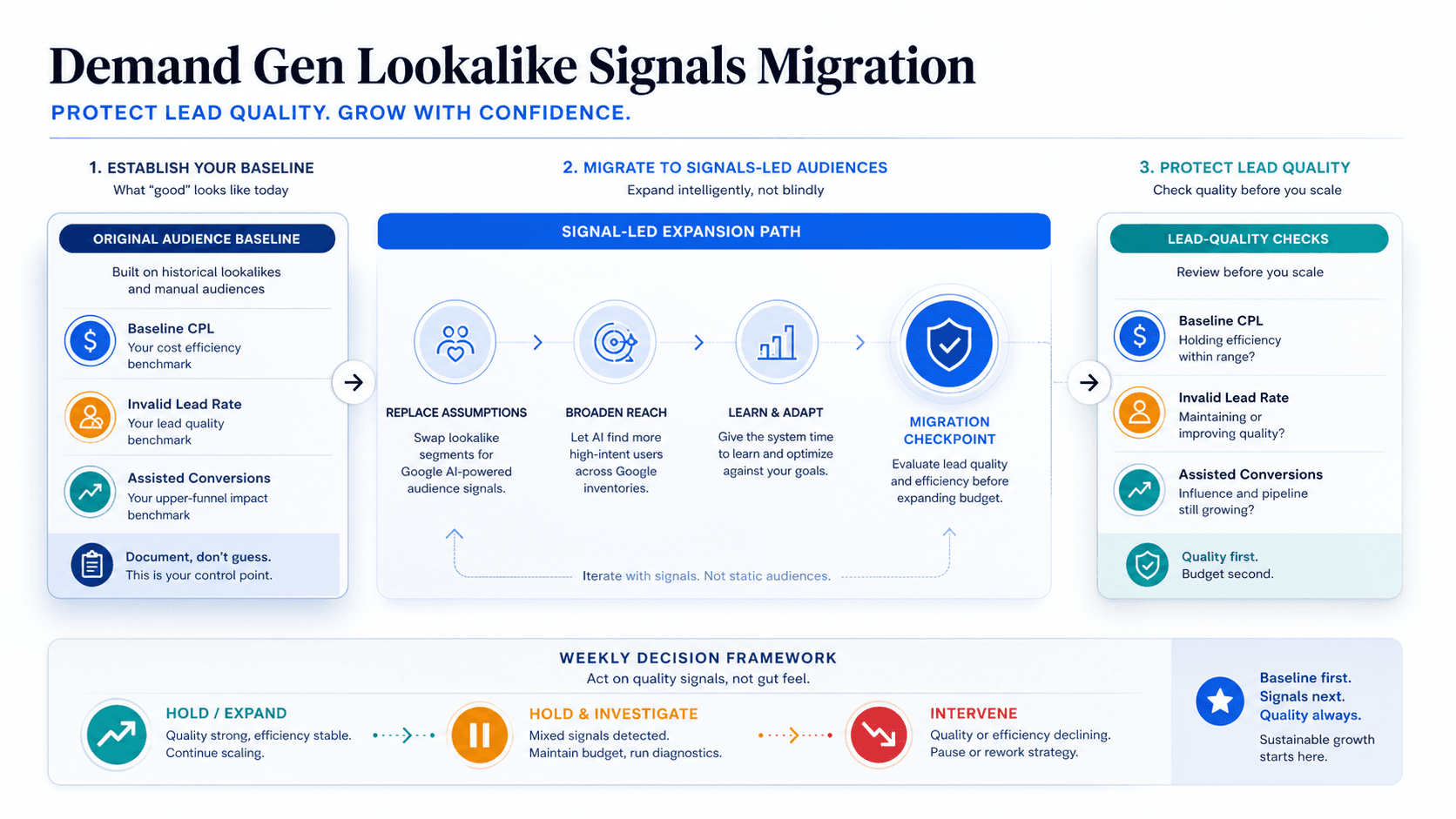
Illustrative concept graphic for the lookalike-to-signals migration, not a product screenshot.
Lookalike migration in Demand Gen is not losing audiences; it is trading list-building for signal-feeding. Baseline quality before budget expands.
Key takeaway
The account team still talks about lookalikes as if Google will keep a fixed audience shape forever. Demand Gen audience work moved toward optimized targeting and first-party seedlists that feed Google AI rather than hard list boundaries you can size in a spreadsheet. That is not necessarily fewer conversions. It is a different job: less time drawing audience edges, more time feeding quality signals and watching what comes back.
Google's YouTube Performance Four guidance recommends enabling optimized targeting on prospecting campaigns and combining it with first-party data seedlists for strong results. The migration frame is signal-feeding: record the pre-change baseline for spend, CPL, lead quality, invalid leads, and assisted conversions, then decide expand, hold, or narrow weekly based on downstream quality, not reach alone. Parallel AI reads the connected account, compares the baseline to current quality movement, and writes the hold or expand note in a doc or spreadsheet before anyone approves a budget change.
Checked against current product behavior, account-review tools, and official Google materials so the explanation matches the real review process and live product boundaries.
- Google's YouTube Performance Four AI targeting section names optimized targeting and first-party seedlists as core Demand Gen practice.
- Google's January 2026 Demand Gen Drop supplies current campaign update context without replacing first-party CRM review.
- Parallel's role stays limited to baseline comparison, finished quality notes, and drafted changes held for human approval.
The weekly report shows reach up, CPL down, and the paid media lead waiting for someone to declare victory. Sales replies that lead quality softened two weeks ago. Both can be true when audience work shifts from list-building, where you knew the segment shape, to signal-feeding, where Google explores around seeds you provide.
DEFINITION
Optimized targeting with seedlists
A Demand Gen targeting approach documented in Google's YouTube Performance Four guidance. Optimized targeting lets Google AI look beyond manually selected segments. First-party data seedlists give the system high-value starting signals. Google recommends combining both on prospecting campaigns rather than relying on a static audience definition alone.
Google Ads Help: The YouTube Performance Four
The emotional mistake is mourning a list size you could screenshot. The operational job is making sure the seeds you feed Google still represent customers you want more of. CRM exports, high-value purchaser lists, and engaged-view audiences can seed prospecting. Remarketing ad groups still target known users with tailored creative. The migration changes how much you trust exploration beyond the seed, not whether seeds matter.
Google's Performance Four guidance also names remarketing for re-engagement and the new customer acquisition goal for net-new buyers when first-party audiences are available. Those are different signal jobs inside the same campaign type. Signal-feeding documentation names which job each ad group performs before budget expands.
Change history is the audit trail when someone asks whether migration already happened. Targeting expansions, seed uploads, and optimized targeting toggles all leave timestamps. Pair those events with the baseline window so the team is not debating a quality slide that started two weeks before the seed change.
Reach is not proof when signals changed underneath it.
Signal-feeding without a baseline is just optimism with extra steps. Record the last stable window before targeting or seed changes, then compare weekly.
Baseline window
14 days
Stable period before migration or major seed change.
Track spend
Weekly
Spend, CPL, and volume movement by campaign.
Track quality
CRM plus platform
Lead grade, invalid rate, assisted conversions.
Illustrative invalid drift
9% to 15%
Example CRM invalid rate rise while platform CPL improved.
The illustrative example: platform CPL improves from $61 to $54 over three weeks while invalid lead rate rises from 9 percent to 15 percent in the CRM. Volume looks like a win. Pipeline does not. The baseline makes that visible early instead of after finance asks why SQL count flatlined.
Assisted conversions matter because Demand Gen touches often precede branded search or direct visits. Google's January 2026 Demand Gen Drop highlighted attributed branded searches as a separate measurement surface for upper-funnel impact. Signal migration reviews should note assisted patterns, not only last-click form fills.
Conversion lag still applies. Google's Performance Four guidance warns against judging yesterday's data. B2B teams especially should align weekly hold or expand calls to lag-aware windows rather than daily platform swings.
Seed hygiene matters as much as seed size. A purchaser list full of one-time discount buyers teaches exploration to find more discount hunters. A CRM segment of accepted opportunities teaches a different pattern. Document which seed fed which ad group so the next reviewer knows what signal Google was asked to extend.
Migration is not a launch day. It is a weekly quality loop until downstream metrics stabilize or the team narrows seeds.
Compare current spend, CPL, lead quality, invalid leads, assisted conversions, and lag to the locked baseline by campaign and seed source. Note which ad groups prospect with optimized targeting and which retain remarketing boundaries.
When volume rises faster than quality stabilizes, hold budget before expand. When quality holds through a full lag window, expand with the seed list documented so the next reviewer knows what changed.
Offer and landing-page context belong in the same weekly note. A seed change paired with a new promo can look like audience drift when the message moved. Tag the note with offer version so sales does not argue against a signal that never changed.
- Lock pre-change baseline for spend, CPL, quality, invalid rate, assisted conversions, lag.
- Review weekly movement by campaign, seed, offer, and conversion action.
- Compare volume gains to downstream quality before budget expands.
- Write hold, expand, or narrow with a reason sales or finance can review.
A migration without weekly quality checks is just broader targeting with better slides.
Expand when lead quality and assisted conversion patterns support broader signal behavior through the lag window you documented. Hold when volume improved but quality has not stabilized. Narrow when invalid leads or weak pipeline rise faster than useful demand.
Expand when
- Downstream quality matches or beats the pre-migration baseline through the agreed lag window.
- Seedlists still represent customers the business wants more of.
- Assisted conversion patterns support the upper-funnel story finance expects.
Narrow when
- Invalid lead rate or weak CRM grades rise while platform CPL improves.
- Nobody documented which seeds or optimized targeting settings changed.
- Budget expanded before a baseline window was locked.
Lookalike-signal migration reviews are a strong Parallel AI workflow on connected Demand Gen accounts. The agent pulls spend, conversion, and audience context, compares current movement to the locked baseline, and writes the hold, expand, or narrow recommendation in a doc or spreadsheet with CRM notes attached where available. If the call is to narrow seeds or hold budget, it drafts that change and waits for a person to approve it. Migration slides age badly when nobody saved the baseline table. See for lag-aware quality checks. On Monday morning, open campaigns touched by recent seed or targeting changes, compare this week to the pre-migration baseline, and send one hold, expand, or narrow line to sales and finance owners before spend moves.
Google documentation
Google's Demand Gen reference for campaign scope, audience, and creative context.
Google's Demand Gen update context for advertisers reviewing campaign quality.
- Demand Gen for B2B and Ecommerce: Diagnose Quality Beyond CTRHelpful when CTR looks strong but B2B pipeline or ecommerce ROAS tells a different story.
- Demand Gen Asset Optimization Audit: Review Controls Before Weekly ScaleHelpful when creative reviews ignore the asset report and debate taste instead of spend concentration.
- Attributed Branded Searches in Demand Gen: How to Use the MetricFor teams where brand search lift looks compelling but downstream proof is not ready yet.