

Comparison
Parallel AI vs groas: Which Google Ads Workflow Fits Better?
Compare Parallel AI and groas on autonomy, Google Ads review and reporting depth, approvals, account coverage, and agency fit.
Key takeaway
The pitch deck promises autonomous search optimization with spend-tier pricing and no free trial. The in-house lead's question is not whether automation can move bids. It is who signs off when Smart Bidding is still learning, the search terms report looks wrong, and finance wants a written rationale before spend shifts.
Parallel AI is the AI agent platform for Google Ads work. Agencies and in-house teams hand off research, reporting, and optimization on connected accounts, and every account change the agent drafts waits for a person to approve it. Most tools in this category stop at recommendations. Parallel finishes the work in docs, spreadsheets, and reports a client or a lead can act on.
groas can optimize without approval; Parallel is the stronger fit when campaign changes still wait for a named approver, a written rationale, and a report someone can defend. Parallel works from the connected Google Ads account, finishes the job in docs, sheets, summaries, and reports, and keeps drafted account changes waiting for human approval. groas is the better match when the team specifically wants teams that want an autonomy-first search optimization layer and are comfortable evaluating aggressive automation claims.
groas leads with autonomous performance marketing and search-campaign optimization rather than a broader review-and-reporting process. Parallel is more Google Ads-first and more complete on reporting and review handoff when the weekly job has to end in a finished doc, sheet, or report.
Checked against current product, pricing, trust, and official Google materials so the comparison, buying guidance, and fit criteria stay current and defensible.
- groas's current official product and pricing pages are the competitor baseline.
- The competitor appears in real buyer evaluations, not only a theoretical watchlist.
- Reddit and practitioner discussion pressure-test fit and reputation signals; they are not the factual source for product capabilities.
- Where details are not explicit on the public source material, the page says so and names what the buyer should verify directly.
- A strong fit combines commercial judgment, human review, and reporting teams can share rather than only surfacing automation ideas.
groas positions itself as an autonomous AI system for Google Ads search campaigns with spend-tier pricing and agency options. Parallel is a Google Ads-first AI agent workspace built around connected-account analysis, research, docs, sheets, summaries, reports, and reviewed next steps. The rows below compare the two products on the jobs a paid search lead actually runs each week.
| Capability | Parallel AI | groas |
|---|---|---|
| Category | Google Ads-first AI agent workspace | groas positions itself as an autonomous AI system for Google Ads search campaigns with spend-tier pricing and agency options. |
| Best for | Teams that want connected-account analysis, research, docs, sheets, summaries, reports, and reviewed next steps in one Google Ads-first system. | Teams that want an autonomy-first search optimization layer and are comfortable evaluating aggressive automation claims. |
| Account connectivity | Connected Google Ads accounts with shared workspace context, uploaded files, and reporting support. | Unlimited Google Ads account support and agency models highlighted on the public pricing page. |
| Multi-account / MCC support | Plan-based connected-account limits with shared visibility on team and agency workspaces. | Agency and enterprise models built around multiple client accounts and spend tiers. |
| Audit depth | Connected-account diagnostics tied to docs, sheets, summaries, reports, and reviewed next steps. | Optimization system centered on autonomous campaign improvement and performance monitoring. |
| Reporting output | Docs, sheets, summaries, reports, and client-ready handoff packs. | Performance reporting and weekly updates are part of the pitch, but client-ready docs and sheets are not the center of the story. |
| Approval review and reporting help | Human review stays explicit around recommendations, handoffs, and high-impact account changes. | The public pricing page says the agent can make optimizations without needing approval, so governance and review controls need extra scrutiny. |
| Creative generation role | Supports briefs, ad copy, planning, and stakeholder-ready reports inside the same workspace. | Search-campaign optimization comes first; creative planning and reporting packages are secondary. |
| Pricing model | Clear first-party pricing with account caps, message limits, and shared-workspace tiers. | Spend-based pricing with no free trial plus agency and enterprise options. |
Same evaluation shortlist, different finish line.
Before either product enters a paid pilot, groas's public positioning and pricing path set the baseline alongside Parallel's current product copy, all reviewed on May 20, 2026.
groas's public positioning
groas leads with autonomous performance marketing and search-campaign optimization rather than a broader review-and-reporting process.
Public pricing and evaluation path
The public pricing page uses ad-spend percentages, says there are no free trials or discounts, and says the agent can optimize without needing approval.
What a real evaluation should pressure-test
groas leads hardest on autonomy, so buyers who need tight approval discipline should inspect that claim especially carefully.
Public pages describe the product; the pilot reveals whether the handoff debt disappears.
Parallel earns the comparison when the report, brief, or recommendation is a finished doc, sheet, or report
groas can optimize without approval; Parallel is the stronger fit when campaign changes still wait for a named approver, a written rationale, and a report someone can defend. That is the split this section pressure-tests against groas's strengths, stated plainly below.
Google Ads stays at the center of the review
Parallel is built around connected Google Ads account context, recurring reviews, research, docs, sheets, summaries, reports, and reviewed next steps rather than a generic ads-software layer.
The team needs a report and next steps, not only a suggestion
Parallel is the stronger fit when the workflow includes diagnosis, reporting, stakeholder handoff, and explicit human approval instead of handing optimization control to an autonomy-first system.
Human approval stays visible in the account story
Parallel keeps review and approval responsibilities explicit instead of implying that campaign changes should happen automatically or disappear into a black-box service layer.
A faster recommendation still loses if the client deck rebuild starts from zero.
groas is a serious product in its category. The comparison is honest when the team's main need aligns with what groas was built to do.
groas fits teams that want its default approach
Teams that want an autonomy-first search optimization layer and are comfortable evaluating aggressive automation claims.
The buyer values that approach more than Parallel's review-and-reporting model
When the main bottleneck is better matched by groas's core model, the evaluation should reflect that instead of forcing Parallel into a job it was not built to solve.
Choosing groas is rational when its core model removes the bottleneck first.
The fairest comparison is not a feature tour. It is one recurring Google Ads job both products run against the same connected account context.
01
Pick one recurring Google Ads job
A weekly account review, an audit summary, or a multi-account reporting loop gives both products the same work to finish.
02
Score the first output you could send, not only the first insight
A useful recommendation still fails if the team cannot turn it into a review-ready doc, sheet, or report without manual rebuilding.
03
Measure review and handoff overhead
The right fit reduces analysis time and handoff friction without weakening approval quality or account governance.
04
Pressure-test multi-account context if the portfolio spans more than one account
If the real workload spans more than one Google Ads account, the output should still hold up at portfolio level with shared visibility intact.
On Monday, open the same connected account, run one weekly account review or audit summary through both products, and keep the first doc, sheet, or report you would actually send to a client or approver.
Use the current Google videos, Help pages, public announcements, and product visuals below to confirm availability, setup details, and reporting limits.
Source page·groas
groas official product page
Official groas positioning reviewed to confirm autonomy-forward Google Ads search optimization language.
Open groas siteSource page·groas
groas official pricing page
Official groas pricing reviewed to confirm spend-based pricing, no-free-trial language, and the claim that the agent can optimize without approval.
Open pricing pageReference figure
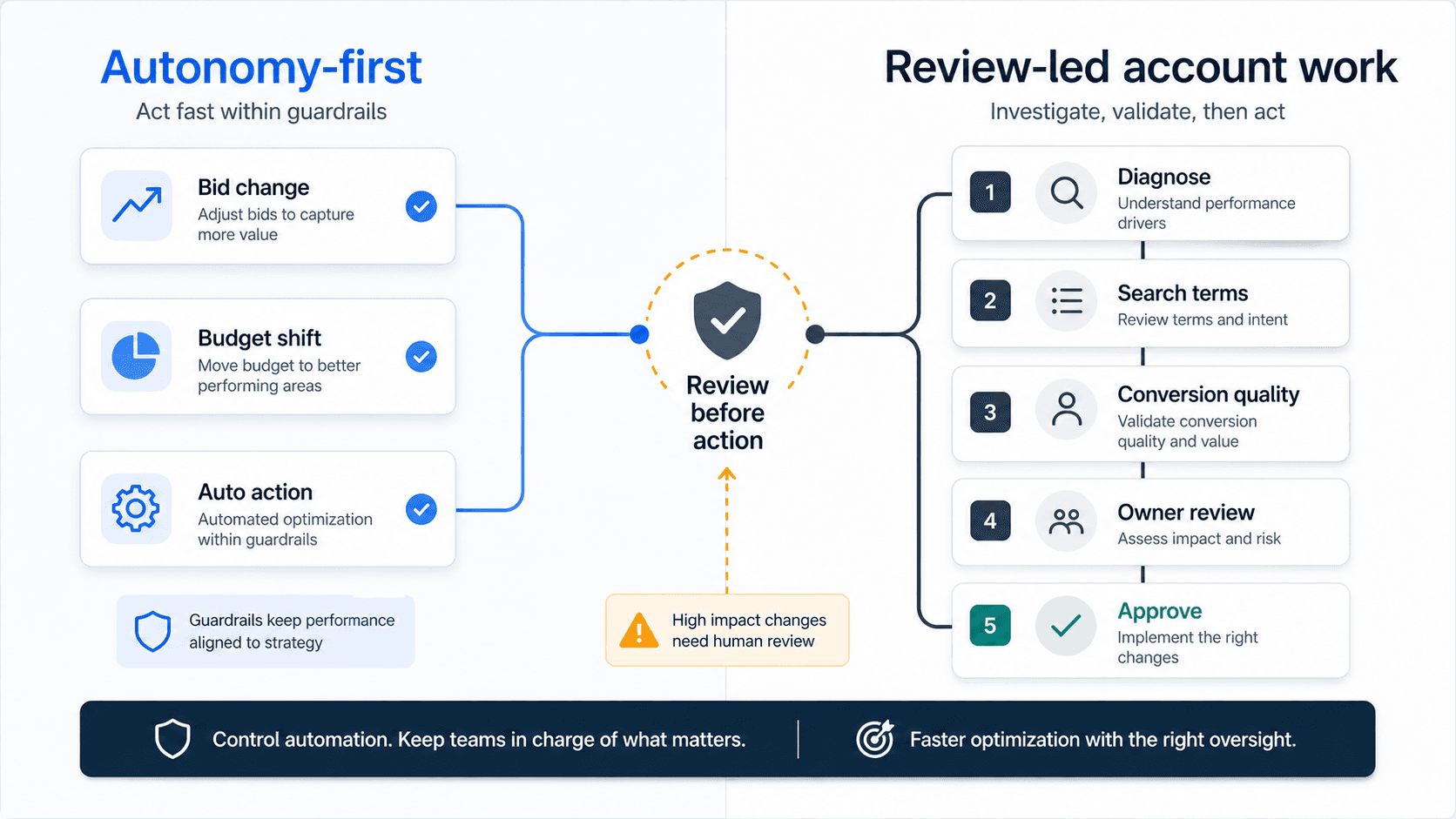
Parallel and groas autonomy fit
Editorial graphic contrasting autonomy-first campaign optimization with review-led Google Ads account work.
Google documentation
Google's current manager-account reference for multi-account structure and portfolio access.
Google's core reference for native bidding automation and where human supervision still matters.
Additional documentation
Official groas homepage for product positioning and autonomy claims.
Official groas pricing page used to verify current spend-tier pricing and agency positioning.
Current practitioner framing for where Google-native AI works well and where teams still need stronger review discipline.
About Parallel
Current security, data-handling, and connectivity framing.
Company mission and editorial review context behind the published guides.
- Blog homeBrowse every published Google Ads guide from one editorial index.
- Google Ads AI agent: complete guideThe pillar guide covers the category definition, the adoption model, and where the agent fits real Google Ads work.
- ResourcesMove between the definition page, pricing, product walkthrough, and trust pages.
- About Parallel AISee the company mission, editorial standards, and operating principles behind the product.
- SecurityReview the public data-handling, account-connectivity, and approval-control framing used throughout the published guides.
- What Is Parallel AI? A Clear Definition for Google Ads TeamsOfficial definition page for Parallel AI, with brand clarity and Google Ads fit.
- Pricing for Google Ads TeamsPricing, account-limit, and trial-policy page for Parallel AI.
- How Parallel AI Works for Google Ads TeamsProduct walkthrough for how Parallel AI fits into Google Ads reviews and approvals.
- Google Ads AI Agent Pricing: Seats, Account Limits, and Total CostFor testing pricing against account load, team shape, day-to-day fit, and the manual hours still left after rollout.
- Best AI Agents for Google Ads: How to Evaluate the ShortlistUseful when buyers need a category-aware framework for evaluating Google Ads AI-agent options by review quality, reporting, and approval fit.
- Google Ads Copilot Alternatives: Native AI, PPC Platforms, Scripts, and AgentsFor buyers searching copilot alternatives who need the right category before comparing brands.