

Audit and Reporting Shortlist
Best AI Agent for Google Ads Audits and Reporting
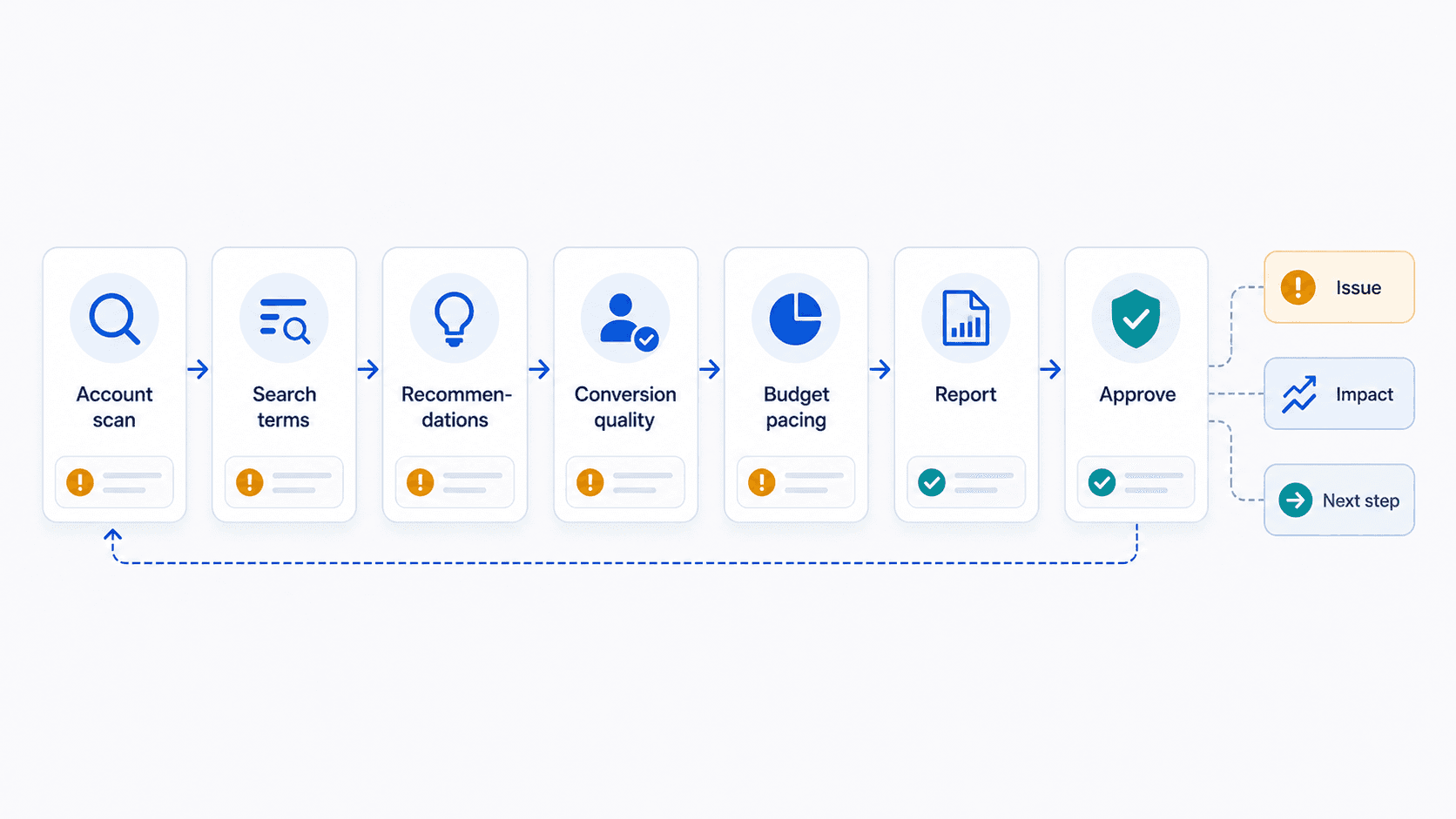
Compare tools by audit coverage, reporting quality, source clarity, and human control.
An audit is only as good as what survives the client handoff. Compare Google Ads AI agents by deck quality, not scan breadth.
Key takeaway
The audit PDF looked comprehensive until the client asked which campaigns drove the CPA move and the account lead opened five exports to answer. The scan was wide. The handoff was weak. That is why audit tools should be judged at the deck, not the checklist.
The best AI agent for Google Ads audits and reporting reviews search terms, Recommendations, Change history, budget pacing, conversion actions, campaign settings, and Performance Max reporting on connected accounts, then finishes in a report or sheet someone can approve. Parallel AI is the AI agent platform for Google Ads work. Drafted account changes wait for human approval.
Checked against current product, pricing, trust, and official Google materials so the comparison, buying guidance, and fit criteria stay current and defensible.
- Audit usefulness was scored by Google Ads surfaces reviewed and by reporting output quality after review.
- Dashboard-only tools were separated from audit-to-report agents that finish in approvable docs.
- Parallel claims stay limited to connected account review, finished reports, and drafted changes held for human approval.
Audit breadth is easy to market. Client handoff is where weak tools get exposed.
DEFINITION
Google Ads audit (working definition)
A structured review of live account signals across search terms, budgets, bidding, conversion actions, Recommendations, Change history, campaign settings, and reporting movement, packaged so another person can decide what to do next. Google's Recommendations page describes in-product suggestions. It is not a substitute for a client-ready audit narrative.
Google Ads Help: Recommendations; Reports
A long issue list without prioritization is not an audit. It is raw material the account lead still has to translate.
Judge tools by whether the output survives the first client question without reopening half the account.
QBR season exposes weak audit tools quickly. The scan looked impressive in April. The May client call still required six exports.
Treat Recommendations as input, not output. Google's in-product suggestions help triage. They do not replace the narrative that explains what your team will do and what you are deferring.
Handoff quality is the audit product.
Surface coverage keeps the scan honest. Missing one row here usually means the deck will overstate confidence later.
| Surface | Why it matters in the audit |
|---|---|
| Search terms | Shows wasted spend, query quality, match behavior, and negative keyword opportunities. |
| Budget and bid strategy | Shows whether pacing, tCPA, target ROAS, and bidding settings match the account goal. |
| Conversion actions | Shows whether the account is optimizing toward the right primary and secondary signals. |
| Recommendations and Change history | Shows what Google is suggesting and what recently changed before performance moved. |
Coverage is necessary. It is not sufficient without reporting quality.
A one-account pilot should score the deck your client or lead actually receives.
Give each shortlisted tool the same account week and ask for a two-page external summary plus a ranked fix list with evidence from search terms, budgets, conversion actions, Recommendations, and Change history.
Reject tools that return a long issue dump without priority, deferrals, or campaign-level specificity. That output still puts the account lead back in translation mode.
Handoff is the product. The scan is raw material.
Once the surfaces are covered, the decision moves to the deck: can someone else act on it?
An audit that stops at a dashboard still leaves the hard work to the account team. The team needs to explain what changed, what matters, what should happen next, and what should not be changed yet.
The useful output is a report, sheet, or summary that names affected campaigns, metrics, reports, and settings. If the manager still rebuilds the whole account story by hand, the agent did not remove the real reporting bottleneck.
Illustrative standard: a good audit deck answers three client questions in the first two pages: what moved, why it moved, and what you are doing about it. Numbers are illustrative. The structure is not.
Deck quality also means honest deferrals. A strong audit says what not to change yet, not only what to fix.
Agency teams should score audit tools on external readiness: could a director send this deck with one edit pass. In-house teams should score leadership readiness: could finance or sales understand the tradeoff without a live account tour.
If the deck needs a live walkthrough to make sense, the audit failed.
Use this checklist after the tool has seen a real account, not after the demo.
Keep on shortlist
- It can inspect Search terms, Recommendations, Change history, budgets, conversion actions, and campaign settings on connected data.
- It produces a report or sheet another person can review quickly.
- Material budget, bid, conversion, and structure changes stay under human review.
Drop early
- The scan is long but the client summary still gets rewritten from scratch.
- It cannot distinguish Google-native Recommendations from the team's own decision.
- It implies automatic account fixes after the audit.
A checklist without a readable deck is still pre-work.
Buying teams often overweight scan breadth because it is easy to demo. Client handoff is harder to fake.
Ask every shortlisted audit tool to produce a two-page summary from the same account week. Score whether another lead could send it externally with one editing pass.
The winner is not the tool that found the most issues. It is the tool that prioritized the right three and explained them in account language tied to search terms, budgets, Recommendations, and Change history.
Parallel AI supports that handoff on connected accounts by moving from live signals into reports, sheets, and drafted changes held for approval. It does not replace your audit rubric or commercial judgment.
Run the same test on a Performance Max account and a Search-heavy account. Weak tools often scan well on one campaign type and produce vague decks on the other.
Demo the deck, not the scanner.
Parallel AI is the AI agent platform for Google Ads work. It supports audits that depend on live account context, moves findings into reports and sheets from the same review, and keeps higher-impact budget, bid, conversion, and structure changes visible before implementation.
Parallel is strongest when the audit must become a client update, leadership summary, or QBR section without a second rebuild. It does not replace Google Ads reporting, Recommendations, or native optimization systems.
Honest boundary: Parallel does not replace your audit template or commercial judgment. It reduces the time between account signals and an approvable deck.
See AI agent for Google Ads audits. On Monday morning, open your last audit deck and mark every paragraph that required a separate export to defend. That list is your shortlist scorecard.
If more than half the deck needed exports, you are paying for scan breadth twice: once in the tool and once in account lead time.
Google documentation
Useful for grounding claims about Google's native Search automation stack.
Anchor source for bid automation and strategy-level diagnostics.
Best source for RSA quality guidance and the 12% conversion-improvement claim tied to Ad Strength.
Google's official tutorial on reading Performance Max results and using the Insights page in ongoing reporting.
- Blog homeBrowse every published Google Ads guide from one editorial index.
- Google Ads AI agent: complete guideThe pillar guide covers the category definition, the adoption model, and where the agent fits real Google Ads work.
- ResourcesMove between the definition page, pricing, product walkthrough, and trust pages.
- About Parallel AISee the company mission, editorial standards, and operating principles behind the product.
- SecurityReview the public data-handling, account-connectivity, and approval-control framing used throughout the published guides.
- Author profileSee the background, specialties, and editorial responsibilities behind the published guides.
- Editorial reviewReview how pricing, trust, and capability claims are checked before public content ships.
- Best AI Agents for Google Ads: How to Evaluate the ShortlistUseful when buyers need a category-aware framework for evaluating Google Ads AI-agent options by review quality, reporting, and approval fit.
- AI Agent That Connects to Google Ads for Campaign Audits: What It Should CheckFor teams that need a Google Ads audit agent for Search, PMax, Shopping, reports, and human review.
- Best Google Ads AI Agent for Optimization and ReportingFor teams buying an AI agent that must handle optimization and reporting as one loop.